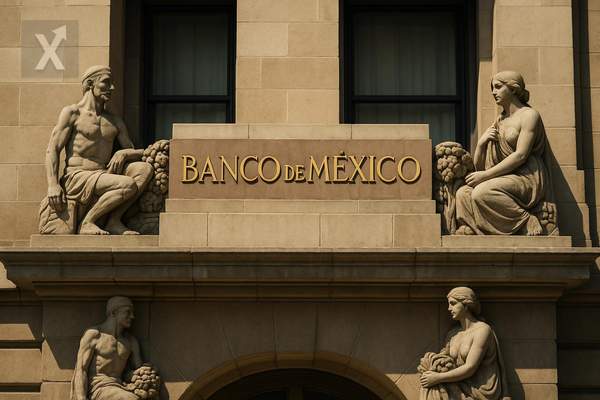
Banxico Rate Cuts and Slower Activity Cool Bank Profits in Mexico

Lower rates and a slower pace of consumer spending and lending are squeezing bank margins after years of profits boosted by expensive money.
Mexico’s banking sector kicked off the year with an unusual signal compared with recent years: a drop in profits. In the first two months, cumulative net income for the 52 banks operating in the country totaled 48.985 billion pesos, a 2% contraction versus the same period a year earlier, according to regulatory data. It’s the first pullback for a January–February period in five years, in an environment shaped by slower economic growth and a rate-cut cycle in the Banco de México (Banxico) policy rate.
The shift in profitability is largely explained by a change in the cost-of-money regime. After a stretch of high rates that inflated net interest margins and lifted returns on treasury portfolios, Banxico’s cuts have increasingly flowed through to the system’s interest income. In January and February, interest income came in at 279.525 billion pesos, an 8.4% year-over-year decline—evidence that the “floor” for yields is moving lower as loans reprice and investments adjust.
To put the turn into perspective: in March, Banxico held its rate at 6.75%, far below the 9% level seen a year earlier. In practical terms, this normalization reduces banks’ financial income—especially for portfolios more exposed to floating-rate instruments or frequent reinvestment—and forces institutions to make up what the rate margin used to deliver through higher loan volumes or operating efficiency.
Among the biggest players by interest income are Banorte, BBVA, Santander, Banamex, and Banco Azteca—institutions that tend to set the tone for the system given their scale in deposits, consumer credit, and business lending. Still, the start of the year also produced an important data point: within the group of systemically important banks, some institutions posted losses in profits at the two-month mark, a reminder that competition, product mix, and the cost of risk can amplify the impact of the monetary cycle.
Sector analysts often note that the first quarter tends to be seasonally slower for financial intermediaries, both because of origination calendars and household and corporate spending patterns. Even so, the macroeconomic component has become more influential: the slowdown—and bouts of weakness in activity indicators—has cooled credit demand and increased sensitivity to delinquencies, particularly in consumer segments.
Consumption, VAT, and the Exchange Rate: Signals That Shape Credit
The trajectory of consumer spending has become a key watch point for banks because of its weight in credit cards, payroll loans, and personal loans. An early signal has been VAT (IVA) collections, which showed a notable drop in the first two months—private estimates say it was the sharpest February decline since the 2009 crisis. Factors cited behind this performance include weaker momentum in activity—with soft readings in monthly indicators—a high comparison base, and the effect of an appreciated exchange rate on the taxable base at customs. Together, these elements tend to cool spending and, by extension, appetite for short-term financing.
The peso’s appreciation also has mixed implications. On the one hand, it typically eases inflation pressures in imported goods and supports purchasing power, which can help the risk profile of indebted households. On the other, it reduces fiscal revenues tied to foreign trade when measured in local currency and can compress margins in certain export sectors, with indirect effects on business credit. For banks, this balance matters because the credit cycle depends both on consumer confidence and on corporate investment and cash flow.
Looking ahead, the central challenge for banks is sustaining loan-book growth while staying prudent on risk in a lower-rate environment. Cuts tend to make financing cheaper, which can eventually revive demand; but if activity is slow to recover, credit may grow more slowly and with greater selectivity. On top of that, the system faces rising costs in technology, cybersecurity, and compliance—areas that pressure operating expenses and raise the bar for profitability.
On the macro side, expectations for a better performance in the second half of the year hinge on a sustained rebound in consumption, continued traction in investment, and an external environment that doesn’t deteriorate. For Mexico, demand from the United States remains a critical driver for manufacturing and exports; any adjustment in that engine can show up in commercial credit and overall business sentiment.
In sum, the profit decline early in the year doesn’t by itself point to a systemic problem, but it does signal a change in conditions: less rate-driven margin, a more fragile economy, and a greater need for efficiency and volume to sustain results. Banking is entering a more “normal” phase of the cycle, where risk management and the ability to originate high-quality credit will be just as important as the level of the policy rate.