Goals, contactless payments, and consumption: what Estadio Azteca revealed about everyday economics in Mexico
Soccer fever lifted in-stadium spending by as much as 15% and highlighted the rise of contactless payments in a country still dominated by cash.
Mexico’s National Team goals didn’t just ignite the crowd—they also triggered spending. During matches played at Estadio Azteca, each El Tri goal translated into a 10% to 15% jump in sales inside the venue, according to metrics from Fiserv, the payments processor that enabled the terminals and monitored transactions in real time. The data, while limited to a single mass event, works as a gauge for a broader phenomenon: how immediate consumption responds to emotional stimuli—and how payments infrastructure is shaping the shopping experience in Mexico.
The average ticket hovered around 474 pesos, with a peak near 570 pesos during the opening match. At a time when households have faced pressure from rising food and service costs in recent years, these figures show that “in-the-moment” entertainment spending can remain high, particularly among middle- and upper-middle-income urban segments. Inside the stadium, the most in-demand products were beer, soda, and food, with prices reflecting the cost of operating in high-traffic venues and consumers’ willingness to pay for convenience: drinks in the 280 to 310 peso range and food with wide variation depending on the item.
Fiserv reported that each match saw an average of up to 146,000 card payments, totaling about 730,000 transactions across five games. At the highest point, the system recorded peaks of 25 transactions per second—an operational load that makes speed, terminal availability, and logistical efficiency essential. The economic takeaway is twofold: on one hand, consumption in mass venues depends as much on the mood as on the operational capacity to move lines; on the other, payment digitization becomes a direct enabler of sales, not just a “way to get paid.”
One telling detail was how spending behaved throughout the sports ritual. According to the monitoring, when the National Anthem was sung, sales practically stopped, while goals sent them soaring. That contrast shows how impulse spending syncs with moments of high collective emotion—a dynamic also seen across other entertainment sectors and events, and one that’s often leveraged through inventory planning, staffing, and better-distributed points of sale.
Contactless payments: rapid gains at events, lagging beyond them
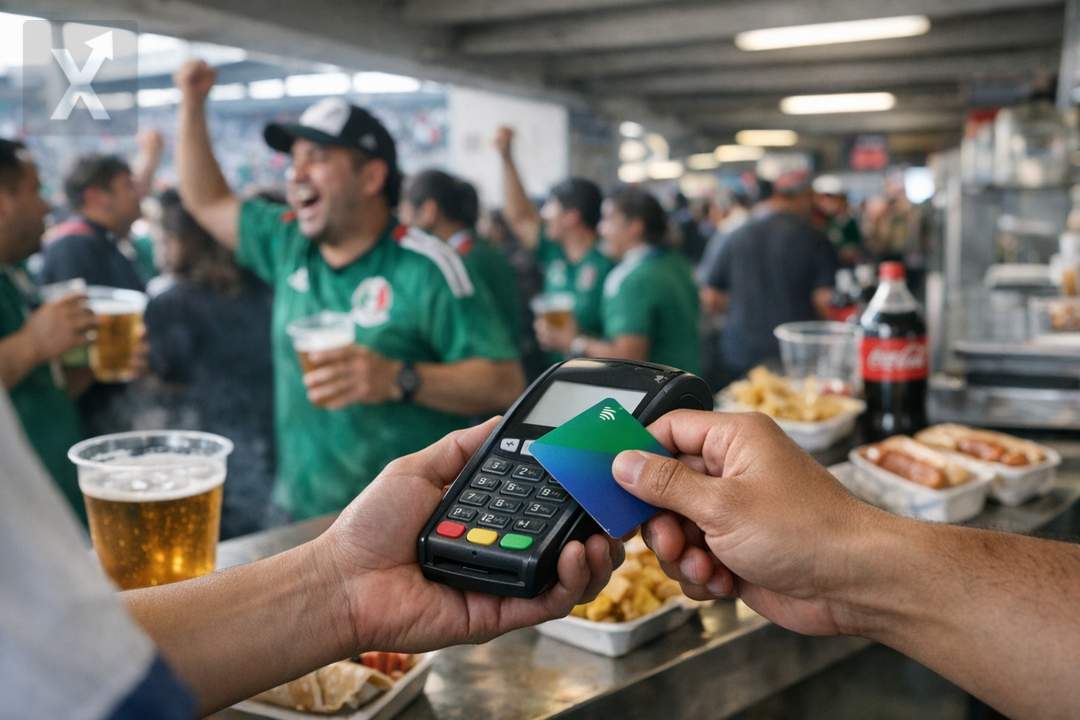
The World Cup delivered another message: at Estadio Azteca, about 80% of sales were made via contactless payments—far above the national average, where this method remains a minority compared with cash and cards that require dipping or swiping. Economically, that jump matters because it shortens checkout times, reduces purchase friction, and can raise the number of transactions per hour in places with intense demand. Still, this performance doesn’t mean adoption is uniform nationwide: across much of traditional commerce—especially microbusinesses—barriers persist, including terminal costs, informality, connectivity, and a preference for cash to manage immediate liquidity.
The stadium experience shows that when the environment demands speed (dense crowds, short windows between plays, and logistical constraints), technology adoption can accelerate. For Mexico—where the financial system has pushed digitization but labor and business informality remains high—these payment “labs” foreshadow what could spread if costs come down, infrastructure improves, and acceptance grows among small merchants.
Traditional banks vs. fintech: who pays at major events
The mix of cards used inside the stadium also reflected the structure of Mexico’s financial system. The most used were BBVA, Citibanamex, Banorte, American Express, Santander, and Scotiabank, while Nu—of Brazilian origin—appeared later on the list. From a market standpoint, this suggests that at events with high average spend, traditional banks keep an edge thanks to their installed base, credit limits, consumer habits, and longer customer relationships. Even with fintech growth, penetration can vary by consumer profile: age, income level, and preference for credit versus debit.
Fiserv estimated that 80% to 85% of the share came from cards issued in Mexico, with the remainder held by foreign issuers such as Bank of America. The figure aligns with the importance of tourism and international visitors at large-scale events, and points to an opportunity: capturing foreign spend with fast payments, but also with a robust security and authorization operation to avoid declines during peak moments.
Overall, the Estadio Azteca case confirms that consumption in Mexico doesn’t depend only on disposable income: it also responds to emotion, convenience, and technological friction. The expansion of contactless payments can boost sales and efficiency at mass events, but the structural challenge remains bringing that speed and acceptance into everyday commerce, where cash and informality still set the pace.