Mexico Rides the Wave of Industrial AI, but Specialized Talent Becomes the Biggest Brake
The expansion of data centers, robotics, and advanced manufacturing is driving up demand for engineers, English proficiency, and hands-on skills in Mexico’s labor market.
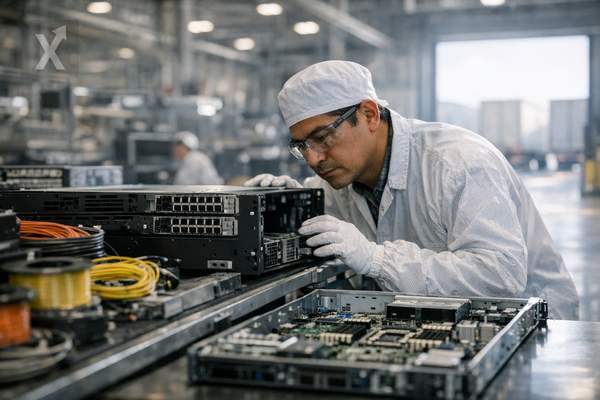
Mexico is entering a new phase of North America’s tech boom—one that combines artificial intelligence (AI) infrastructure, automation, and advanced manufacturing. The reshoring of supply chains, the growth of investment in data centers, and demand for high-performance computing components are pushing Mexican industry to move beyond traditional assembly. But as this transition accelerates, companies, experts, and educational organizations agree on one point: the main bottleneck is no longer installed capacity, but the availability of engineers and technicians with specific skills.
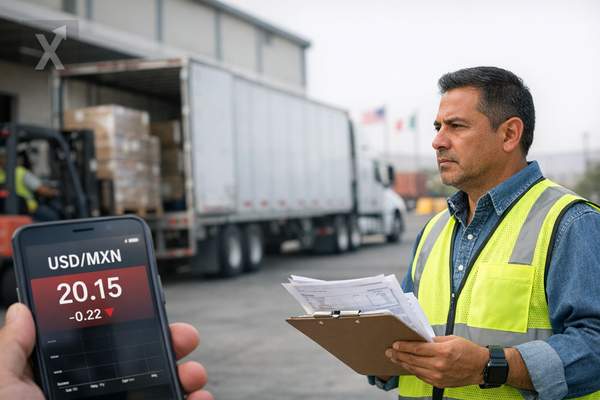
In regional trade, the shift is visible. More and more goods tied to data processing and digital infrastructure are gaining weight in cross-border commerce between companies operating on both sides of the border—showing that Mexico is supplying not only auto parts and home appliances, but also the parts and systems required by the data economy. The trend is driven by logistical proximity to the United States, the country’s network of trade agreements, Mexico’s manufacturing experience, and the momentum of northern states and the Bajío region, where industrial parks, suppliers, and technical universities converge.
The challenge is that this opportunity is constrained by human capital. To attract and retain technology-intensive projects—from automated production lines to precision manufacturing for data-center hardware—companies are raising the bar: more engineers each year, profiles with knowledge of programming, electronics, mechatronics, data, cybersecurity, and industrial control, along with practical experience. In business discussions, the recurring question is whether a region can “produce” enough talent at the pace investment requires.
Demand pressure doesn’t stop at industry. It also reaches professional services, consulting, and the operation of digital infrastructure. In an environment where AI is being built into production processes, specialized staff becomes a competitiveness factor on par with energy, water, or connectivity. For Mexico—where potential growth depends on investment and productivity—access to tech talent can determine whether the country moves up into design and engineering activities or remains stuck in the least profitable part of the value chain.
From manufacturing to “physical AI”: the leap that demands new skills
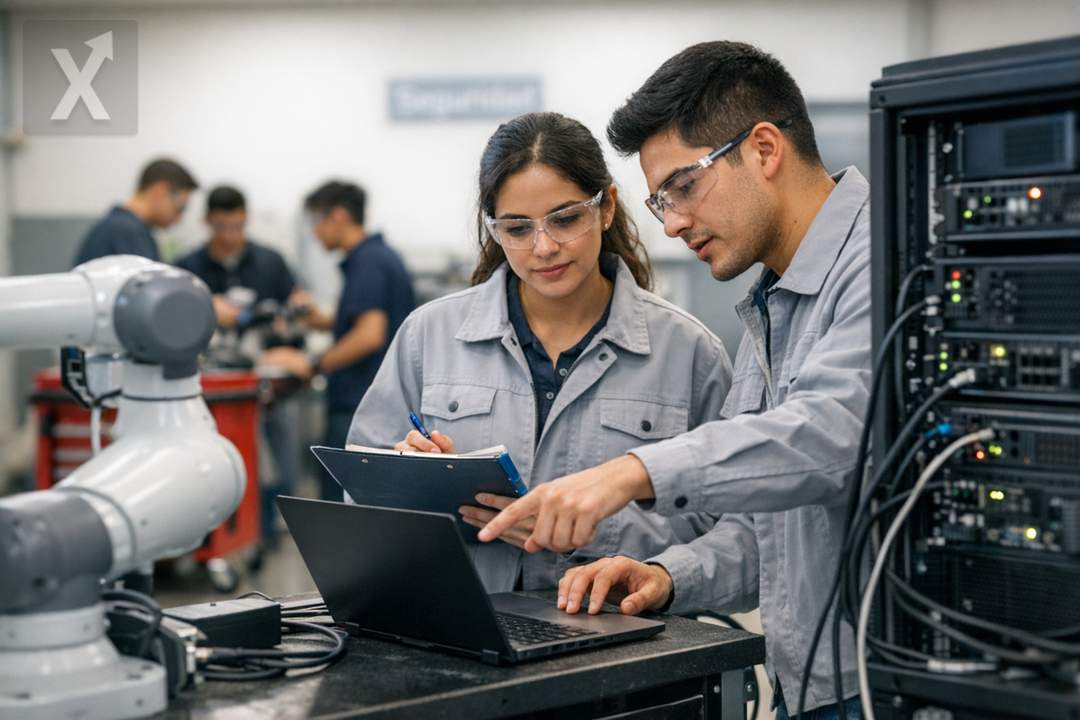
The next stage of technological change is tied to what’s known as “physical AI”: systems that integrate algorithms, sensors, computer vision, and robotics so machines can perceive their environment and make decisions in real time. In manufacturing, that translates into more flexible robotic cells, predictive maintenance, automated quality control, and advanced traceability. In logistics, it means smart warehouses and more precise inventory management. These applications promise higher productivity and fewer operational stoppages, but they also require hybrid profiles: it’s not enough to run machinery—you have to understand data, software, and processes.
In practice, many companies are willing to train specific technical skills on the factory floor, but they want graduates to arrive with solid foundations: mathematical reasoning, strong English skills, and “soft” skills for collaborative work, documentation, communication, and leadership. This matters because AI automates tasks like searching for and summarizing information; as a result, value shifts toward the judgment needed to interpret results, spot bias, ask the right questions, and coordinate multidisciplinary teams.
The challenge is playing out in an economic context where Mexico competes for industrial investment with other destinations and, at the same time, faces structural constraints: education gaps, regional inequality, and high labor informality that weakens incentives for training and skills certification. While foreign direct investment has remained significant in recent years, the pace of new project expansion depends on conditions such as energy and water availability, permitting, and security—but also on the pipeline of technicians and engineers who can operate, maintain, and improve processes.
Schools and universities are adjusting their programs, and early training organizations in robotics and applied science have become spaces where industry can identify talent before students reach higher education. In these settings, students don’t just code or build prototypes: they learn to manage budgets, document work, present results, and solve problems under pressure—skills aligned with what companies want for engineering and advanced operations roles.
Another key component is women’s participation in STEM fields. Increasing it expands the available talent pool and eases pressure on a labor market that already shows shortages in technical profiles. For the country, this isn’t only about inclusion: it’s an economic variable that affects Mexico’s ability to scale in higher value-added sectors, where wages tend to be higher and productivity per worker is greater.
In the short term, the boom in tech infrastructure can translate into more formal jobs in advanced manufacturing, engineering services, and data-center operations, with positive effects on wages in certain specialties. In the medium term, the question is whether Mexico will be able to turn today’s momentum into a stronger innovation ecosystem—with more patents, design, and development—or whether growth will remain limited by an insufficient supply of talent and gaps in technical training.
The window of opportunity is open, but it isn’t automatic: it depends on aligning industry, education, and public policy to accelerate training, certification, and ongoing skills development. If that coordination happens, Mexico can strengthen its role as North America’s tech platform; if not, the country could see part of the investment shift to regions with a deeper pool of specialized engineers and technicians.