Taiwan is boosting Mexico’s AI hardware cluster—even if official FDI numbers don’t show it
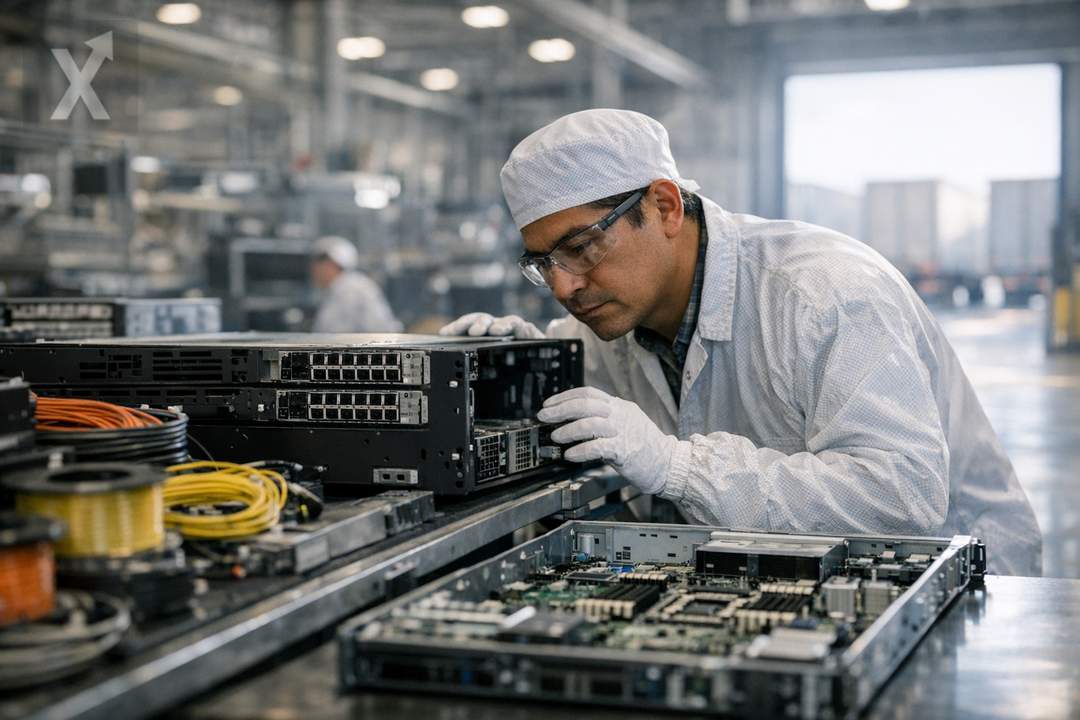
Mexico is cementing its role as a manufacturing platform for data centers and AI servers, with Taiwanese companies expanding capacity despite low recorded FDI.
The global race for artificial intelligence (AI) is reshaping North America’s supply chains, and Mexico is capturing a growing share of the hardware business that makes that revolution possible: servers, computing components, and networking equipment. One striking feature is the prominent role of Taiwanese firms—an origin that doesn’t show up among the country’s largest foreign investors in the usual records, but does stand out in industrial expansion announcements, warehouse and plant leasing, and trade momentum tied to U.S. data-center demand.
According to figures reported by Mexico’s Ministry of Economy, foreign direct investment (FDI) from Taiwan totaled only around $40 million in 2025, a low level compared with recent years. Even so, the physical footprint of Taiwanese manufacturers in northern and western Mexico has continued to grow: plant expansions, large-scale leases in industrial parks, and rising exports in categories linked to digital infrastructure. At the same time, bilateral trade accelerated with triple-digit growth rates in 2025—though with a large deficit for Mexico—reflecting heavy imports of parts, equipment, and components tied to electronics supply chains.
The trend is better understood as productive integration: Mexico is functioning as an advanced assembly and manufacturing link to supply the U.S. market, in an environment shaped by the USMCA, nearshoring, and escalating trade and technology tensions between the United States and China. In that map, Taiwan contributes critical capabilities in electronics manufacturing and server design/assembly (ODMs), which helps explain why its industrial presence can expand even when formally recorded FDI flows look modest or volatile.
Taiwanese participation in Mexico isn’t new. Since the late 1990s, with the boost from NAFTA, several companies set up operations to produce personal computers and export-oriented electronics. That experience left behind skilled labor, supplier networks, border logistics, and an electronics manufacturing culture that is now being repurposed toward higher-value products: servers, boards, cooling systems, cabling, and networking gear for data centers.
In the most recent phase, expansion announcements and new facilities by major Taiwanese manufacturers—part of the global AI hardware chain—stand out. Projects discussed in the market include expansions in Chihuahua, Ciudad Juárez, Guadalajara, and Monterrey, with investments that, based on corporate announcements and industry reports, often range from tens to hundreds of millions of dollars per site, focused on servers and systems for data centers. For Mexico, the appeal is clear: proximity to the main end market, USMCA rules of origin, shorter logistics times, and the ability to scale production quickly.
This shift is already showing up in foreign trade data: the category of automatic data-processing machines—where many server-related devices and components are grouped—has posted a significant jump, exceeding $85 billion in exports during 2025, with Chihuahua as a dominant hub. Other categories critical to the digital economy have also grown sharply, such as boards and components for servers, cables and fiber optics, and networking equipment (routers, switches, and modems), pointing to a broader ecosystem beyond final assembly.
Why “low FDI” can coexist with an industrial boom
The fact that recorded FDI is low doesn’t necessarily contradict rising activity. In advanced manufacturing, it’s common for part of the growth to occur through reinvested earnings, expansion within already-established subsidiaries, built-to-suit industrial leases, contract manufacturing arrangements, and machinery purchases financed by parent companies or corporate vehicles in third countries. In addition, FDI statistics are recorded by the country of the immediate investor, which can dilute the weight of certain economies when investment comes in through global holding companies.
In practice, the most visible signal of the boom is in industrial real estate and trade: the absorption of millions of square feet in markets such as Ciudad Juárez, Monterrey, Guadalajara, and Tijuana, and higher imports of components that are then converted into higher-value exports. This pattern fits Mexico’s export-manufacturing model, where imported content remains high in electronics, but the country captures value through assembly, testing, logistics, jobs, and a growing share of specialized processes.
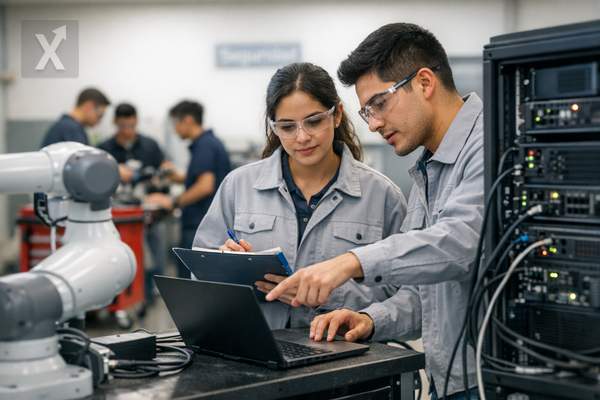
The macro backdrop matters as well. Mexico enters this phase with both strengths and constraints: relative stability in its financial system, a consolidated export base, and monetary policy that has prioritized disinflation. At the same time, it faces bottlenecks in energy, water, power transmission capacity, border crossings, and the availability of technical talent. For the AI hardware boom to translate into higher productivity and wages, the agenda shifts toward infrastructure, regulatory certainty, training engineers and technicians, and developing local suppliers.
In the short term, U.S. data-center demand will remain a key driver, particularly due to Big Tech investment in accelerated computing and the need for networks, storage, and power. In the medium term, Mexico’s opportunity will be to move up from assembly into more engineering-intensive processes: higher-precision manufacturing, advanced testing, component design, automation, and eventually applied R&D tied to AI and high-performance computing. The challenge is that competition to attract these production lines is intense and depends on costs, energy reliability, and logistics timelines.
There is also a geopolitical angle: “friendshoring” strategies and tighter technology controls have pushed production to reorganize toward countries with agreements and proximity to the United States. Mexico, given its trade and manufacturing integration, appears as one of the potential winners—though the outcome will depend on its ability to sustain a competitive operating environment and prevent infrastructure saturation from slowing new projects.
Looking ahead, the Taiwan chapter is likely only part of a broader movement: South Korea and Japan have increased their interest in industrial investment in North America, and Europe is seeking to strengthen resilient supply chains linked to the digital and energy transition. If that convergence takes hold, Mexico could evolve from “North America’s factory” into a node of digital-economy infrastructure, with impacts on exports, skilled employment, and domestic supply-chain linkages—provided it can address internal bottlenecks.
Overall, the evidence suggests Taiwan’s role in Mexico’s electronics manufacturing is larger than what single-year FDI flows imply: its contribution is visible in installed capacity, export momentum, and integration into the AI hardware chain supplying the United States—a segment that could redefine Mexico’s industrial profile in the second half of the decade.