Contactless Payments Are Accelerating in Mexico, Spurring a New Wave of Phone-Based Checkout
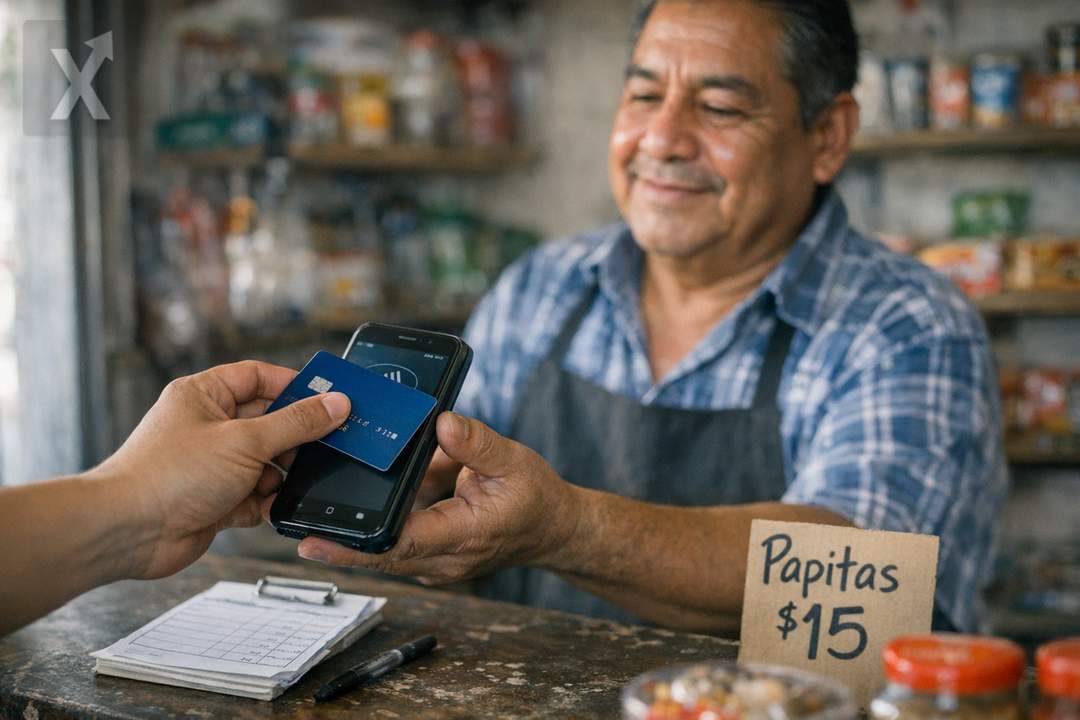
The boom in contactless and “tap to phone” is reducing reliance on payment terminals and expanding card acceptance among microbusinesses.
The way people pay in Mexico is changing fast: the use of contactless payments has gone from marginal to increasingly common among consumers who prioritize speed and convenience. As financial digitization moves forward, a Visa study shows that two years ago only 2% of people used this method, and today the figure is around 30%—a sign of rapid adoption that is already beginning to reshape merchants’ payment infrastructure.
The momentum is also visible in total card transaction volume. In 2025, Mexico recorded 11.261 billion credit and debit card payments, up 14% year over year. In the first quarter of the year, 2.810 billion card payments were logged, according to data from the Bank of Mexico (Banxico), confirming that transactional spending continues to shift from cash to digital methods—particularly in urban segments and high-turnover businesses.
This change isn’t just technological: it reflects an economy in which households are making more careful spending decisions—given persistent price pressures in services, the cost of credit, and the global slowdown—while still seeking quick, frictionless shopping experiences. For businesses, line speed and the availability of payment methods have become competitive factors: accepting cards can mean closing a sale that previously would have been lost due to a lack of cash or not having a terminal.
The next stage of that transformation is “tap to phone” (or “tap to pay” on a phone): turning a smartphone into a point of sale simply by having the customer tap their card or device, reducing dependence on physical terminals and some of the costs associated with operating them. In a country where microbusinesses and self-employment dominate, the promise is clear: lowering the barriers to accepting card payments and expanding acceptance at neighborhood shops, corner stores, and formal street vendors.
Stori has joined this trend with a solution integrated into its app, aimed at customers who need a more affordable alternative to traditional terminals. The company says that out of its more than five million users, about half a million identify as micro-entrepreneurs—a group for whom the ability to accept payments on a phone can translate into more funds captured in accounts and more sales driven by convenience. The firm allows payments of up to 1,000 pesos under this model, betting the tool will be used frequently in day-to-day operations.
Clip, for its part, has also rolled out a similar launch within an ecosystem that combines digital solutions and terminals. This expansion aligns with initiatives led by Visa to broaden card acceptance among small and mid-sized businesses; the stated goal is to add hundreds of thousands of merchants. In the program’s first months, participating businesses posted monthly sales near 16,909 pesos, with an average ticket of 464 pesos—metrics that illustrate typical spending patterns at convenience-oriented merchants and low-denomination services.
Beyond these platforms, other institutions and payment aggregators have enabled phone-based acceptance features in their apps, including Mercado Pago, Banorte, Afirme, Banco Azteca, and Grupo Financiero Multiva. The progress is unfolding in parallel with a financial system that, while it has improved its digital infrastructure, still faces structural challenges: high levels of informality, regional gaps in connectivity, uneven financial education, and acceptance costs that can weigh heavily on low-margin businesses.
Less Cash, More Traceability: Opportunities and Friction for Microbusinesses
The expansion of digital payments carries broader economic implications. For microbusinesses, accepting card payments via phone can mean better income tracking, simpler reconciliation, and potential access to cash-flow-based financial products (such as credit or interest-bearing accounts), in a country where financing for small economic units is often limited. However, it also introduces friction: per-transaction fees, dependence on connectivity, chargeback risk, and the need to handle refunds or disputes. At the macro level, greater payment traceability can contribute to gradual formalization, but the impact will depend on incentives, regulatory burdens, and whether the benefits (more sales, access to credit, security) outweigh the costs merchants perceive.
The regulatory and security context matters as well. Adoption of contactless and mobile acceptance is happening in a market where trust in digital methods is growing, but fraud and identity theft still exist. That’s why payment technology rollouts typically come with authentication, tokenization, operating limits, and transaction monitoring—while consumers demand smooth experiences without sacrificing protection. For acquirers and banks, the challenge will be balancing broader acceptance with controls that don’t discourage everyday use.
Looking ahead, competitive pressure among issuers, acquirers, fintechs, and merchants could accelerate cost reductions and innovation in value-added services (inventory, invoicing, loyalty, credit). If the trend holds, “tap to phone” could become a bridge for bringing electronic payments to segments where a terminal used to be a financial or logistical hurdle—especially in local economies with high cash turnover and small-ticket transactions.
In short, the leap in contactless payments and the rise of phone-based acceptance confirm a shift in consumption toward digital channels, with potential benefits for sales, efficiency, and financial inclusion; whether it becomes firmly established will depend on costs, connectivity, and confidence in the ecosystem’s security.






