Finance Ministry leaves Premium gas without a subsidy and adjusts support for Magna and diesel
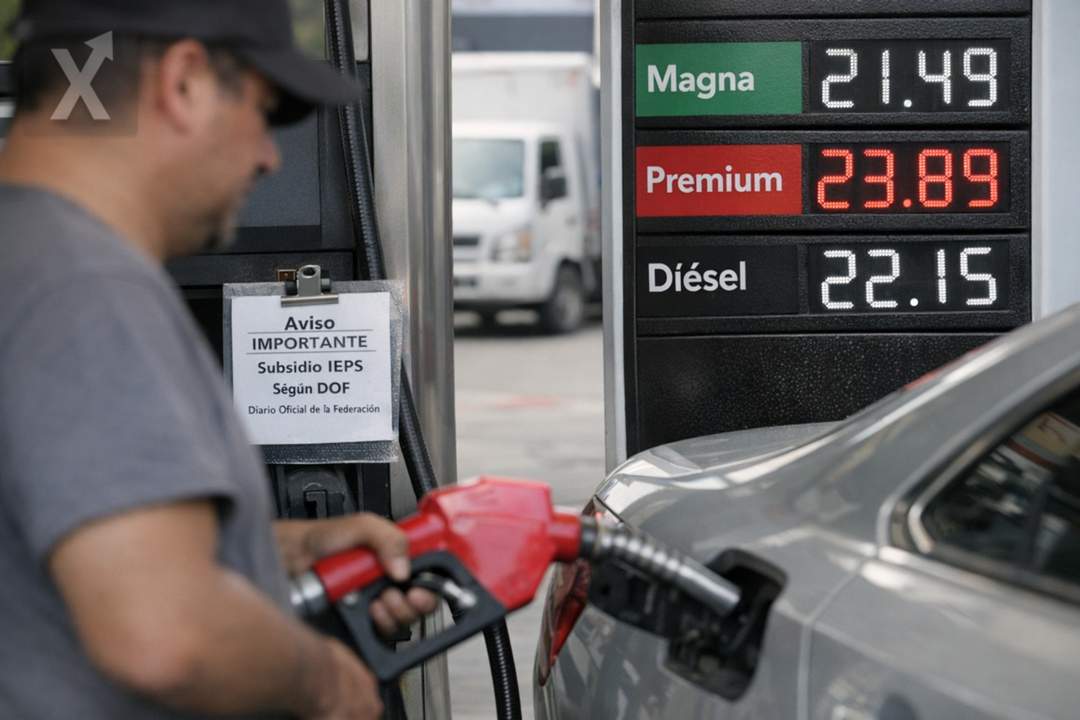
The government kept the Premium IEPS subsidy at zero and modified support for Magna and diesel, amid still-volatile energy prices.
Mexico’s Ministry of Finance and Public Credit (SHCP) kept the fiscal subsidy to the Special Tax on Production and Services (IEPS) on Premium gasoline at zero for a second consecutive week—an indication that, at least for now, the fiscal cost of smoothing pump prices is not viewed as a priority for that fuel. According to what was published in the Official Gazette of the Federation (DOF), for the week of June 13 to 19 the IEPS rate for Premium gasoline stood at 5.66 pesos per liter.
In contrast, Magna gasoline did receive a subsidy: the Finance Ministry increased support to 15.22% of its assessed rate, bringing the tax due to 5.68 pesos per liter. For diesel, the subsidy was trimmed slightly, from 40.42% to 39.10%, and the IEPS rate was set at 4.48 pesos per liter. These adjustments, while technical, often have a direct impact on the path of consumer prices, especially in regions where competition among gas stations is limited.
The IEPS on fuels works as a public policy lever to cushion international swings—especially in crude and refined products—and exchange-rate moves, since a significant share of supply is priced off external benchmarks. During periods of pressure, the subsidy reduces the tax burden to prevent sharp increases; when prices cool or revenue becomes more important for the fiscal balance, support tends to be reduced or eliminated.
In Premium’s case, a zero subsidy is often associated with consumption that is more concentrated among higher-income households and with lower political sensitivity to price changes, unlike Magna—Mexico’s most widely used gasoline—and diesel, which is critical for freight transport and, by extension, for the price chain of food and goods.
Implications for inflation, transportation, and public finances
IEPS changes do not, by themselves, determine the final price—which also includes logistics costs, retail margins, and regional differences—but they do influence non-core inflation through the energy component. For the Bank of Mexico (Banxico), energy dynamics matter because they can spill over into expectations and feed into other prices, particularly if diesel makes transportation more expensive. In an environment where inflation has shown persistent pockets in some categories, a smaller diesel subsidy could add indirect pressure to distribution costs, although the effect depends on the international trend in refined products and on the exchange rate.
On the fiscal side, maintaining high subsidies means forgoing a portion of revenue. In recent years, IEPS management has served as a price-stabilization tool, but it carries a budgetary cost when support is expanded. Keeping Premium without a subsidy and cautiously adjusting Magna and diesel allows the Finance Ministry to ration that cost, especially at a time when the government is looking to preserve room for public spending and investment without unanchoring expectations of fiscal discipline.
Looking ahead, the room to maintain subsidies will depend on oil-market volatility, the strength of the peso against the U.S. dollar (USD), and domestic demand trends. If new international price shocks or logistical disruptions emerge, authorities will likely adjust the subsidies week by week to avoid abrupt moves at the pump; if stability holds, the IEPS may gradually regain its revenue-raising role.
In sum, the decision to keep the Premium subsidy at zero and recalibrate support for Magna and diesel confirms a fine-tuning approach: partially shielding the fuels with the biggest impact on consumption and transportation costs, without extending broad-based support that would strain public finances.






