Fed Appointment Reshapes U.S. Rate Expectations and Puts the Peso to the Test Again
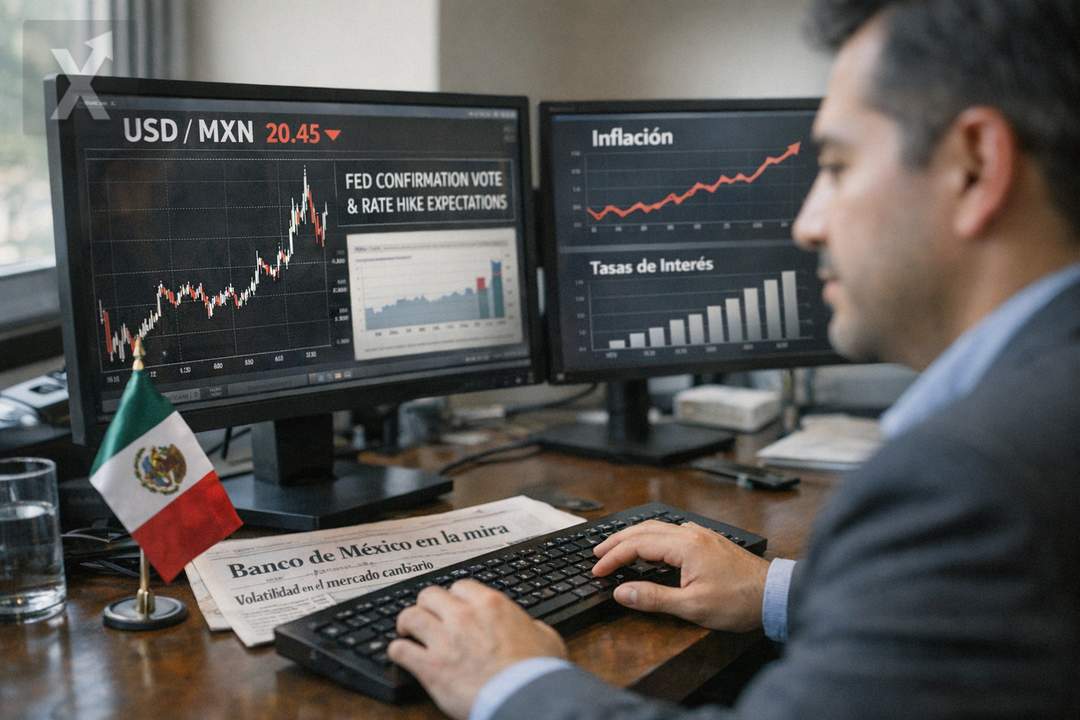
Kevin Warsh’s arrival at the Federal Reserve comes amid elevated inflation in the United States and could move Mexico’s exchange rate and borrowing costs.
Kevin Warsh’s confirmation by the U.S. Senate as a member of the Federal Reserve’s Board of Governors reopens the debate over the direction of monetary policy at the world’s most important central bank—and its spillovers into highly integrated economies like Mexico’s. The move comes at a delicate moment: U.S. inflation has picked up, and markets are starting to revise expectations for the timing of rate cuts, with direct effects on the U.S. dollar (USD) and flows into emerging markets.
Warsh, often associated with a more rate-cut-leaning stance, joins the Fed as U.S. prices show meaningful pressure—particularly in energy and food—while there are also signs of cooling in employment. Politically, his nomination by President Donald Trump has revived questions about the central bank’s independence, an issue that can quickly show up in global financial volatility when markets sense pressure on interest-rate decisions.
For Mexico, the transmission channels are multiple: a shift in the Fed’s bias changes the relative yield on dollar-denominated assets, affects demand for Mexican instruments, alters risk appetite, and translates into exchange-rate moves. While the peso has shown an ability to adjust during periods of stress, its performance depends both on interest-rate differentials and on perceptions of macroeconomic and fiscal stability.
If the Fed tilts toward faster cuts despite inflation, the U.S. dollar could lose some of its strength, which typically supports emerging-market currencies. However, if markets read a “too-soon” pivot as raising the risk that inflation becomes entrenched, the outcome could be the opposite: higher long-term yields, bouts of risk aversion, and a stronger USD—pressuring the peso and making external financing more expensive.
Implications for Banxico: rate differentials, inflation, and a delicate balance
The Bank of Mexico (Banxico) faces an environment in which the Fed’s trajectory matters as much as local inflation dynamics. Generally speaking, a wide rate differential has supported the peso by encouraging positions in local-currency instruments; but that same differential also raises borrowing costs and weighs on activity. If the Fed accelerates cuts, Banxico would gain room to adjust its stance without sacrificing as much of the peso’s relative appeal; if the Fed stays restrictive for longer, the space to cut rates in Mexico narrows if policymakers want to avoid FX pressure that ultimately feeds into prices.
The takeaway for the Mexican market is that the exchange rate does not respond only to the level of interest rates, but also to institutional credibility. In that sense, any sign of politicization at the Fed tends to lift global risk premia. For Mexico, that translates into greater sensitivity in the FX market and higher hedging costs—factors that matter especially for importers, firms with dollar-denominated debt, and sectors with supply chains tightly linked to the United States.
In the short run, portfolio decisions typically move with rate expectations and the USD’s performance. Over the medium term, the impact on Mexico is amplified by trade and manufacturing integration: a prolonged tightening in U.S. financial conditions can cool domestic demand there and, in turn, temper Mexican exports; while looser conditions could support consumption and investment—though with the risk that U.S. inflation re-accelerates and forces sharper adjustments later.
Another variable to watch is energy prices. A U.S. inflation backdrop driven by energy often coincides with greater commodity volatility, which can affect logistics and production costs in Mexico. While Mexico is an oil producer, the net effect on the economy depends on domestic pricing, fuel imports, fiscal margins, and how much of the cost is passed through to consumers.
In perspective, Warsh’s confirmation is not, by itself, a policy shift; but it is an event that changes the “risk map” for the coming months. For Mexico, the challenge will be navigating a cycle in which central-bank credibility, inflation, and the direction of the U.S. dollar become decisive for peso stability and the cost of capital.
In conclusion, the change at the Fed arrives as U.S. inflation is rising and employment signals are mixed, making the path for rates more uncertain; for Mexico, that means a stronger focus on the exchange rate, the differential versus Banxico, and USD-linked financial volatility.






