S&P Sees Persistent Inflation in Mexico, Casting Doubt on a Return to 3% Before 2029
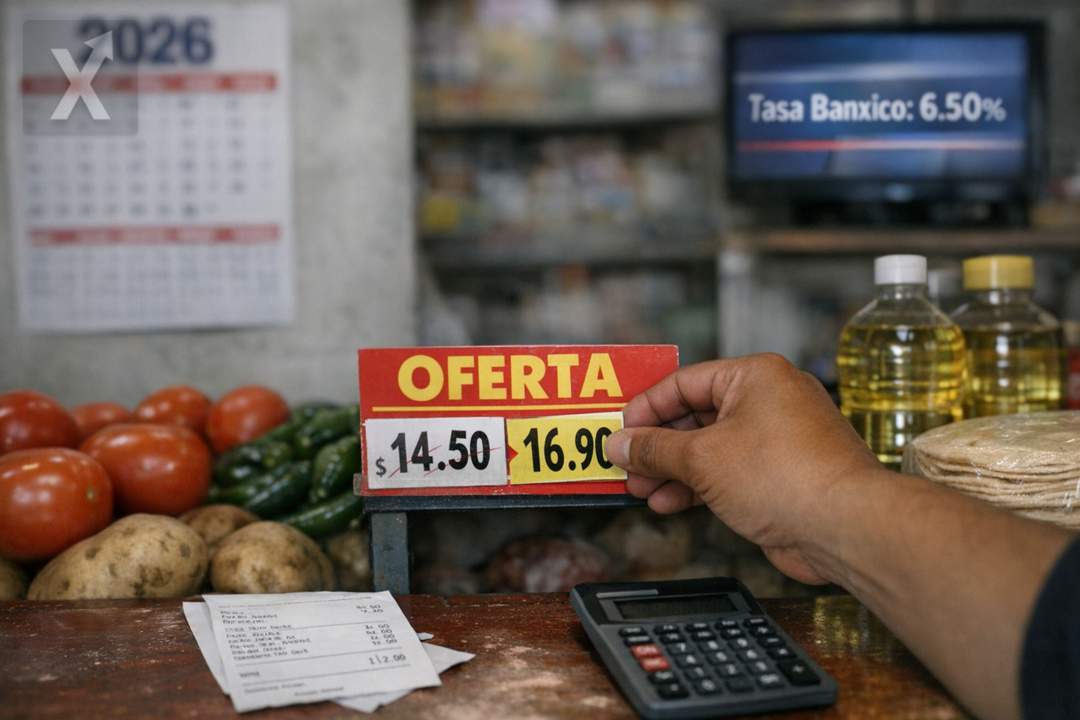
S&P Global estimates that prices in Mexico will remain above Banxico’s target for several years, even with monetary policy already near neutral.
Mexico’s inflation path could be longer and bumpier than the central bank projects. S&P Global Market Intelligence expects price increases to end 2026 around 5.5%, and for inflation to stay above 4% at least until early 2029—an outlook that contrasts with Banco de México’s (Banxico’s) baseline scenario, which still points to convergence toward 3% around the second quarter of 2027.
The firm’s assessment comes after Banxico cut its benchmark rate by 25 basis points to 6.50%, a move that effectively places borrowing costs in a range considered close to neutral. For S&P, with pressures still active across different components of the index, it is “extremely unlikely” that inflation will return to the 3% target over the next 24 months—implying a stickier price environment for consumers, businesses, and public policy design.
In the near term, S&P expects headline inflation to end 2026 at 5.5% and ease to 4.4% by the end of 2027; however, it warns that the disinflation process would be slow and vulnerable to shocks, meaning the 4% threshold would remain difficult to break for an extended period.
Part of the challenge, various market analyses note, is that Mexico is dealing with a mix of domestic and external factors: fiscal and regulatory adjustments that affect specific prices, labor-cost pressures in services, volatility in energy and food, and climate shocks that hit agricultural supply. On top of that, the anchoring of expectations—key to bringing inflation down sustainably—depends both on Banxico’s credibility and on the exchange rate’s performance, international prices, and global financial conditions.
Inflation’s “Floor”: Services, Food, and Energy
Inflation persistence is largely explained by two fronts. On one hand, core inflation—which tends to reflect medium-term trends—has proven resilient, driven by increases in services tied to higher labor costs and by the impact of indirect taxes (such as the IEPS excise tax) on certain products. On the other, non-core inflation remains exposed to swings in agricultural goods and energy, categories sensitive to logistical disruptions, weather events, and changes to subsidies or administered prices. In this context, even when some prices moderate, pressure shifts elsewhere and keeps the cost of living elevated in essential components.
The social impact is especially significant: when price increases are concentrated in food and everyday services, the hit is disproportionate for lower-income households, whose consumption basket is more heavily weighted toward those goods. In recent months, the cost of the basic food basket has risen at a faster pace than headline inflation, underscoring that a slowdown in the overall index does not always translate into relief for essential spending.
On the monetary side, Banxico’s cut to 6.50% is viewed as a signal that the easing cycle that began in 2024 is nearing its balance point—especially if the ex ante real rate stops being clearly restrictive. The split vote on the Governing Board, with some members favoring holding the previous level, highlights that the central bank still sees risks in the persistence of the core component and in the possibility that temporary shocks become more lasting.
For economic activity, a scenario of elevated inflation for longer has two main implications. First, it limits room for additional rate cuts without jeopardizing price convergence, which could keep financial conditions relatively tight for consumer and business credit. Second, it erodes purchasing power and can cool domestic demand—especially if wages fail to keep up with higher costs for food, transportation, and services.
S&P also factors in risks that could reignite pressure: higher oil prices, changes to energy support programs, episodes of extreme weather that damage agriculture, and domestic issues such as security problems that raise logistics and operating costs. In addition, demand associated with the 2026 FIFA World Cup could add pressure on services—hotels, restaurants, and transportation—in host cities, a dynamic that is typically temporary but can amplify short-term price spikes.
Looking ahead, the key debate will be whether disinflation can reassert a clearer trend without sacrificing growth, in an environment where Mexico’s economy remains closely tied to the U.S. manufacturing cycle, foreign trade dynamics, and the peso’s stability. For Banxico, the challenge is to keep expectations firmly anchored and respond prudently to supply shocks, while the government faces the task of containing pressure on essential goods without creating distortions that ultimately fuel new price increases.
Overall, S&P’s projections suggest Mexico may have to live with stickier inflation than expected, especially in categories that matter most for households. The central message is that even with rates near neutral, shocks in food, services, and energy could continue to complicate a sustained return to 3%, requiring careful management of monetary policy and expectations.






