Trump Proposal to Suspend the U.S. Gas Tax Rekindles Energy Volatility and Puts Pressure on Mexico’s Exchange Rate
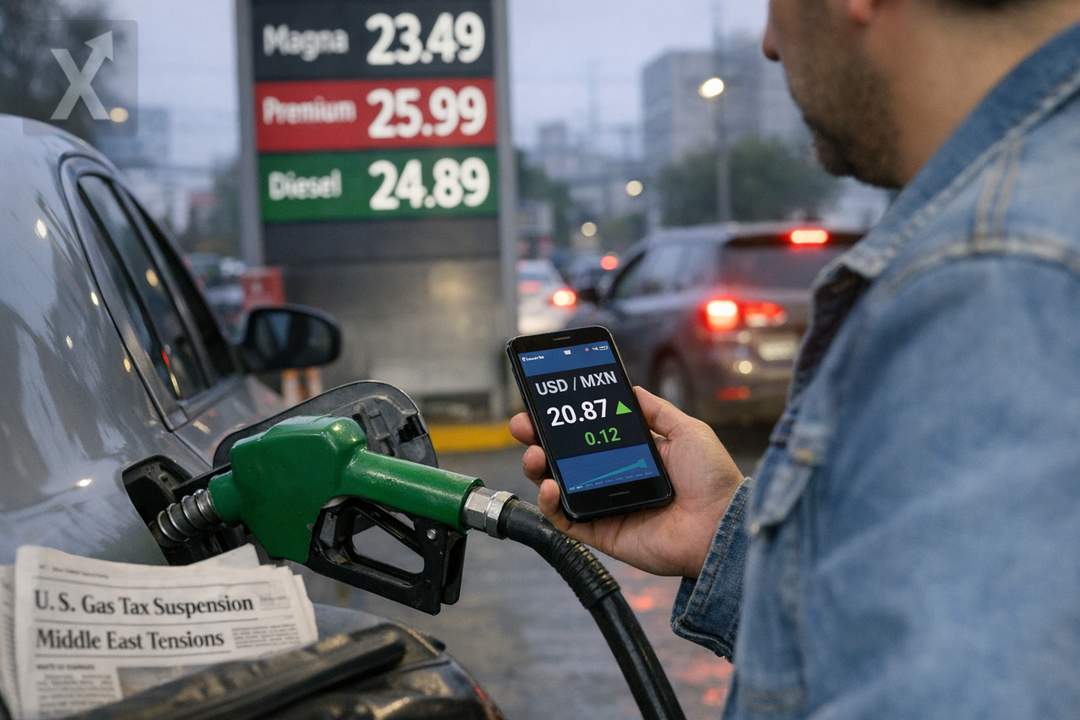
The potential fuel tax cut in the U.S. aims to cushion consumers, but the Middle East oil shock keeps risks elevated for inflation and the Mexican peso.
President Donald Trump’s intention to suspend the federal gasoline tax in the United States (U.S.) “for a period of time” has once again put energy at the center of the region’s macroeconomic concerns, at a moment when the conflict in the Middle East has pushed up the cost of oil and fuels. The proposal, which would require approval by the U.S. Congress, seeks to temper consumer prices through a cut equivalent to 18.4 cents per gallon for gasoline and 24.4 cents for diesel, according to figures from the Energy Information Administration (EIA).
For Mexico, the announcement matters through two channels: the financial channel—via expectations for inflation and interest rates in the U.S. that influence the U.S. dollar (USD) and, by extension, the exchange rate—and the real economy—through the cost of energy, logistics, and transportation that filters into prices along production chains. While a potential suspension of the tax would marginally ease the final price in the U.S., the underlying driver remains the international price of crude and the risk premium tied to supply out of the Gulf.
In the foreign-exchange market, spikes in energy prices tend to increase risk aversion and strengthen the USD, especially if markets anticipate that the Federal Reserve will keep a restrictive stance in the face of renewed inflation pressures. For the Mexican peso, that can translate into bouts of depreciation or higher volatility, even if local fundamentals—such as the interest-rate differential—continue to provide support during calmer periods.
In Mexico, the impact on inflation depends on how quickly higher gasoline and diesel costs pass through to domestic prices, where factors such as fuel import costs, distribution margins, and the tax structure (the IEPS excise tax) come into play; historically, this tax has been adjusted to smooth shocks. In recent years, authorities have used IEPS fuel tax rebates countercyclically when international prices push higher, though that mechanism carries a fiscal cost and reduces effective tax revenue.
Implications for Inflation and Monetary Policy in Mexico
If the global energy upswing persists, the main risk for Mexico is a resurgence of inflation pressures via transportation, processed foods, and services with high logistics intensity. In that scenario, Banco de México (Banxico) would face the dilemma of continuing gradual cuts to its policy rate—as long as core inflation keeps easing—or pausing to prevent a rebound in expectations. Unlike the U.S., where a fuel tax cut can cushion the hit to consumers, Mexico often absorbs part of the shock through fiscal adjustments and, at times, through peso appreciation itself, which makes imports cheaper; however, that FX “release valve” is not permanent and can reverse quickly amid geopolitical events.
In addition, Mexico’s fuel-market structure remains highly sensitive to external prices: Mexico imports a significant share of gasoline and diesel, and replacement costs track international benchmarks. This means that even with domestic measures, the global trend sets the floor for the adjustment. For transportation and manufacturing companies, the risk is twofold: more expensive fuel and a stronger USD, which raises the cost of imported inputs and puts pressure on costs.
On the fiscal front, any attempt to contain prices through sustained IEPS rebates can strain revenues, just as the government faces spending commitments and the need to maintain investor confidence in the debt path. If the shock is temporary, the cost may be manageable; if it drags on, the debate shifts to how to finance relief without weakening fiscal balances or crowding out public investment.
For households, the most visible channel would still be gasoline and transportation prices, with indirect effects on the basic consumer basket. In the near term, Mexican authorities’ ability to prevent an accelerated pass-through will depend on how long the shock lasts, how the exchange rate behaves, and how well fiscal and monetary policy are coordinated.
Looking ahead, Trump’s announcement underscores that even with domestic measures in the U.S., the energy outlook remains dominated by geopolitics and global hydrocarbon supply. For Mexico, the environment argues for caution: bouts of oil volatility often spill over into inflation and the FX market, testing Banxico’s strategy and the fiscal capacity to cushion impacts without compromising stability.
In short, suspending the federal gas tax in the U.S. could partially ease prices for American consumers, but it does not eliminate the core risk: a prolonged energy shock that strengthens the USD and reignites inflation pressures in Mexico, with implications for rates, the exchange rate, and public finances.






