Mexico Moves to Lock In Canadian Investment: Hidalgo Announces $2B Pharmaceutical Plant
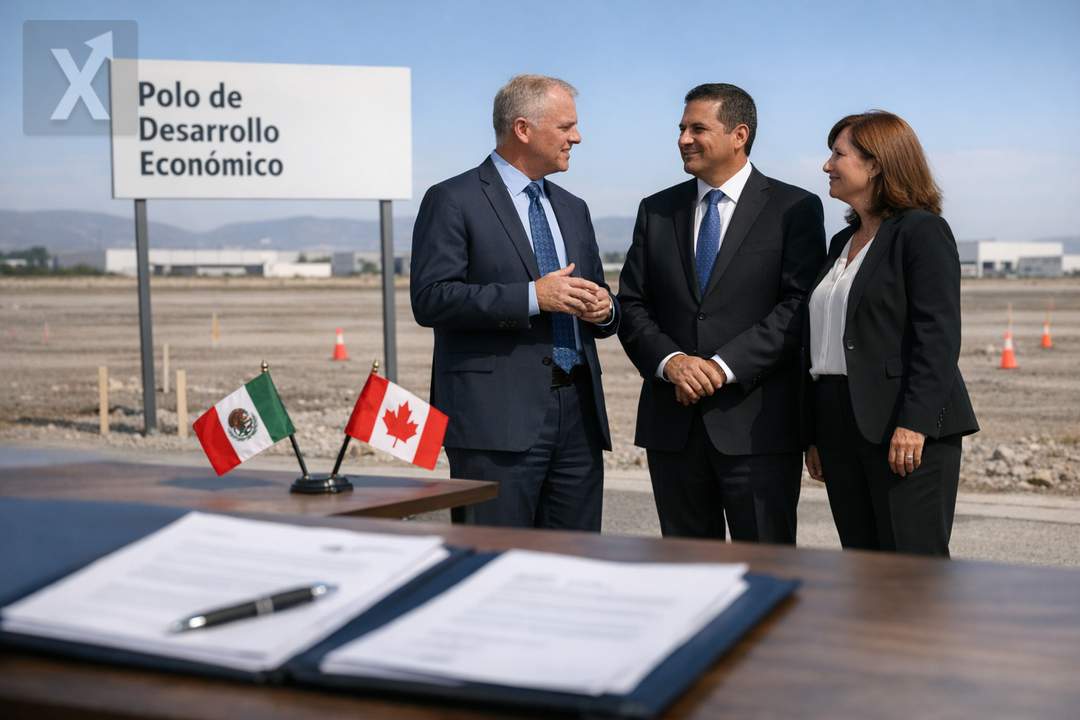
The economic mission to Canada yielded a pharmaceutical project in Hidalgo and letters of intent for manufacturing, mining, and agribusiness in other states.
Mexico’s economic promotion tour in Canada wrapped up with a high-profile announcement for the pharmaceutical industry: the government of Hidalgo finalized an agreement to set up an active pharmaceutical ingredients (API) plant, with an estimated value of $2 billion. The project would be led by Solar International Core Canada and located at the Zapotlán Economic Development Hub, with a first phase of $70 million earmarked for land acquisition and initial preparations.
The understanding was formalized through a memorandum signed by the company and Hidalgo’s Ministry of Economic Development, at an event attended by Mexican and Canadian officials. For Mexico, the announcement is significant at a time when attracting foreign direct investment is taking place in a more cautious global environment: still-elevated interest rates in advanced economies, supply-chain reconfiguration, and trade tensions that are pushing companies to diversify suppliers and geographies.
The bet on an API plant, in particular, targets a strategic link in the value chain. After recent years’ logistics disruptions, countries and companies have sought to reduce dependence on critical inputs concentrated in Asia. For Mexico, strengthening pharmaceutical-ingredient production could raise the domestic content of medicines, shorten delivery times, and open export opportunities—especially if the project secures certifications and regulatory standards compatible with demanding markets.
The Hidalgo announcement added to an agenda of business meetings in Canada involving hundreds of Mexican companies, aimed at creating avenues for investment and industrial cooperation. The official narrative focuses on cementing Mexico’s role as a North America–integrated manufacturing platform and attracting projects tied to reshoring/nearshoring, logistics, and regional supply networks.
Other State-Level Bets: Modular Housing, Battery Materials, and Agribusiness
The mission also produced letters of intent and preliminary assessments in other states. Chiapas signed an agreement to study the installation of a modular-housing plant with potential investment of up to $360 million, at a time when the housing backlog and the need for faster construction solutions have gained attention. In Puebla, a Canadian firm will evaluate a project to process minerals and materials geared toward batteries, with possible investment of $380 million; feasibility will depend, among other factors, on access to infrastructure, permits, energy, and regulatory certainty for value-added mining and processing operations. In Jalisco, a plan was proposed to process agave and produce pulp, estimated at $100 million, in line with the state’s agribusiness footprint and efforts to diversify uses and markets for agri-food inputs.
These announcements reflect a recurring feature of the current economic moment: competition among states to capture projects through industrial parks, land availability, logistics connectivity, and—more and more—reliable access to energy and water. For several regions of the country, attracting new plants not only means capital, but also the challenge of developing technical talent, strengthening local supplier networks, and expanding specialized service capacity.
On the macroeconomic front, Mexico enters these kinds of missions with clear strengths and constraints. On one hand, a stable monetary framework, the size of the domestic market, and trade integration with North America support investor interest. On the other, bottlenecks persist: infrastructure congestion along some corridors, regional disparities, security challenges, and the need for greater certainty for long-term investments, especially in energy-intensive sectors.
The visit also included educational and cultural agreements. Mexican higher-education institutions established cooperation mechanisms with Canadian counterparts to promote exchanges and academic projects—often a key component when the goal is to attract more sophisticated industries. On the cultural front, partnerships for audiovisual co-productions and professional exchanges were explored, an area that, while less visible than industrial investment, can also strengthen networks and bilateral positioning.
Going forward, the real impact of these announcements will depend on execution: investment timelines, permits, construction, hiring, and above all, the ability to anchor domestic suppliers. If the projects move ahead, they could help diversify exports, increase regional content, and spread economic spillovers beyond traditional hubs; if they remain preliminary, they will highlight the gap between intent and on-the-ground delivery that economic promotion often faces.
Overall, the Canada mission showcased a project pipeline with an industrial and supply-chain focus, led by the pharmaceutical announcement in Hidalgo. The next step will be to measure results in terms of construction, jobs, and productive linkages—beyond the headline dollar amount committed.






