Banxico hits pause on rate cuts, opening a window of certainty for investment
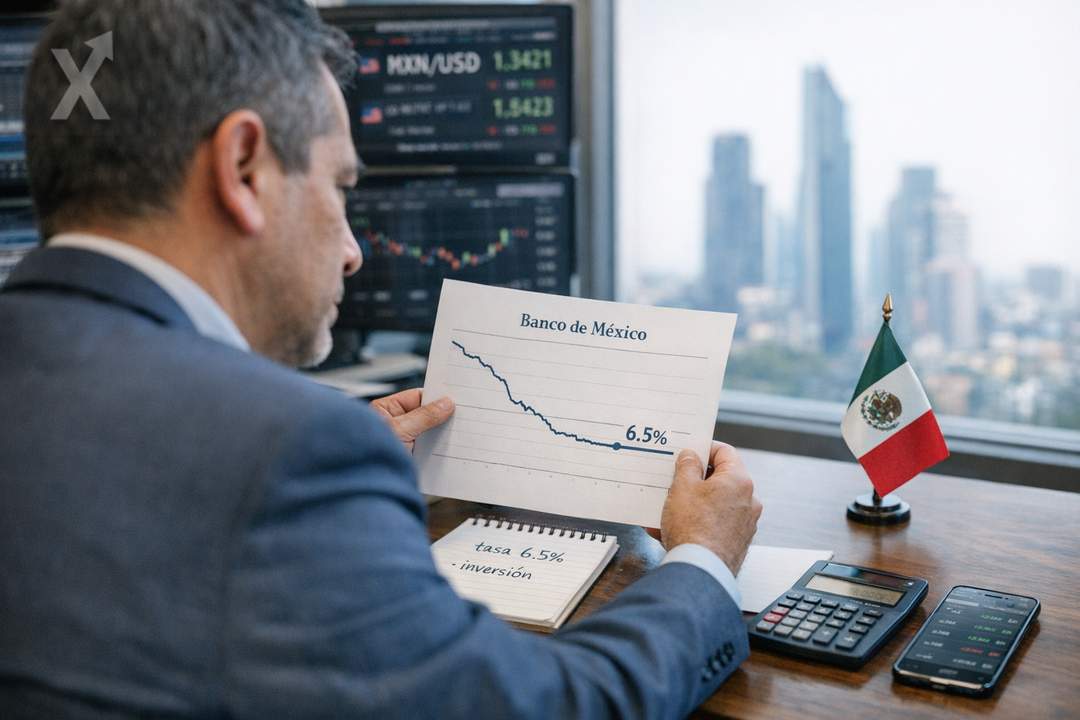
With the policy rate at 6.5%, the central bank is looking to lock in disinflation without further choking an economy that is showing signs of weakness.
The Bank of Mexico (Banxico) has wrapped up its rate-cut cycle and kept the benchmark rate at 6.5%—a decision that signals the start of a different phase in the monetary cycle: less focused on continuing to make credit cheaper and more aimed at supporting inflation’s convergence without adding volatility to financial markets. For businesses and households, the core message is that the cost of money is no longer falling for now, but the central bank is trying to offset that with a key asset for investment: predictability.
The current rate stands in contrast to the double-digit levels seen during the most restrictive stretch of the previous cycle. That decline has begun to filter through— with lags—into bank lending, corporate issuance, and some consumer-credit segments. At the same time, slowing growth and a global backdrop marked by recurring bouts of risk aversion have increased the peso’s sensitivity to external shocks, making the need to maintain an “appropriate” stance—without jeopardizing disinflation—the backbone of Banxico’s messaging.
Financial-sector analysts have emphasized that a stable rate reduces the need to reprice projects in response to frequent changes in the cost of capital. With a positive real rate—that is, above expected inflation—policy remains restrictive, though less so than at the cycle’s peak. That can support investment decisions in sectors where financing is pivotal and cash flows are assessed over long horizons.
The central bank is also sending an implicit signal: an upward move would only be justified if inflation—especially core inflation—reversed course and showed persistent pressure. Without that scenario, the pause is read as an attempt to balance two risks: easing too soon and reigniting price pressures, or maintaining excessive restraint and deepening the slowdown.
Credit, housing, and businesses: the sectors that feel (and welcome) the rate the most
Real estate is typically among the most rate-sensitive sectors because of its reliance on mortgage financing and expected project returns. With the benchmark at 6.5%, the environment is less unfavorable than when the cost of money was significantly higher, though the boost is not automatic: retail rates depend on funding costs, bank competition, risk perceptions, and the pace of households’ real income growth. In parallel, for businesses—especially mid-sized firms—a stable rate can make it easier to plan working capital and execute incremental investments, even if more ambitious projects remain constrained by demand and regulatory certainty.
In practice, the “pause” can help reset expectations: if the market internalizes that the cuts have run their course, decisions to buy a home, invest in machinery, or expand capacity tend to be made using more realistic assumptions, without betting that financing will be cheaper in the near term. For the financial system, an extended period of stability can also dampen volatility in margins and valuations, supporting more consistent intermediation.
Looking ahead, the drivers of any future move in the policy rate center on the inflation path, the performance of economic activity, and how the exchange rate reacts to external shocks. In Mexico, core inflation remains the key gauge because of its persistence, while energy and food prices—more volatile—can shift the conversation from one month to the next. On the external front, the course of monetary policy in the United States, global financial stability, and geopolitics that affect energy markets tend to influence the risk premium and appetite for emerging-market assets.
For investment, the impact of this stage does not hinge on the rate alone: the quality of institutional signals, regulatory clarity, infrastructure availability, and the degree of productive integration with North America also matter. With the easing cycle over, the debate shifts from “how much further will it fall” to “what conditions will allow growth with price stability”—a conversation that in 2026 and 2027 will be tied to productivity, nearshoring, and the economy’s ability to sustain expansion without reigniting inflationary pressures.
Bottom line, Banxico is betting on consolidating an environment of lower monetary uncertainty: the policy rate stops being the engine of stimulus and becomes an anchor for expectations. If inflation keeps easing and activity does not deteriorate sharply, the pause could translate into a planning window for households and businesses—though investment will still require certainty beyond monetary policy.






