Banxico Halts Rate Cuts and Sets the Policy Rate at 6.5% Amid Slow Disinflation and External Risks
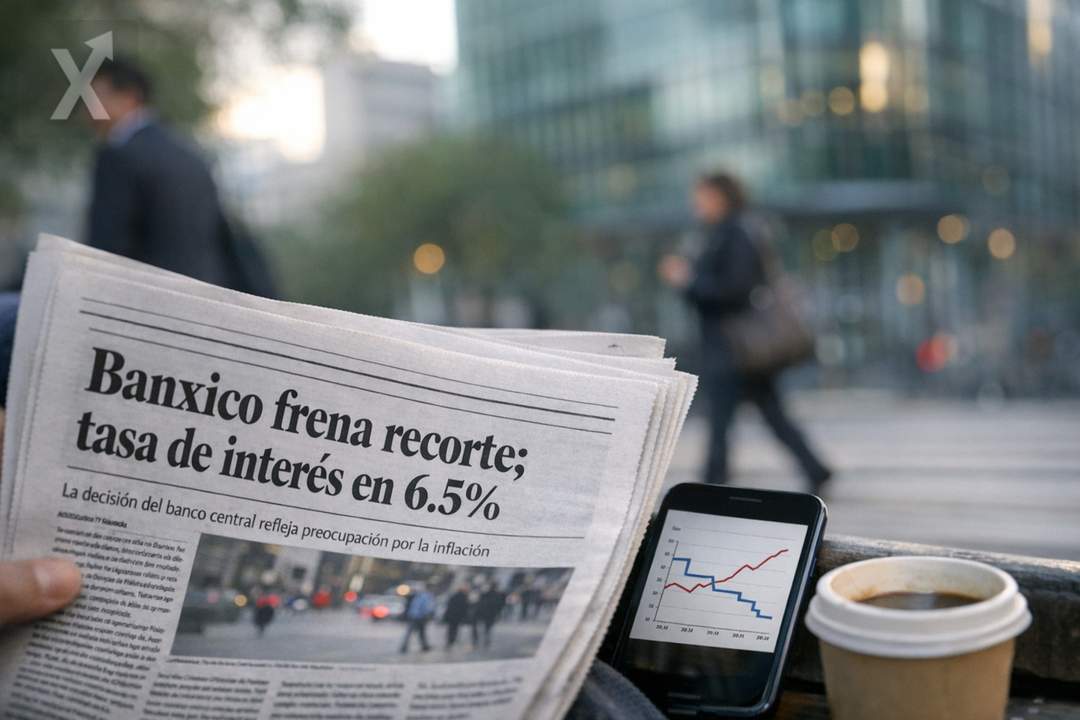
The central bank wrapped up its easing cycle and chose to keep a restrictive stance as inflation remains above target and global risks rise.
The Bank of Mexico (Banxico) cut its benchmark interest rate by 25 basis points to 6.5% and, at the same time, sent a clear signal that this move brings the rate-cut cycle that began in 2024 to an end. The decision was not unanimous: two members of the Governing Board voted to hold the rate at 6.75%, reflecting an internal debate over the balance between slowing economic activity and persistent inflation pressures.
The central bank’s main message was that, going forward, it “will be appropriate” to keep the policy rate at its current level. In other words, Banxico is trying to avoid additional easing that could fuel a new round of price increases—especially with inflation still far from the 3% target and the international backdrop becoming more volatile.
Recent conditions have lent support to the disinflation narrative: headline inflation came in at 4.45% in April, helped by lower electricity rates and more stable energy components. Still, the central bank kept a cautious assessment: the balance of risks for inflation remains tilted to the upside, and convergence to 3% is not expected until the second quarter of 2027—a horizon that underscores how drawn-out the disinflation process is likely to be.
In the background, Mexico’s economy is dealing with a complex mix: signs of softer momentum in activity, more selective consumption as credit has become more expensive, and investment that depends largely on regulatory certainty and the overall business climate. In that context, holding the rate at 6.5% aims to preserve anti-inflation credibility and keep expectations anchored, even if it means limited monetary support for demand.
Inflation, the Exchange Rate, and Mexico’s Credit Path
Banxico’s newly announced pause also reflects how the “three-legged stool” that typically defines monetary policy room has been moving: inflation, the exchange rate, and financial conditions. On one hand, the peso’s appreciation at different points and weaker activity have helped contain pressures in goods and some services; on the other, shocks such as energy price spikes, logistics disruptions, or higher food costs could reignite core inflation—the measure the bank watches most closely because of its persistence. In the real economy, a 6.5% policy rate means consumer and business credit will remain relatively expensive by historical standards. That tempers demand but also raises the cost of productive financing. For households, the impact shows up in credit cards and personal and auto loans; for companies—especially small and medium-sized businesses—it translates into higher working-capital costs and more caution about expanding capacity.
The international component weighed explicitly in the statement. Banxico cited uncertainty around changes in economic policy in the United States and the worsening of geopolitical conflicts, emphasizing the potential for escalation in the Middle East. These factors matter for Mexico because they can affect oil and fuel prices, transportation costs, and financial-market volatility: a risk-off episode can put pressure on the exchange rate, make imports more expensive, and complicate the disinflation path.
Ending the easing cycle also has an implicit coordination angle tied to the interest-rate differential versus the United States. When the Federal Reserve keeps restrictive conditions in place for longer, Mexico has less room to cut if it wants to avoid abrupt depreciation episodes and portfolio outflows. In that sense, an extended pause at 6.5% acts as “insurance” against external shocks, though it does not eliminate vulnerability to sudden shifts in global risk appetite.
Looking ahead to the rest of the year, the key question will be whether inflation continues to fall due to more structural forces—especially in services—and not just temporary effects such as regulated rates or seasonality. If the downtrend loses momentum or food and energy shocks emerge, the Governing Board could extend the pause beyond what markets currently expect. By contrast, if activity cools more sharply and core inflation eases consistently, the debate could reopen—though the bank has made it clear that its current preference is to lock in disinflation progress.
In short, Banxico opted for one last cut followed by a pause, prioritizing price stability in a context of incomplete disinflation, moderate growth, and external uncertainty. The signal is that the central bank prefers to maintain a restrictive stance for as long as needed to reinforce convergence to target—even if the tradeoff is slower relief for credit conditions and domestic demand.