Mexico Improves Tax Collection, but Still Lags in Latin America and Remains Far Below the OECD Standard
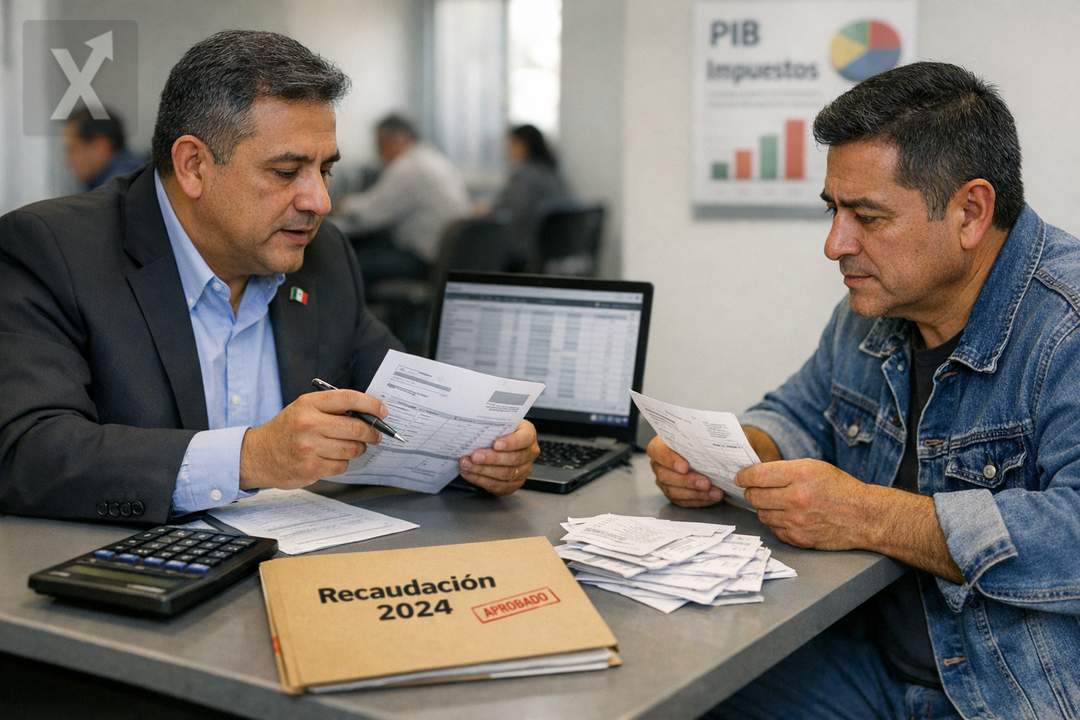
Recent fiscal gains are lifting revenue, but the low tax burden limits room for public investment and financial stability.
Mexico increased its tax revenue in 2024, but it remains near the bottom of the regional ranking, according to the latest OECD comparative snapshot of tax revenues in Latin America and the Caribbean. The country reached tax collection equivalent to 18.3% of GDP, up from 17.7% in 2023 and its highest level in two decades, though still below the regional average (21.7%) and far from the average for OECD member countries (34.1%).
In the comparison of 28 economies in Latin America and the Caribbean, Mexico ranked 22nd. Above it were countries with more robust tax structures or heavier levies on consumption and payroll; at the top stood Brazil at 33.7% of GDP, while at the low end Guyana came in at 9.2%. The regional picture shows that 15 of 28 countries managed to raise their tax burden, though with differences across subregions: in Central America and Mexico (including Cuba) the average rose by 0.7 percentage points, while South America increased by just 0.1 point and the Caribbean fell by 0.2.
In nominal terms, Mexico’s tax revenues in 2024 totaled 6,199,485 million pesos, an annual increase of 551,325 million. Part of the gain was explained by higher taxes on specific goods and services, a category that typically captures VAT, indirect taxes, and duties tied to foreign trade, in a context where stronger consumer activity, formalization in certain segments, and tighter oversight of invoicing chains have boosted collection efficiency.
The contrast with the OECD average points to a structural challenge: Mexico finances the state with a relatively small tax base and a composition that relies more on consumption taxes and income tax than on wealth/property taxes or broad social security contributions. In practice, this narrows budget space to invest in infrastructure, health, education, and public safety, and increases the sensitivity of public finances to economic shocks or declines in non-tax revenue.
SAT Enforcement and Technology: The Engine Behind the Rebound
The strengthening of tax collection in recent years has been closely tied to the strategy of Mexico’s Tax Administration Service (SAT) to intensify audits and collections from large taxpayers, as well as to digitization. Between 2020 and 2025, revenue obtained through enforcement actions targeting large taxpayers rose from 165,575 million pesos to 349,970 million, with an additional boost from fines and surcharges. The expanded use of electronic invoicing, data cross-checks, and analytical tools—including automated alerts and risk profiles—has made it possible to detect inconsistencies more precisely and speed up audit processes, increasing revenue without necessarily changing tax rates.
This approach, however, raises a debate about limits and sustainability. Part of the increase comes from one-off collections or compliance regularizations that do not always repeat year after year. To lock in an upward trajectory, the challenge is to broaden the taxpayer base, reduce informality—which remains high in the labor market—and improve incentive design so more economic units move into the formal economy without losing viability.
Tax Structure: Reliance on Consumption and a Low Property-Tax Contribution
The composition of Mexico’s revenues shows a significant weight of VAT and other taxes on goods and services, along with income tax on individuals and corporations. By contrast, property taxes contribute a small share relative to international standards, in part due to limited local collection capacity and administrative differences across municipalities and states. This feature matters: a stronger property-tax take often provides stability and, at the same time, room to ease pressure on consumption taxes, which tend to hit lower-income households proportionally harder.
In the short term, revenue performance will also depend on the economic cycle. Moderate GDP growth, tighter financial conditions, and trends in formal employment can affect income tax and VAT. At the same time, manufacturing integration with North America and the reshuffling of supply chains are creating opportunities for investment and formalization that, if they translate into more registered jobs and business expansion, could raise tax intake more permanently.
Implications for the Budget and Credit Ratings
A low tax take relative to GDP typically translates into tougher budget choices: either borrowing increases, spending is cut, or programs are reshuffled—especially when pressures grow for public investment, debt-service costs, and social demands. For investors and credit rating agencies, the ability to generate recurring revenue is a key variable in assessing fiscal sustainability. In that sense, the improvement recorded is a positive signal, but not enough to close the gap with comparable economies unless it is paired with a strategy to broaden the tax base and strengthen subnational institutions.
Looking ahead, Mexico’s fiscal debate will likely remain focused on how to raise revenue without slowing investment or consumption, and how to better allocate responsibilities between the federal government and local governments. Greater use of technology by the SAT offers efficiency, but the underlying challenge is structural: growing with more formalization and higher productivity so that tax collection rises alongside the economy.
In short, Mexico made a meaningful advance in tax collection in 2024 and reached a 20-year high, driven by SAT enforcement and digital tools; even so, its tax burden remains below the regional average and far from the OECD benchmark, keeping pressure on the financing of public spending and fiscal resilience.






