“Grow Again” Program Seeks to Untangle Legacy FND Debts and Ease Financial Pressure in Rural Mexico
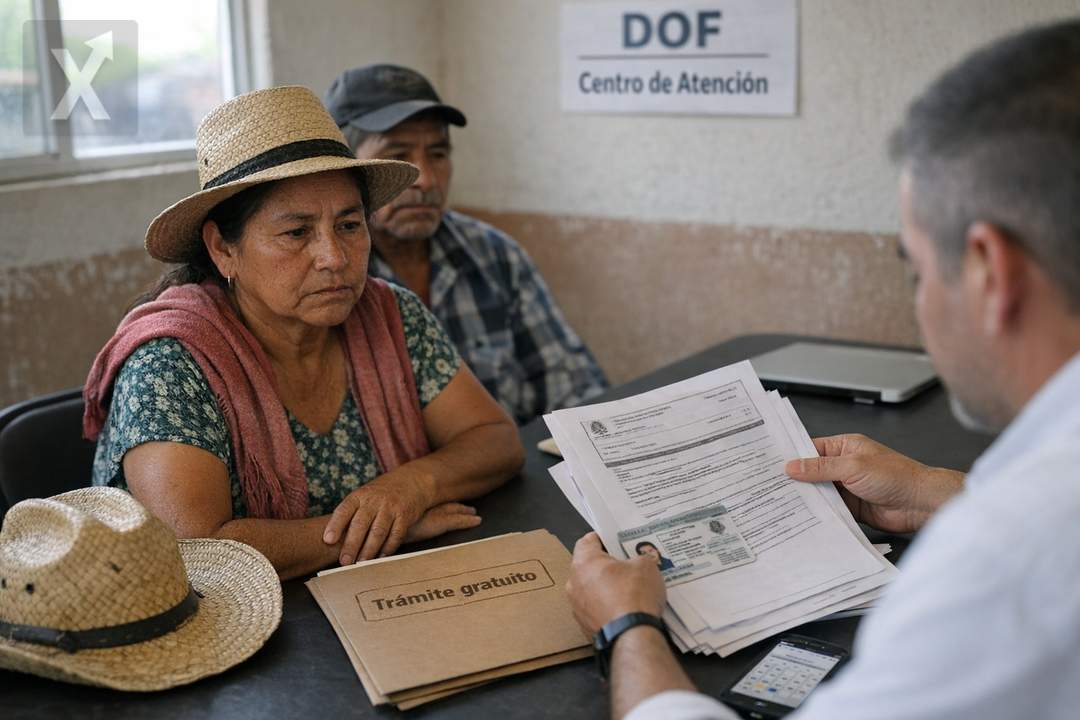
The federal government rolled out a framework to forgive or restructure debts left by the now-defunct FND, with a focus on small producers and rural women.
The federal government introduced the “Grow Again” program, a strategy to eliminate and restructure outstanding debts held by borrowers of the former National Development Finance Institution for Agriculture, Rural Development, Forestry, and Fisheries (FND), which entered liquidation in 2023. The measure aims to address virtually all borrowers who still carry balances, face court proceedings, and have pledged collateral tied up—an effort to close one of the most sensitive unresolved issues in public financing for Mexico’s rural sector.
According to what was presented during President Claudia Sheinbaum’s morning press conference, the plan will be administered by the Institute to Return Stolen Goods to the People (INDEP) and includes benefits for 59,967 individuals across 69,568 loans. The pool consists mainly of small producers and rural women producers—groups that tend to be more vulnerable to climate shocks, swings in agricultural prices, and rising input costs.
Authorities said that after the FND was dissolved, irregularities were identified in the management and collection of the loan portfolio: improper recovery practices, alleged extortion, collateral files that were incomplete or nonexistent, and a heavy concentration of lawsuits handled by outside law firms. In practice, this left thousands of borrowers in default while facing legal and asset-related costs that, for many, made the balance “unpayable” even if their productive activity continued.
The program’s design includes two tracks. The first is full debt forgiveness for small producers with loans below 28,068 UDIS (about 248,000 pesos) and for women producers with loans below 45,000 UDIS (about 398,000 pesos). In this segment, the government estimates it will support 41,060 customers and 42,897 loans.
The second track applies to loans above those thresholds and below 10 million pesos: borrowers will be offered a 30% discount on the book balance and the option to restructure the remaining 70% at an annual rate of 8.5%. This group would include 18,907 customers, including 1,639 cases involving women producers and 17,268 involving small producers.
Beyond financial relief, the program includes legal and administrative components: withdrawal of judicial actions, release of pledged or mortgaged collateral, and updates to borrowers’ status with the credit bureau. For those already in litigation, the plan anticipates signing court-approved settlement agreements to bring cases tied to the financing to a close.
The rules and guidelines will be published in the Official Gazette of the Federation (DOF), and as of that date, an official cutoff of balances will be used to determine eligibility. Borrowers will need to appear in person at one of the designated service centers with identification, their CURP (national ID number), and their loan number. Authorities stressed that the process will be individual and that no intermediaries will be involved. In principle, a small group—around 330 customers—with debts above 10 million pesos would be excluded.
Implications for Rural Credit and the Public Finance Agenda
In the context of the Mexican economy, the plan arrives at a time when financing for the countryside faces a twofold challenge: on one hand, the need for investment to boost productivity and resilience to droughts and extreme weather; on the other, higher borrowing costs after the high-rate cycle of recent years. By offering restructurings at a fixed 8.5% rate and clearing legal and collateral records, the government is trying to restore minimum conditions so that some of these producers can re-enter formal financing channels—although the program, on its own, does not amount to a comprehensive rural credit policy.
There is also a fiscal and governance angle: forgiving and restructuring the portfolio means recognizing losses and absorbing administrative and litigation costs, but it may reduce accumulated social and legal “pressure,” while also bringing order to records and procedures. Over the medium term, the main challenge will be avoiding the perception that the solution rewards nonpayment; therefore, the impact will depend on how eligibility criteria are implemented, how cases are verified, and how transparent the DOF guidelines are.
For rural women, the measure targets a common issue in directed credit programs: the use of beneficiaries as stand-ins (fronts), which distorts risk assessment and shifts legal and asset-related burdens onto people with less ability to defend themselves. Serving 13,400 women producers—nearly the entire registered universe—suggests an explicit attempt to correct reputational and social harm linked to the previous operation.
Looking ahead, the most economically significant effect will be whether the “clean slate” is paired with new channels for productive financing and technical assistance that reduce repeat delinquency. Without stronger origination and monitoring mechanisms, the relief could be temporary; with them, it could free up productive capacity and support regional economies where credit is essential for planting cycles, input purchases, and commercialization.
In short, “Grow Again” aims to close the FND chapter through forgiveness and restructurings that prioritize small producers and rural women, while defusing litigation and releasing collateral. Its reach is broad, but its long-term impact will depend on execution, the clarity of DOF rules, and the build-out of a new rural credit architecture with stronger controls.






