Finance Ministry steps up IEPS fuel tax relief for gasoline and diesel, aiming to curb the impact on prices
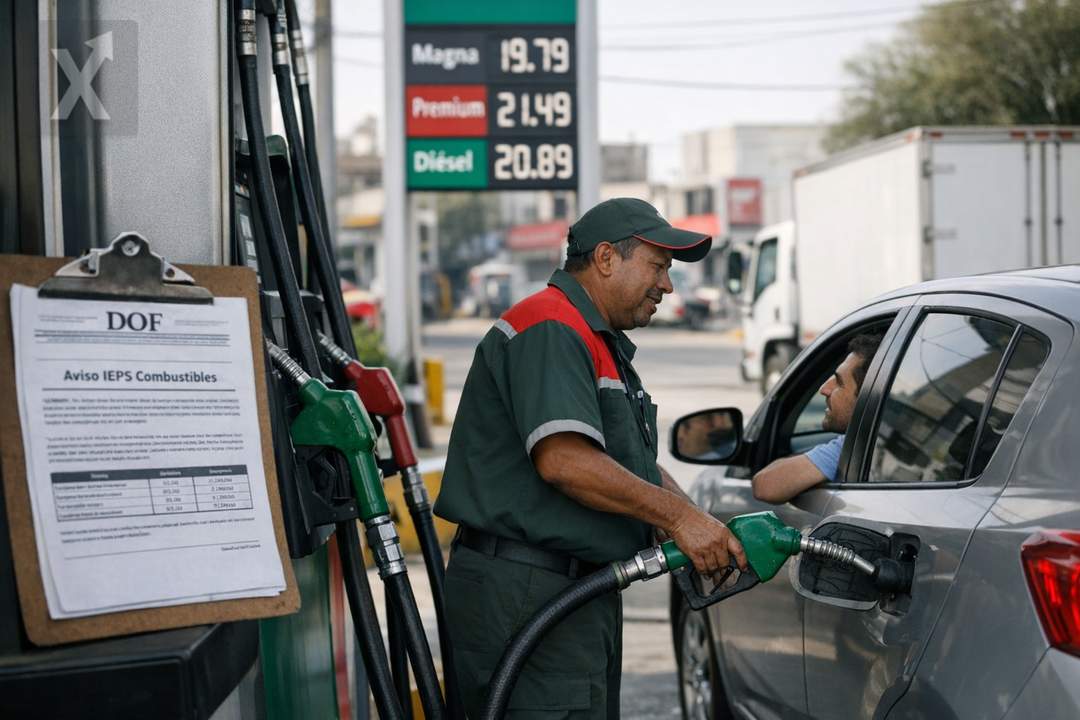
Fuel tax subsidies have risen for two straight weeks amid external pressures that are driving up energy costs and feeding into inflation.
Mexico’s Ministry of Finance and Public Credit (SHCP) increased, for the second consecutive week, the tax relief applied to the Special Tax on Production and Services (IEPS) for gasoline and diesel. The measure is intended to cushion the pass-through of international pressures to pump prices and, by extension, to transportation and distribution costs for goods across the country.
For the week of May 9–15, the subsidy for Magna gasoline was set at 3.29 pesos per liter, equivalent to 49.15% of the tax rate, leaving an effective IEPS charge of 3.41 pesos. For Premium gasoline, the discount will be 2.29 pesos (40.42%), resulting in an effective rate of 3.37 pesos per liter. For diesel, the subsidy will be 4.66 pesos (63.22%), bringing the amount to be paid to 2.71 pesos per liter.
The Finance Ministry publishes these subsidies every Friday in the Official Gazette of the Federation (DOF) and adjusts them based on international fuel price dynamics and U.S. benchmark market prices, since Mexico imports a significant share of the gasoline it consumes from the United States. During periods of heightened external volatility, the government typically uses the IEPS as a buffer to smooth sharp swings in the final consumer price.
The recent increase in support comes amid energy pressures driven by geopolitical factors and higher crude oil prices, which raise refining costs and the prices of petroleum products. In Mexico, where trucking is central to logistics, diesel prices often have direct implications for freight rates and supply chains.
Implications for inflation, consumption, and public finances
The most immediate effect of higher IEPS subsidies is to contain—at least partially—rising pump prices and reduce their contribution to inflation. This matters because fuels affect the non-core component directly and, indirectly, the prices of food, services, and goods through transportation costs. If energy pressures persist, the subsidy can help moderate inflation spikes, although its effectiveness depends on the size of the external shock, the exchange rate, and how quickly retail prices adjust.
However, there is also a fiscal cost: as the IEPS collected on fuels is reduced, fuel-related revenue declines in the short term. In highly volatile periods, policymakers must strike a balance between stabilizing prices and preserving revenue, especially when public spending competes with other priorities. In practice, the subsidy functions as a “cushion” that can be turned on or withdrawn as market conditions change, but its sustainability depends on how long elevated prices last.
In the coming weeks, subsidy levels will hinge on crude oil prices and U.S. wholesale gasoline prices, as well as the performance of the peso against the U.S. dollar, since most energy imports are traded in that currency. If global uncertainty persists, the Finance Ministry is likely to continue weekly adjustments to avoid abrupt moves in the final price, although room to maneuver could shrink if pressures become more persistent.
Overall, the higher subsidies confirm that the government is using fuel tax policy as a short-term stabilization tool in response to external shocks—with potential effects on inflation and logistics costs, but also implications for tax revenue. The path ahead will depend on how long energy prices remain elevated and on the balance between price containment and fiscal discipline.






