Oil Surges on Middle East Clash: The New Risk for Mexico’s Inflation, Exchange Rate, and Public Finances

The disruption in global crude supply threatens to keep energy prices high and put pressure on inflation and growth in Mexico.
The escalation of the conflict in the Middle East has translated into an unusually large oil disruption that has already surpassed—by the volume of barrels lost—the most memorable supply shocks of the 20th century. With a significant share of global energy trade under threat along critical routes, the market has stopped treating the episode as a temporary scare: the base case being discussed by investment banks and international organizations is higher prices for longer, even if geopolitical tensions ease.
In practical terms, the problem is not limited to the price per barrel. The disruption involves production, shipping, refining, and cargo insurance—physical components of supply. That nuance matters because when the shock is tangible—not just about expectations—normalization tends to be slow: damaged or idled infrastructure doesn’t return to full operation overnight, and companies also adjust their risk tolerance with a months-long lag.
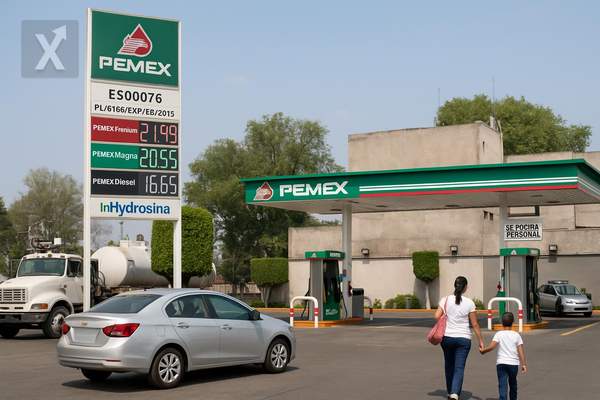
In this context, the global crude benchmark has swung with high volatility, but with a higher “floor” than in recent episodes. For Mexico, which imports a significant share of its gasoline and diesel and consumes natural gas that is mostly brought in from the United States, higher external energy costs tend to filter through multiple channels: inflation, logistics costs, and pressure on corporate margins, especially in manufacturing, transportation, and processed foods.
The potential impact also comes at a time when Mexico’s economy tends to move with the pace of the U.S. industrial cycle and where core inflation has been more persistent than non-core inflation. A prolonged energy shock complicates the disinflation path and forces a recalibration of consumption and investment expectations, even when the labor market remains relatively resilient.
Inflation and Banxico: Gasoline as a Shortcut to Higher Expectations
The pass-through from expensive oil to inflation in Mexico isn’t automatic, but it is recurring. Even with mechanisms designed to cushion swings in final fuel prices, higher crude prices often seep in through transportation, inputs, and services. In particular, when gasoline prices, freight costs, and part of industrial energy costs rise, the risk of “second-round” effects increases: businesses adjust price lists and households bake those increases into their perception of future inflation.
For the Bank of Mexico (Banxico), that environment raises the cost of easing monetary policy too soon. While monetary policy can’t produce oil or reopen shipping routes, it can prevent a supply shock from turning into a persistent expectations problem. In practice, a months-long stretch of elevated energy prices tends to translate into a more cautious central bank—especially if the peso loses some strength against the U.S. dollar amid a broader global risk-off mood.
Public Finances: More Oil Revenue, but Also Higher Fuel Costs
The fiscal effect is mixed. On the one hand, a higher crude price can lift gross oil revenues, but Mexico is not a net exporter of gasoline: it imports fuels and refined components in meaningful volumes. On the other hand, when international prices squeeze the domestic market, the government faces a dilemma: allow the full pass-through to consumers (with political and inflationary costs) or cushion it with fiscal or budget measures that can reduce tax intake or increase spending needs.
On top of that is the state-owned oil company’s sensitivity to changes in prices, operating costs, and its financial burden. A high-oil environment can provide short-term breathing room for some cash flows, but it doesn’t eliminate structural challenges: investment to sustain production, maintenance and efficiency in refining, and the cost of financing itself when global rates remain restrictive.
Exchange Rate and Activity: The External Channel Matters More if the Shock Drags On
During episodes of geopolitical tension, the U.S. dollar tends to strengthen its role as a safe-haven asset, which can trigger bouts of depreciation in emerging-market currencies even if local fundamentals haven’t changed right away. For Mexico, a weaker exchange rate makes imports more expensive and can amplify the inflationary impact of energy and goods—especially if it coincides with shifts in risk premia or weak external data.
On the real side of the economy, expensive energy acts like a global “tax” on consumption. If the shock trims growth in key trading partners—especially the United States—the hit to Mexico can show up in manufactured exports, industrial orders, and eventually investment. For businesses, the takeaway is twofold: higher costs and potentially weaker demand, although some segments tied to nearshoring may stick with plans if Mexico’s location advantage remains intact.
Overall, the oil disruption stemming from the Middle East conflict is shaping up as a meaningful macroeconomic risk for Mexico: it could delay inflation’s convergence, put pressure on the exchange rate, and complicate monetary and fiscal policy decisions. The deciding variable will be the duration of the shock and the extent to which the energy market restores flows and operational confidence—more than the day-to-day moves in the price.