U.S. ruling against Trump’s global tariff offers a legal breather, but keeps uncertainty alive for Mexico
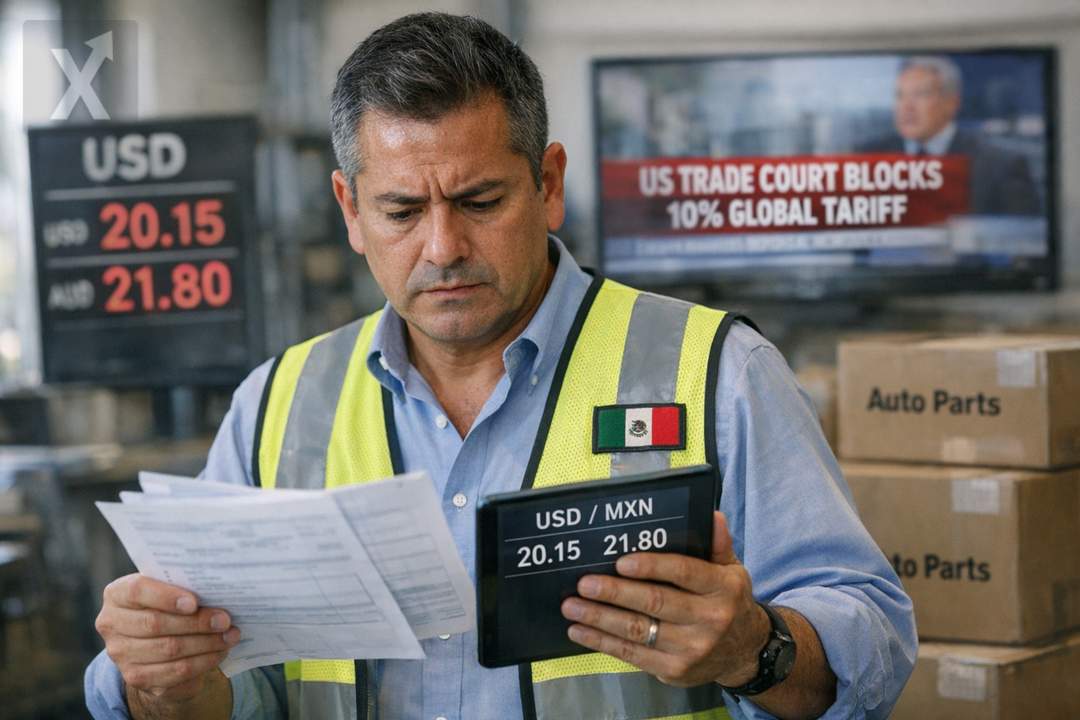
The decision curbs the 10% global tariff and reshapes trade risk for Mexican exporters, though pressure from sector-specific measures remains.
A U.S. trade court ruled against the 10% global tariff that Donald Trump’s administration temporarily imposed on imports, finding that its use was not justified under the 1970s-era law cited as the legal basis. While the decision’s immediate reach is limited to the plaintiffs, the legal precedent increases the likelihood that other companies will seek to challenge similar charges—at a time when trade with the United States remains the main channel through which external shocks ripple into Mexico’s economy.
For Mexico, the episode arrives at a sensitive moment: export strength—driven by automotive manufacturing, auto parts, electronics, and machinery—depends heavily on stable access to the U.S. market and clear rules under the USMCA. A “blanket” tariff like the one that was attempted can disrupt deeply integrated supply chains, even if a meaningful share of bilateral trade benefits from preferential tariff treatment, because it raises input costs, complicates transfer pricing, and increases uncertainty for long-term contracts.
The U.S. administration argued that the levy was meant to address balance-of-payments imbalances. However, the court ruling underscores the legal limits of the tools used and pressures the White House to pursue more durable mechanisms—either through Congress or via trade investigations—to advance its agenda. For Mexican companies exposed to exports, the message is mixed: the risk of an immediate across-the-board surcharge declines, but the possibility of targeted measures that are just as disruptive—or more so—remains.
In the short term, the ruling could also influence risk sentiment and volatility in the FX market. The Mexican peso tends to react not only to macro data, but also to trade headlines and the path of U.S. interest rates. Legal relief temporarily reduces the uncertainty premium, but the final outcome will depend on whether U.S. trade policy is steered toward new investigations, product-specific tariffs, or renegotiations that hit sectors that matter most to Mexico.
Implications for exports, investment, and Mexico’s exchange rate
The key economic takeaway for Mexico is that the trade front with the United States remains a first-order variable for investment and industrial planning. In recent years, nearshoring and supply-chain reshoring have fueled manufacturing projects in northern Mexico and the Bajío region, but these decisions hinge on regulatory certainty, logistics, and access to the U.S. market. If a global tariff becomes less viable, some of the pressure shifts to sector-specific measures—for example, in industries where Washington alleges excess capacity, labor-compliance issues, or origin risks—which can translate into tighter regional-content reviews, audits, and higher compliance costs.
From a financial perspective, bouts of trade tension often show up in more expensive FX hedging and greater peso sensitivity to news out of Washington. For Banco de México, whose primary mandate is inflation control, these shocks matter because they can move the exchange rate and, in turn, affect the price path of imported goods and industrial inputs. In an environment where inflation has been easing from recent peaks but remains exposed to risks (energy, food, and logistical disruptions), the trade component adds another reason for caution.
There is also a fiscal and competitiveness angle: if the U.S. approach shifts toward selective tariffs, Mexico could face pressure to accelerate improvements in customs, traceability, and rules-of-origin verification to avoid losing advantages under the USMCA. Companies’ ability to respond—by diversifying markets, redesigning supplier networks, and strengthening compliance—can cushion the blow, but it does not eliminate the risk of stoppages or delays if border scrutiny intensifies.
Looking ahead to the coming months, the court ruling provides partial relief from the prospect of a universal tariff, but it does not clear the picture. U.S. trade strategy appears to be moving toward more specific—and more litigable—tools, which will keep Mexico watching regulatory signals and potential sector-by-sector investigations closely. In short, an immediate risk has eased, but the underlying uncertainty remains and will continue to influence exports, investment, and the FX market.






