Treasury boosts IEPS fuel tax relief amid pressure on gasoline and diesel prices
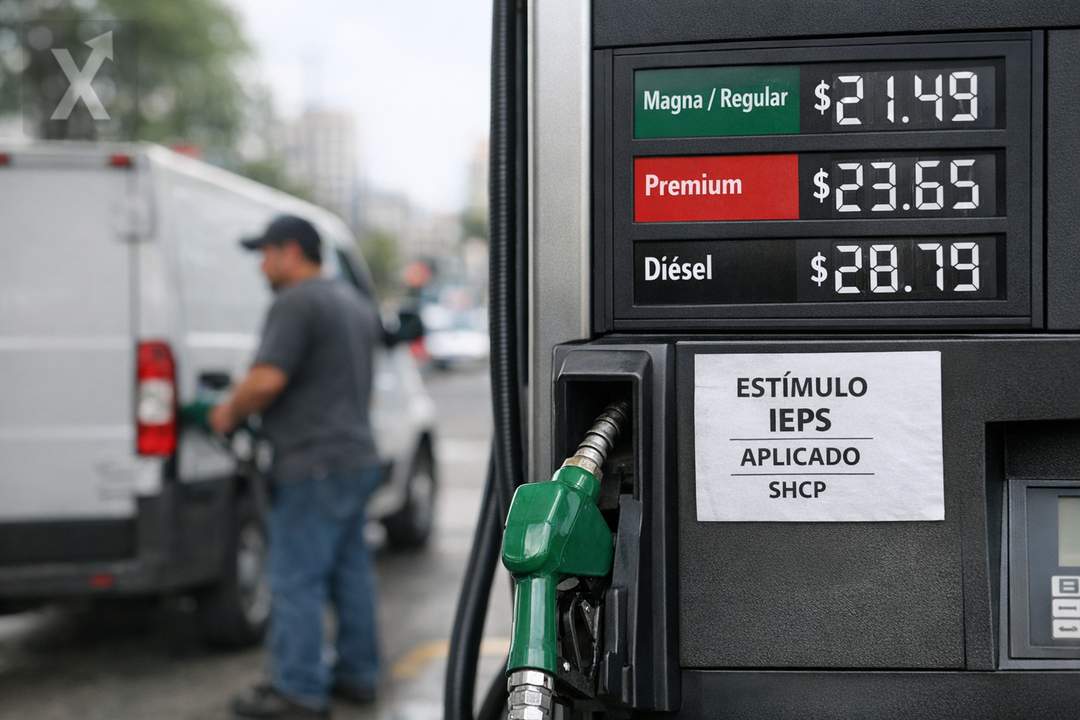
A larger diesel subsidy and weekly IEPS adjustments aim to curb the inflation hit, but they raise the fiscal cost and don’t eliminate volatility.
Mexico’s Ministry of Finance and Public Credit (SHCP) once again increased the relief applied to the Special Tax on Production and Services (IEPS) on fuels for the week of April 4–10, amid heightened volatility in international energy prices and persistent pressure on the domestic market. The measure, published in the Official Gazette of the Federation (DOF), is part of the mechanism the government uses to cushion sharp increases in prices paid by consumers, particularly when external conditions push up import benchmarks.
For diesel—a key fuel for freight transport and therefore highly sensitive within the broader price chain—Treasury set the relief at 81.20%, equivalent to 5.97 pesos per liter. As a result, the tax amount consumers actually pay is 1.38 pesos per liter. For regular gasoline, the relief was set at 31.34% (2.09 pesos), while for premium it was 18.48% (1.04 pesos), reducing the IEPS burden to 4.60 and 4.61 pesos per liter, respectively.
Still, the fiscal adjustment has not been enough to reverse the upward trend in prices. Market data show regular gasoline at around 23.70 pesos per liter, premium near 28 pesos, and diesel close to 28.79 pesos, despite the support measures and stabilization efforts through price agreements. The uptick aligns with a more adverse international backdrop for energy products, which has raised input costs and increased uncertainty about the near-term price path.
In Mexico, fuel price sensitivity depends not only on crude oil prices, but also on international benchmark prices for gasoline and diesel, the exchange rate, logistics costs, and marketing margins. Heavy reliance on fuel imports—especially from the United States—often amplifies external moves: when benchmarks rise, the pass-through to consumers can be swift if it isn’t offset with tax relief.
The federal administration also maintains agreements with fuel retailers to cap the price of regular gasoline, with a ceiling that has been renewed on several occasions. While the arrangement is voluntary and not applied uniformly nationwide, authorities and market participants have pointed to broad participation. Even so, exceptions remain in regions where distribution costs are higher—particularly in the southeast—making it harder to sustain uniform prices without affecting the profitability of stations and carriers.
The fiscal cost and the inflation challenge: the other side of the subsidy
The IEPS relief works as a shock absorber: it reduces the immediate impact of international price increases and helps prevent the energy shock from translating into a faster rise in inflation. This is especially relevant because energy affects inflation both directly (through household spending) and indirectly (through transportation and production costs). In a country where goods movement depends heavily on trucking, diesel is a strategic input, and higher diesel prices tend to filter into food and consumer goods.
However, heavy use of relief measures also carries a fiscal cost: by reducing or eliminating IEPS revenue, the government forgoes income that in other contexts is used to fund public spending. When support is extended, pressure grows to offset it through other revenue sources, spending cuts, or higher borrowing—potentially limiting budget flexibility. In practice, the dilemma is balancing price stability with healthy public finances, particularly if a high interest-rate environment raises the government’s financing costs.
At the same time, the role of the Bank of Mexico (Banxico) becomes more complex: if energy prices push inflation higher, the risk increases that inflation expectations will deteriorate. While monetary policy cannot control international fuel prices, it does aim to prevent “second-round effects”—when the initial price increase spills over into broader prices and wages. For that reason, the trajectory of fuel prices remains a key focus for analysts and for calibrating the inflation fight.
Looking ahead to the coming months, market performance will depend on external factors—such as geopolitical stability, global refined-product supply, and exchange-rate behavior—as well as domestic factors such as the effectiveness of caps, regional logistics, and competition among service stations. If international volatility persists, Treasury is likely to keep weekly IEPS adjustments as its main tool to smooth consumer price changes.
Overall, the increase in relief reflects an effort to contain inflationary pressure in an input that cuts across the entire economy, while also highlighting the fiscal cost of prolonged subsidies and the challenge of stabilizing prices in a market shaped by international benchmarks and regional logistics disparities.