Mexico seeks to shore up its network of trade deals: the EU modernization runs up against USMCA uncertainty
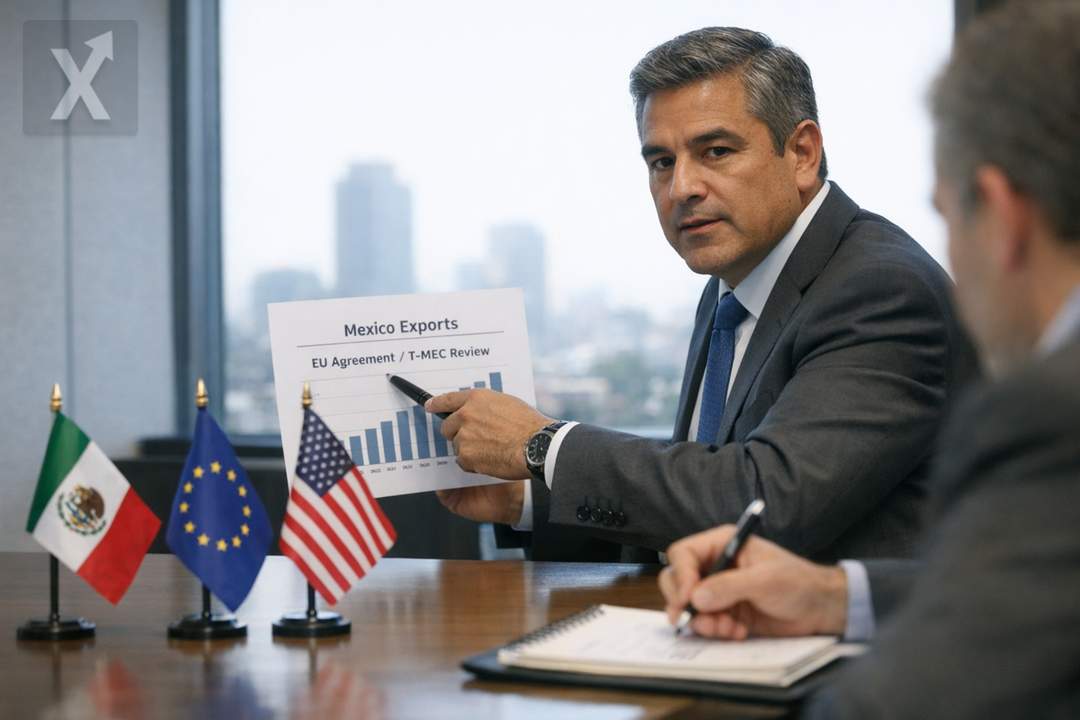
Updating the agreement with the EU could boost trade and investment, but its impact hinges on the certainty Mexico can secure under the USMCA.
The modernization of the Free Trade Agreement between Mexico and the European Union (TLCUEM) is shaping up to be one of the most consequential moves to diversify exports and attract European capital in a more fragmented global environment. However, business leaders and analysts warn that the real “floor” of confidence for new investment in Mexico remains tied to the stability of the Agreement between Mexico, the United States, and Canada (USMCA), which is currently under review and exposed to a more uncertain political climate in North America.
The Mexican Institute of Finance Executives (IMEF) has stressed that a modernized TLCUEM can energize key sectors, but it does not replace the role of the U.S. market as the main destination for Mexican exports, nor the USMCA’s function as the umbrella for rules of origin, preferential access, and legal certainty for integrated supply chains. For many industries—especially automotive, auto parts, electronics, and medical devices—investment decisions are made on 10- to 15-year horizons, a timeline that is hard to justify if trade rules are seen as volatile.
At the same time, Mexico–EU negotiations aim to update an agreement in force since 2000 to incorporate issues that were not on the table back then: digital trade, data protection, sustainability provisions, investment, services, and broader access to government procurement. In practice, the European and Mexican goal is to reduce regulatory friction and expand sector coverage at a time when global trade is being reshaped by geopolitical tensions, industrial policy, and new non-tariff barriers.
The federal government is betting that a more modern network of trade deals will strengthen Mexico’s position as an export platform and a nearshoring destination. But the private sector’s assessment is more cautious: without a clear outcome on the USMCA, modernizing the agreement with the European Union may translate into gradual gains rather than the investment leap often anticipated in public rhetoric.
Automotive: the barometer of trade certainty
The automotive industry has become a sensitive indicator of the health of trade agreements. Business leaders have warned that if the USMCA changes or is interpreted more strictly, some automakers could face tariff costs that completely upend the logic of producing in Mexico to sell into the United States. In that context, the risk is not only losing new investment, but also seeing existing projects “paused” or resized while the framework for access to the North American market is clarified.
Concerns are growing because Mexico competes head-to-head with other locations for industrial capital—and not just on labor costs. It competes on regulatory certainty, infrastructure, available energy, and stable trade rules. With deep production integration with the United States, any sign of tighter trade policy or a prolonged dispute raises risk premiums and affects decisions on sourcing, line expansions, and model allocation. For automakers and suppliers, Mexico’s appeal is closely tied to the continuity of tariff preferences and compliance with rules of origin; if that “anchor” weakens, investment may shift to countries with clearer access or toward domestic production in the destination market itself.
Beyond the automotive sector, the same dilemma shows up in other export industries: modernizing ties with the European Union makes trade easier and opens opportunities in services and the digital economy, but it cannot offset the size of the U.S. market or the speed of regional logistics. Today, more than 80% of Mexican exports go to the United States, making the USMCA a critical component of manufacturing growth and the stability of formal employment in industrial states across the Bajío region, the north, and central Mexico.
In addition to the trade agenda, domestic conditions matter: companies weigh security, regulatory compliance, legal certainty, water availability, and the reliability of the power supply. In Mexico, the nearshoring conversation has collided with infrastructure bottlenecks, challenges in electricity transmission, and long industrial grid-connection timelines—factors that can limit the follow-through on investment announcements even with a modern agreement with Europe.
On the macroeconomic front, Mexico has maintained relative stability in inflation and a well-capitalized financial system, but it faces the challenge of sustaining growth with sufficient investment. In that context, the definition of trade rules—and how long they effectively last—acts as either a catalyst or a brake: when the horizon is clear, projects accelerate; when it gets cloudy, caution takes precedence and resources are reallocated to geographies with less uncertainty.
In short, modernizing the TLCUEM can expand opportunities and update the rules for today’s economy, but its impact will depend on Mexico’s ability to dispel doubts around the USMCA and strengthen domestic conditions for investment. The most powerful signal for productive capital is not a single treaty, but the combination of stable market access, legal certainty, and the operational capacity to produce and export competitively.






