Finance Ministry Keeps Diesel IEPS Subsidy Above 60% and Tweaks Support for Regular and Premium Gasoline
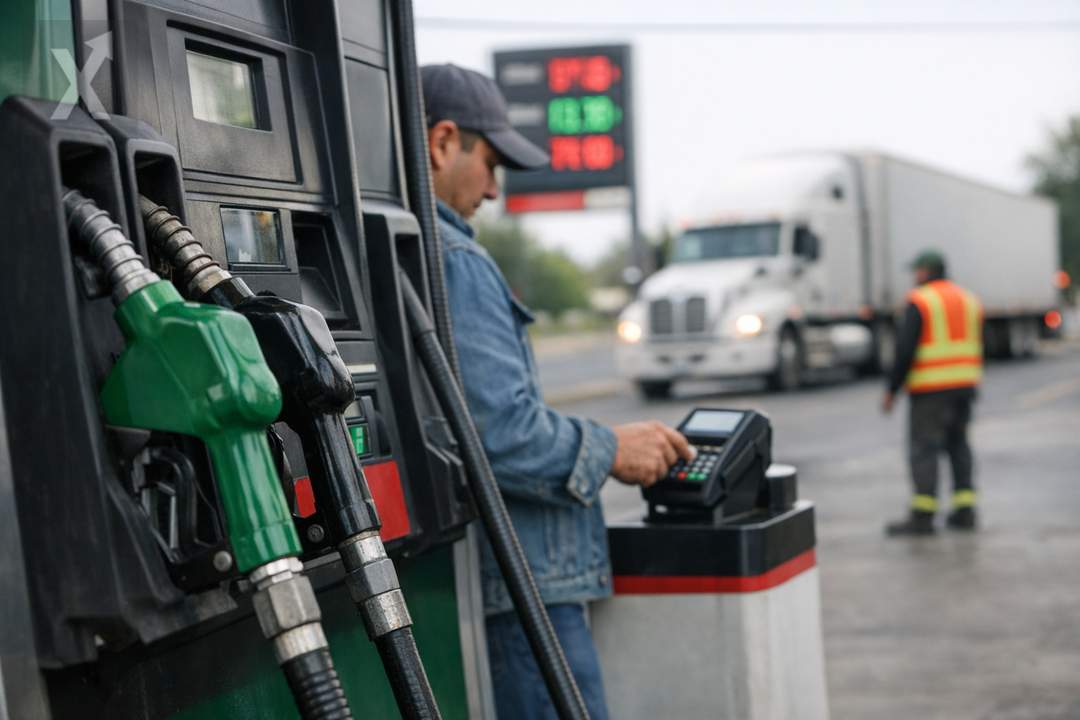
The government is keeping diesel subsidies high to contain logistics costs, while recalibrating tax relief for gasoline amid energy market volatility.
Mexico’s Ministry of Finance and Public Credit (SHCP) will keep, for a third straight week, a fiscal subsidy above 60% on the Special Tax on Production and Services (IEPS) applied to diesel, while slightly increasing support for Regular (Magna) and Premium gasoline for the May 16–22 period.
According to the percentages published for that week, diesel will receive a 62.92% discount on the IEPS rate, equivalent to 4.63 pesos per liter. That leaves an effective IEPS charge passed on to consumers in the final price of 2.73 pesos per liter. Meanwhile, the subsidy for Regular (Magna) gasoline inched up from 49.15% to 49.46% (from 3.29 to 3.31 pesos per liter), so its effective IEPS charge will be 3.39 pesos per liter. For Premium gasoline, the subsidy will stand at 41.07% (2.32 pesos), leaving a charge of 3.33 pesos per liter.
These subsidies act as a shock absorber during periods of rising international energy prices and their derivatives. In Mexico, the IEPS framework allows the Finance Ministry to temporarily reduce the tax burden per liter—without permanently changing the tax—helping smooth sudden increases in pump prices, particularly at service stations where inflation is felt immediately.
In diesel’s case, the emphasis is deliberate: it is the most widely used fuel for overland freight transportation and a significant share of mass transit, so higher diesel prices tend to feed quickly into distribution costs and, ultimately, into the prices of food, consumer goods, and services. That’s why the diesel subsidy level is often read as a policy signal aimed at containing short-term inflation pressures.
The adjustment comes as Mexico’s economy continues to show uneven performance: on one hand, consumer spending and some service segments have proved resilient; on the other, industry and investment have tended to feel the effects of global uncertainty and a cooling cycle in North America. In that landscape, price stability—and managing energy shocks—remains a key component of supporting purchasing power and domestic demand.
Implications for Inflation, Transportation, and Public Finances
Keeping diesel subsidies high can help contain logistics costs and reduce the likelihood of “second-round” effects on inflation, especially for goods that are highly sensitive to freight rates. However, the mechanism also has fiscal implications: by lowering the effective IEPS collected, the government temporarily forgoes a share of tax revenue that, under normal conditions, supports the public balance. During oil-price volatility, fiscal space depends on a combination of factors such as the path of international prices, the exchange rate, non-oil tax collection performance, and debt service costs. For analysts, the central question is usually not whether subsidies are activated, but how long—and how aggressively—they can be sustained without crowding out other budget priorities.
Looking ahead, fuel prices in Mexico will remain tied to external variables—crude and refined product prices, geopolitical disruptions, and import costs—as well as domestic conditions, such as competitive dynamics in the gas-station market and supply logistics. In that environment, IEPS subsidies will continue to serve as a fine-tuning tool: useful for stabilizing prices in the short term, but with an opportunity cost that becomes more visible if energy volatility drags on.
In short, the Finance Ministry is prioritizing cushioning the impact of higher diesel prices given diesel’s role in the transportation chain, while recalibrating support for Regular (Magna) and Premium gasoline; the challenge will be balancing price control with the sustainability of public revenues.






