The European Union doubles down on Mexico with a summit to unlock trade and investment
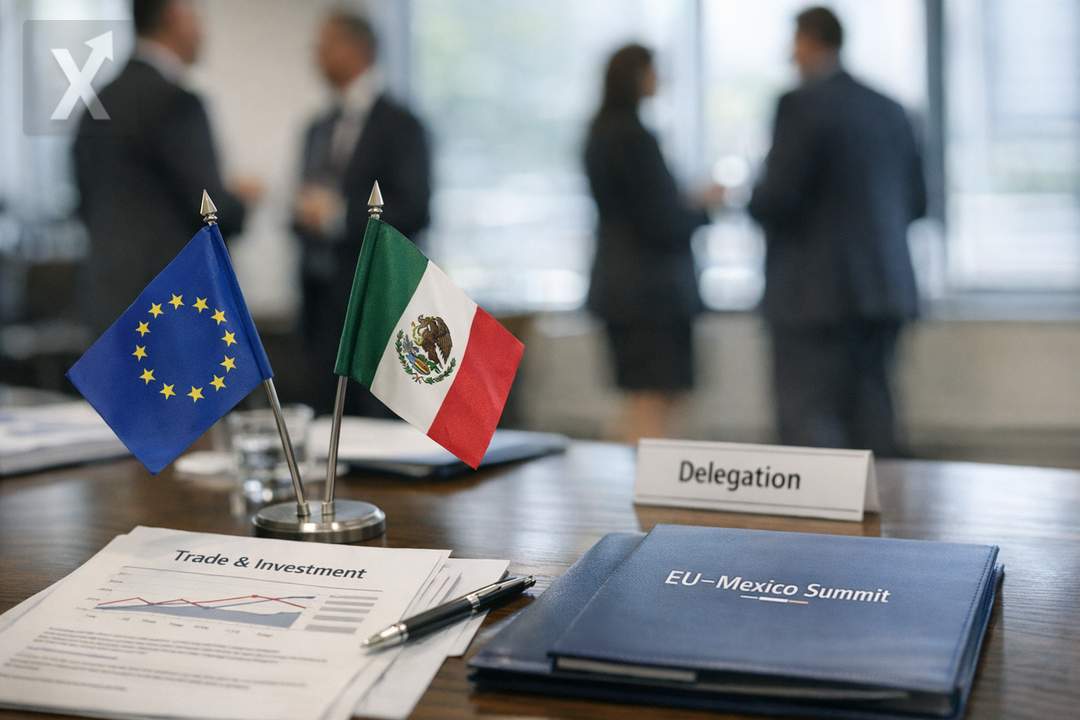
EU leaders’ visit to Mexico aims to wrap up outstanding items in the modernized agreement and speed up investment flows amid a push to diversify trade.
The European Union’s (EU) top leaders are expected to travel to Mexico next week to lead a high-level summit aimed at removing remaining barriers to trade and investment, at a time when both the European bloc and the Mexican government are reshuffling their external priorities in response to a more protectionist and volatile global environment.
The agenda includes European Council President António Costa and European Commission President Ursula von der Leyen, who will meet with President Claudia Sheinbaum. At the center of the meeting is the signing of the modernized trade agreement between Mexico and the EU—an update process intended to broaden coverage and reduce regulatory hurdles in sensitive areas such as services, government procurement, technical rules, agribusiness, and access to strategic inputs.
The reboot of the relationship comes a decade after the last EU–Mexico summit and takes place as Mexico holds complex talks with the United States (U.S.) and Canada over the future of the trilateral framework governing regional integration. For Mexico, strengthening the European front is also a diversification signal: while the Mexican economy is benefiting from nearshoring into North America, its exposure to regulatory and trade shocks from its main partner has grown in the same proportion.
In terms of scale, the EU remains one of Mexico’s most important partners in trade and investment. Beyond goods trade—where manufactured products, transport equipment, chemicals, and food stand out—European foreign direct investment has been key in sectors such as automotive and auto parts, pharmaceuticals, energy (especially renewables), logistics, and financial services. For Mexico, locking in a more certain framework with the bloc could also support the attraction of long-term projects, particularly along industrial corridors in the Bajío region, the north, and the southeast.
In practice, the modernized deal seeks to bring standards closer together and streamline procedures. For Mexican companies, that could mean lower compliance costs for exports—especially for agri-food products, beverages, industrial inputs, and certain intermediate goods—and greater predictability in rules of origin and certifications. For European firms, the goal is to reduce friction in operating, investing, and joining supply chains, with Mexico serving as an export platform, especially to North America.
Implications for Mexico’s economy: diversification, investment, and pressure to compete
The summit comes as Mexico faces domestic challenges that directly affect its ability to capitalize on agreements: logistics costs, energy availability, security along productive corridors, and a regulatory environment that companies typically scrutinize closely before committing capital. If the modernized agreement translates into more European investment, the potential impact would be twofold: on one hand, it would strengthen the export base and technology transfer; on the other, it would raise competition in sectors where Mexican productivity remains uneven, potentially pushing local suppliers to improve standards, traceability, and compliance.
On the macroeconomic front, Mexico arrives at this moment with a relatively resilient currency and a strong export engine, but with growth that depends on investment and the trajectory of external demand. In that context, expanding market access and diversifying risks matters: deeper integration with the EU would help mitigate Mexico’s trade concentration with the U.S. and reduce vulnerabilities to global supply-chain disruptions, including those linked to Asia and China.
There is also a geopolitical and industrial policy component. The EU has stepped up its strategy to secure critical raw materials and components, while Mexico is looking to move up the value chain and attract advanced manufacturing. That opens opportunities in e-mobility, semiconductors, medical devices, and the circular economy—but it requires public-private coordination, infrastructure, and clear rules to trigger investment at scale.
Beyond trade, the agenda includes climate cooperation and efforts to combat organized crime. In economic terms, both issues affect country risk: environmental targets influence financing, market access, and consumer preference; and security shapes logistics, insurance costs, operational continuity, and ultimately plant-location decisions.
Looking ahead, signing the modernized agreement could be a meaningful step toward expanding Mexico’s room to maneuver on trade, but its reach will depend on implementation. Process harmonization, institutional capacity, and investment certainty will be decisive in ensuring that the relationship with the EU translates into more productive projects, higher value-added exports, and formal employment.
In short, the EU–Mexico summit aims to clear outstanding hurdles that could facilitate trade and investment while also underscoring Mexico’s need to strengthen domestic conditions—such as infrastructure, energy, security, and regulation—to fully capture the benefits of diversification.






