Banxico Bets on 2026 World Cup Coins: Limited Circulation and Collectibles Tied to Gold and Silver Prices
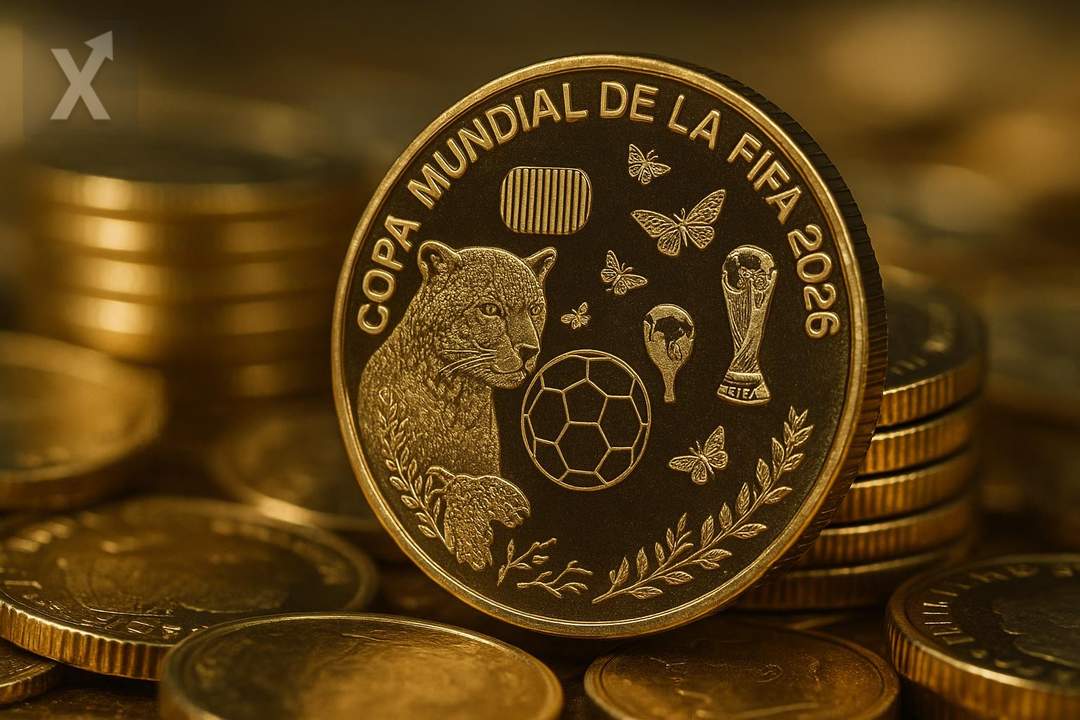
The release mixes everyday-use coins with precious-metal pieces, amid strong demand for collectibles and volatile input costs.
The Bank of Mexico (Banxico) announced the issuance of 12 commemorative coins for the 2026 FIFA World Cup—an launch that combines cultural goals with a clear economic angle: only four coins will be designed to circulate in everyday transactions, while eight will be offered as collectible pieces minted in precious metals.
According to information released by the central bank, the four everyday-use coins will be bimetallic 20-peso coins, dodecagonal in shape, with security features such as microtext and a latent image. They will initially be available at Banxico service windows with limits per design, and later at bank branches. The other eight coins—four in gold and four in silver—will be sold as commemoratives: while they will carry a symbolic face value, their final price will depend on international metals prices.
The visual narrative focuses on Mexico’s host cities for the tournament (Mexico City, Guadalajara, and Monterrey) and on national symbols. In practical terms, the announcement highlights a key distinction for the public: the 20-peso coins can be used as cash in the normal flow of transactions, while the precious-metal pieces are aimed at the collectibles market and at saving via physical assets.
The Mexican Mint (Casa de Moneda de México) will strike the coins, and the legal framework is supported by provisions published in the Official Gazette of the Federation (DOF), as well as legislative decisions that defined ownership rights over the designs and minting. For Banxico, the historical precedent—issues released during the 1986 World Cup—serves as a benchmark for potential demand in a country where numismatic collecting coexists with a strong preference for cash among certain segments of the population.
Precious metals, final pricing, and the economic angle of collecting
The most direct economic component of the collection lies in the gold and silver coins: their denominations (25 pesos for gold and 10 pesos for silver) do not reflect their sale price. In practice, the price moves with the international gold and silver markets, while also factoring in minting and distribution costs and commercial margins. In a global environment where precious metals often serve as a safe haven during periods of financial uncertainty, these releases tend to attract both collectors and buyers seeking exposure to physical metals in high-demand formats.
For Mexico’s market, this can translate into two effects: first, a burst of demand that tightens inventories and fuels reselling—especially if distribution is limited; second, greater visibility for saving in metals as a complementary alternative to traditional financial instruments. However, it also carries risks for consumers: the numismatic premium can widen on the resale market and may not be recovered, and the “safe-haven” value depends on the metal’s trajectory, the exchange rate, and liquidity in the secondary market.
For the bimetallic 20-peso coins, the economic impact is more indirect. These pieces join a family of commemorative coins that, while legal tender, often get pulled out of everyday circulation because people hold onto them. When that happens, the public benefit is primarily cultural and educational, but it has cash-operations implications: if a meaningful share is “hoarded,” the system has to make up the difference with additional coins to keep enough change available—especially for businesses that still rely on cash for small transactions.
The release also comes as Mexico prepares for the 2026 World Cup’s economic impact on tourism, services, and local consumption, particularly in the host cities. While issuing coins does not by itself move variables like growth or inflation, it does capitalize on the news cycle and can energize niches such as the numismatic trade, sales of storage supplies (capsules, cases), and the activity of specialized dealers.
Looking ahead, the collectibles’ commercial performance will depend on the balance among mintages, sales channels, and clear consumer information. If distribution is orderly and transparent, the collection could solidify as a high-visibility cultural-financial product; if scarcity is poorly managed, the secondary market could drive prices up quickly and concentrate access.
In short, Banxico’s 2026 World Cup issue combines pocket-ready coins with collector-focused pieces, with an economic component anchored to gold and silver prices and to supply-and-demand dynamics in the secondary market—while Mexico gears up for an event also expected to boost activity in tourism and services.






