Kevin Warsh Takes the Helm at the Fed: Signals for the Dollar and Potential Effects on Mexico’s Economy
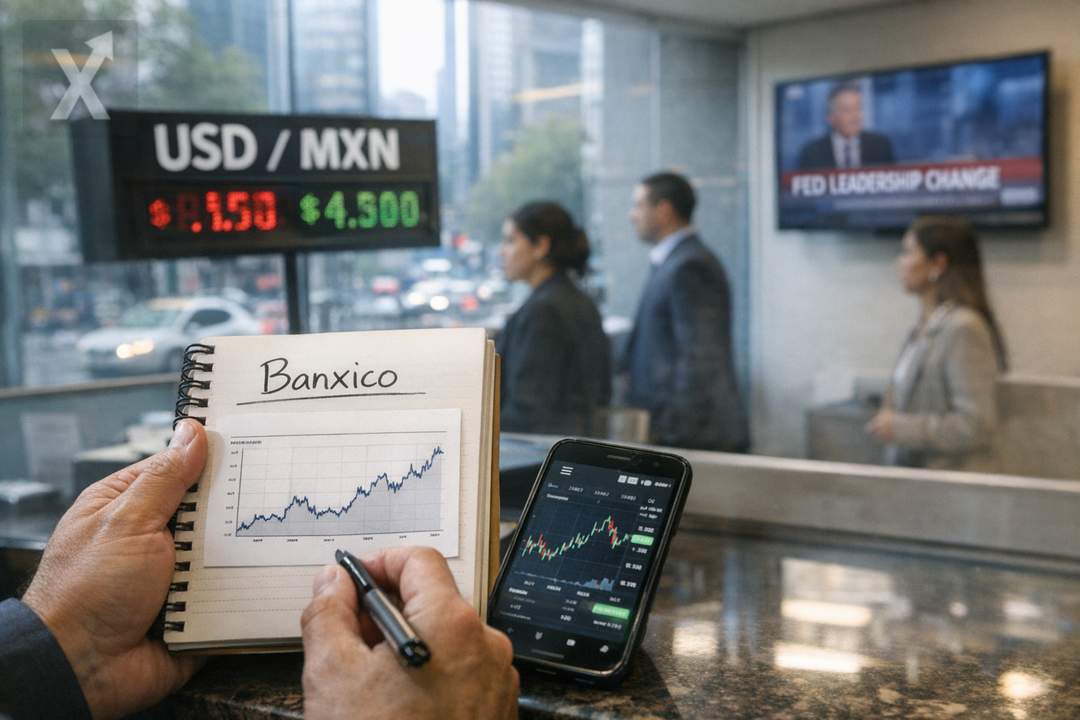
The leadership change at the Federal Reserve is renewing attention on U.S. interest rates and their impact on Mexico’s exchange rate and financing conditions.
The U.S. Senate confirmed Kevin Warsh’s appointment as Chair of the Federal Reserve (Fed) for a four-year term, at a time when inflation in the U.S. economy remains elevated and the debate over the central bank’s independence has returned to the center of public discussion. Warsh has expressed affinity for a lower interest-rate stance, a view that aligns with the U.S. executive branch’s preference for cheaper borrowing costs.
For Mexico, the Fed leadership change is more than a Washington matter: it is a factor that can influence the behavior of the U.S. dollar and the cost of global financing—two variables that often move immediately in response to signals about the direction of U.S. monetary policy. Given the deep trade and financial integration between the two countries, Mexico’s market typically adjusts expectations for the exchange rate, capital flows, and credit conditions based on how it reads the Fed.
In the short term, if markets interpret the Fed as more inclined to cut rates, portfolios could rotate toward assets with relatively higher yields, which in certain scenarios has supported emerging-market currencies. However, that channel is not linear: if perceptions of Fed independence weaken or if U.S. inflation expectations pick up, the outcome may be greater volatility and bouts of risk-off sentiment, putting pressure on currencies like the Mexican peso.
In Mexico, attention also focuses on the interest-rate differential between Banxico and the Fed, a key factor behind part of the appeal of peso-denominated instruments. With local inflation showing disinflation trends over time but still sensitive to shocks in food, energy, and the exchange rate, Mexico’s central bank typically seeks to balance price control with avoiding financial conditions that are overly restrictive for economic activity.
Exchange Rate, Rate Differentials, and Banxico’s Response
The most visible channel for the public is the exchange rate. Shifts in expectations for the Fed’s policy rate tend to be reflected in the U.S. dollar and, by extension, in the dollar–peso exchange rate. If the path in the U.S. points to lower rates, Mexico could retain some of the appeal of its rate differential, but the effect will depend on perceptions of global risk, the fiscal outlook, and the strength of growth. Banxico, for its part, often emphasizes that its decisions depend on the domestic inflation outlook; even so, the external backdrop matters: a stronger dollar makes imports more expensive and can feed into prices, while a weaker dollar can create room for gradual easing if the disinflation process becomes firmly established.
On the financing side, the U.S. benchmark rate influences the cost of corporate and sovereign debt in international markets. A lower-rate environment in the U.S. typically reduces dollar funding costs for issuers with strong credit profiles, although risk premiums can widen if institutional or inflation uncertainty grows. For Mexican companies with U.S.-dollar liabilities, the balance between the base rate and the risk premium will be decisive for their total cost.
There are also implications for trade. A U.S. economy with high inflation and uncertain monetary adjustments can cool consumption or shift demand, affecting Mexican exports—particularly manufactures integrated into regional supply chains. At the same time, the relocation of investment toward North America has been a structural theme for Mexico; international financial stability and access to capital at reasonable costs are important pieces for industrial projects to move forward more quickly.
Looking ahead, the market will closely watch Warsh’s initial messages: his assessment of inflation, employment, and the balance between growth and price stability. For Mexico, the key issue will be whether the Fed can anchor expectations without fueling doubts about its independence, since that factor often determines the magnitude of moves in the dollar and the financial volatility that ultimately spills over into emerging economies.
In sum, the Fed appointment reshapes expectations and can move the U.S. dollar, with indirect effects on Mexico’s exchange rate, borrowing costs, and the pace of economic activity; the final outcome will depend on the credibility of the U.S. central bank and Banxico’s response to inflation and the external environment.






