Treasury Looks to Reverse S&P’s Negative Outlook With Fiscal Tightening and Debt Mostly Denominated in Pesos
Mexico’s Finance Ministry is betting that a smaller deficit and a mostly domestic funding profile will ease S&P’s concerns about the debt path.
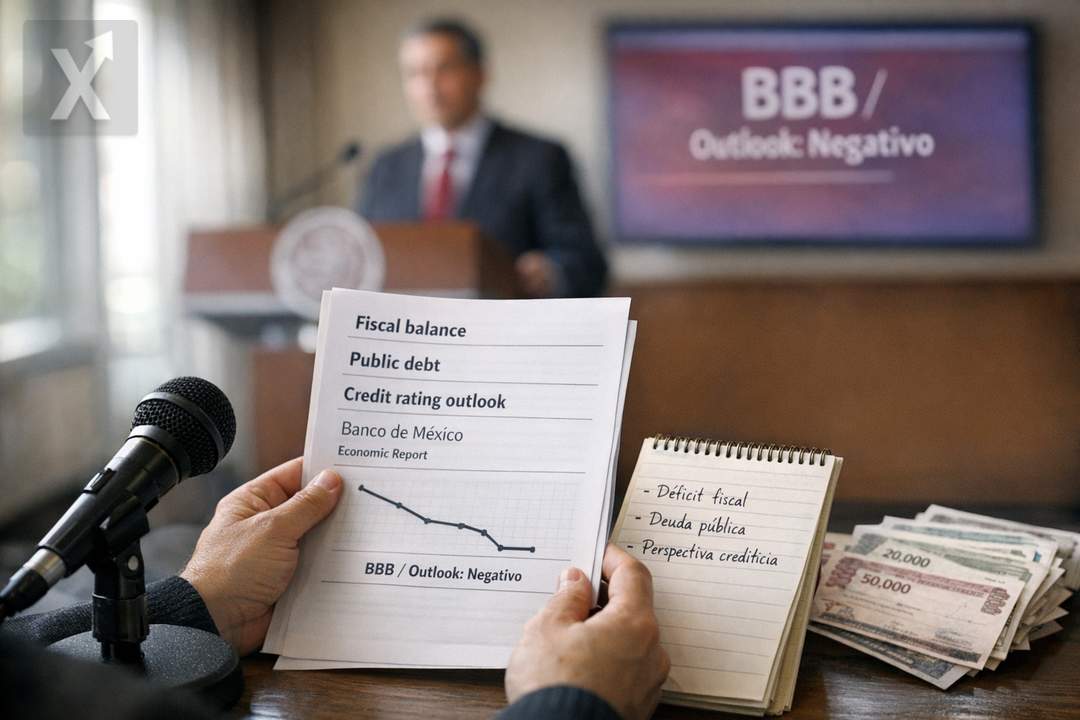
Mexico’s Ministry of Finance and Public Credit (SHCP) said the measures it has implemented to put public finances in order—particularly its management of the deficit, debt, and financing strategy—should be enough to persuade S&P Global Ratings to reverse its outlook change on Mexico’s sovereign rating from stable to negative, even though the rating itself remained at BBB.
In public remarks, Finance Minister Édgar Amador Zamora stressed that the government is seeking to reinforce its message of commitment to long-term fiscal sustainability to investors, analysts, and international organizations. The official narrative points to the consolidation seen recently: the deficit fell from 5.8% of GDP to 4.3% of GDP in one year, a 1.5-percentage-point adjustment that, given its size, is unusual even among emerging-market economies.
S&P justified the negative outlook by citing a combination of slow economic growth, budget constraints, and the possibility that contingent liabilities could materialize—factors that, in the agency’s view, could translate into gradual fiscal consolidation and a moderate increase in debt. The assessment also reflected uncertainty tied to renegotiating the free trade agreement with the country’s main trading partner—an element that can weigh on confidence and investment at the margin, even when bilateral trade remains robust.
For the Finance Ministry, the key is the composition of financing: the public sector relies mostly on domestic sources, with a base of local and institutional investors and issuance in the local currency, while external financing plays a supporting role. During bouts of global volatility, this feature typically mitigates refinancing and FX-exposure risks, though it does not eliminate the impact that higher rates and weaker risk appetite can have on borrowing costs.
Dependence on macroeconomic performance, however, remains at the center of the credit debate. In recent years Mexico has faced low trend growth, with uneven gains across sectors: export-oriented manufacturing has shown resilience, but private investment momentum depends on regulatory certainty, financing costs, and external-demand prospects. At the same time, spending pressure persists due to infrastructure needs, social programs, and the cost of debt in an environment where rates are still relatively high.
Debt, Revised GDP, and What Ratings Agencies Are Watching
One point the Finance Ministry highlighted is the statistical effect stemming from INEGI’s GDP base-year revision, which adjusted historical series and altered metrics such as the debt-to-GDP ratio. According to SHCP, between 2025 and 2026 there was a meaningful change in that indicator, of which roughly 1.5 percentage points are explained by the statistical revision. On that basis, the ministry expects to end 2026 with debt around 54.2% of GDP, a level it views as competitive relative to peer economies and below the OECD average.
In ratings agencies’ view, the level of debt is only part of the picture: the trajectory matters, as do the credibility of the fiscal framework, the quality of revenues, spending rigidities, and the political capacity to sustain consolidation. In that sense, Mexico’s challenge is to show that the deficit reduction was not a one-off event, but the start of a consistent path that contains the rise in debt-service costs and preserves room to maneuver in the face of external shocks.
Looking ahead, the balance of risks includes both the international environment and domestic factors. Stronger investment performance—driven by supply-chain relocation, deeper industrial integration, and logistics projects—could lift potential growth and improve the fiscal outlook. By contrast, a sharper global slowdown, extended episodes of financial-market volatility, or greater budget pressures from contingent liabilities could complicate the goal of stabilizing debt.
In parallel, market attention to monetary policy decisions by the Bank of Mexico and to inflation dynamics will continue to influence sovereign borrowing costs, the local bond market, and demand for peso-denominated assets. An orderly disinflationary environment helps, but the debt-service burden tends to reflect periods of restrictive rates with a lag.
In sum, the Finance Ministry is aiming to show that fiscal tightening, together with a debt profile that is mainly domestic and in local currency, is enough to ease S&P’s concerns; the outcome will depend on whether consolidation is sustained, growth strengthens, and contingent-liability risks remain contained.