U.S. Appeals Court Keeps Trump’s 10% Global Tariff Alive, Raising Uncertainty for Mexico
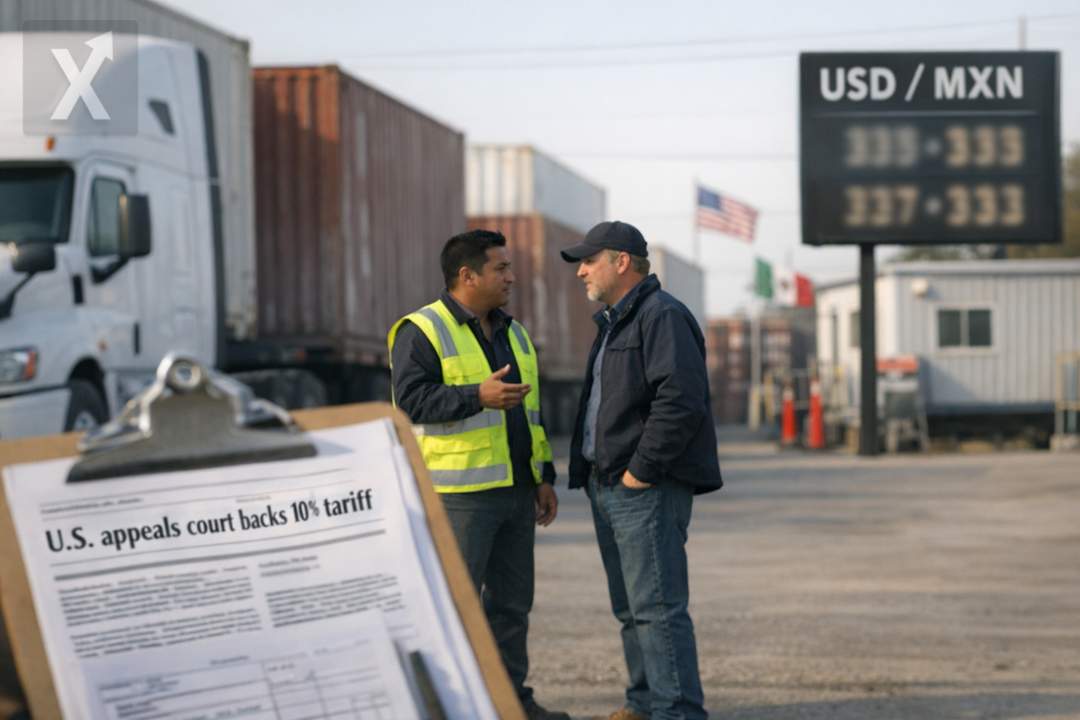
The temporary stay of the ruling against Trump’s global tariff adds volatility to supply chains and pressures investment decisions tied to Mexico.
A federal appeals court in the United States granted a temporary stay that, for now, blocks a ruling that had found the 10% global tariff pushed by President Donald Trump to be illegal. With that decision, the duty remains in effect while the case proceeds—reintroducing a source of trade uncertainty with potential spillovers for Mexico, given its deep manufacturing integration with the U.S. market.
The tariff was imposed in February on the grounds of addressing balance-of-payments imbalances, invoking Section 122 of the Trade Act of 1974. Previously, the Supreme Court had struck down most of the administration’s broad-based tariffs, prompting officials to look for new legal footing to sustain the trade policy. The U.S. Court of International Trade (CIT) had ordered the tariff blocked after a lawsuit filed by two companies and the state of Washington; however, the appeals court agreed to keep the measure on hold while it reviews the merits.
For Mexico, the impact is not limited to a direct increase in the cost of certain flows: the global tariff functions as a broad “tax” that reshapes costs and sourcing strategies across North America. In a context where Mexican exports rely heavily on U.S. demand, a sweeping measure can translate into price adjustments, contract renegotiations, and inventory shifts—even when goods cross borders multiple times as part of shared manufacturing processes.
In addition, the tariff’s continuation—even if temporary and subject to litigation—raises the premium on legal certainty. For companies planning expansions in Mexico (autos, electronics, machinery, medical devices), the cost is not just the tariff itself, but the possibility that the rules could change within weeks, affecting margin forecasts, investment timelines, and location decisions within the country’s industrial corridor.
Implications for the Exchange Rate, Imported Inflation, and Banxico’s Strategy
The news also lands at a sensitive moment for the peso and inflation. When the United States takes a tougher trade stance, markets often respond with greater risk aversion toward open economies dependent on manufactured exports, which can increase exchange-rate volatility. A weaker peso—if it materializes—raises the cost of imported inputs and could complicate the disinflation path, especially for goods sensitive to logistics costs and component prices.
In that scenario, the Bank of Mexico faces a delicate tradeoff: on one hand, the domestic economic slowdown and normalization in inflation create room for gradual adjustments; on the other, external shocks—such as a U.S. tariff shift—can complicate expectations and keep pressure on certain prices. Without anticipating specific decisions, the environment suggests that Banxico’s communication and its assessment of external risks will remain key to anchoring expectations and preventing exchange-rate volatility from feeding persistently into inflation.
The litigation in the United States leaves open the question of how long the tariff will last. Under Section 122, it remains in effect through the end of July unless Congress extends it. At the same time, the U.S. government is pursuing additional avenues to reinstate tariffs that were previously struck down, while sector-specific duties—such as those applied to steel, aluminum, and automobiles—sit outside this particular legal challenge, preserving another source of trade friction for the region.
From the standpoint of Mexican public policy, the episode reinforces the importance of market diversification, trade facilitation, and lowering domestic costs (energy, logistics security, customs infrastructure) to cushion external shocks. It also puts supply-chain risk management back at center stage: currency hedges, contracts with adjustment clauses, and dual-sourcing strategies become more relevant in an environment where the rules can shift due to court rulings and political decisions.
Overall, the stay of the ruling that would have invalidated the 10% global tariff does not, by itself, change Mexico’s macro outlook—but it does raise trade uncertainty with its top partner. The legal outcome and the tariff’s effective duration will be key to gauging the impact on costs, exports, and investment in the coming months.