Mexico Eyes Europe to Speed Up Export Diversification by 2030
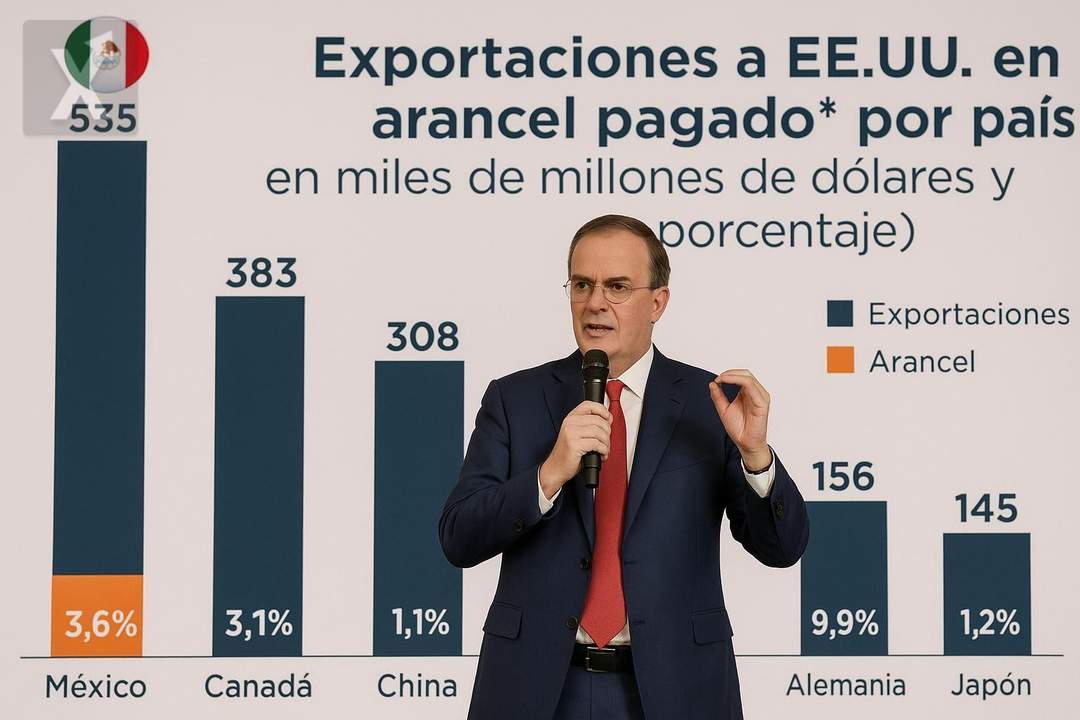
With the new agreement with the European Union on the horizon, Mexico aims to boost its sales to the bloc by 50% and reduce risk amid the U.S. shift toward protectionism.
Mexico wants to deepen its trade diversification strategy at a time of heightened global uncertainty, marked by a tougher protectionist tone in the United States. Economy Secretary Marcelo Ebrard set a goal of increasing Mexican exports to the European Union (EU) by 50% by 2030—from $23.817 billion in 2025 to $36.096 billion—driven by the upcoming signing of the modernized Mexico–EU agreement, scheduled for May 22.
The logic behind the goal is twofold: expand markets for the export sector and reduce vulnerability to regulatory or tariff shocks in North America. Although the United States remains the main destination for Mexico’s foreign sales, the government is seeking to accelerate a gradual rebalancing that increases the relative weight of other destinations—particularly Europe, Canada, and Japan—while still taking advantage of the benefits of the USMCA.
According to Ebrard, the agreement with the EU would include the complete elimination of tariffs for access to the European market, with a significant focus on agri-food exports. At a time when European consumers tend to prioritize traceability, sanitary standards, and sustainability attributes, Mexico’s challenge is not only to “sell more,” but also to meet technical requirements, certifications, and rules of origin that are often stricter than in other markets.
The proposal envisions increasing manufactured exports—such as autos, machinery, telecommunications equipment, medical devices, and tech components—while also strengthening the agri-food mix with products such as coffee, beer, oils, cocoa, legumes, seafood, fruit, and frozen fish. In the short term, performance will depend both on European demand and on logistical capacity, access to financing, and regulatory stability to invest in new production lines.
The New U.S. Tariff Landscape and the Incentive to Diversify
The protectionist shift in the United States—which at different times has used trade tools such as those tied to “Section 232”—has increased perceived risk for economies that are highly integrated with the U.S. market. In that context, Ebrard argued that Mexico maintains a “better relative position” versus other competitors, reporting $535 billion in exports to the United States in 2025 with an average tariff rate of 3.4%. Beyond the specific figure, the underlying message is that global competition is being reshuffled: the country where goods are made, the degree of regional integration, and compliance with rules of origin matter more and more—favoring export platforms with established production networks.
For Mexico, the challenge is to balance two goals: protect preferential access and the continuity of North American supply chains, while also expanding its “room to maneuver” into other markets. In macroeconomic terms, effective diversification can cushion external shocks, but it also requires higher productivity, fewer logistics bottlenecks, and stronger border, port, and rail infrastructure to support larger volumes and tighter delivery times.
The strategy presented by the Ministry of Economy is built around five pillars: maintaining relatively more favorable trade treatment with the United States versus competitors; diversifying with Europe, Canada, and Japan; leveraging nearshoring to attract investment; promoting high-growth industries (pharmaceuticals, electronics, and microprocessors); and protecting domestic industry. In practice, these goals intersect with variables the private sector watches closely: energy availability and cost, regulatory certainty, security along industrial corridors, and the quality of technical human capital.
One of the sectors with the strongest near-term potential is medical devices. Ebrard estimated that Mexico could triple exports in an industry currently valued at $17 billion, partly due to the United States’ intention to reduce its dependence on China and other Asian countries. For Mexico, the opportunity lies in consolidating existing clusters—particularly in the north and west of the country—and moving up the value chain into design, testing, specialized materials, and international regulatory compliance.
The medium-term push also includes gaining ground in semiconductors and data centers, segments where global competition for advanced manufacturing has intensified. However, these projects often require more complex conditions: reliable electricity supply, water, physical and digital security, and close coordination among the federal government, state governments, and companies to enable industrial parks, permits, and connectivity.
In parallel, the government has pointed to investment opportunities with Canada (CAD), following meetings with business leaders and funds. Investor appeal typically rests on regional integration, proximity to the U.S. market, and the installed manufacturing base—but also on Mexico’s ability to speed up permitting, reinforce infrastructure, and ensure operating conditions for new plants. If these elements align, the export push toward Europe and the strengthening of North America could become complementary rather than substitutes.
Overall, the goal of increasing exports to the EU by 50% by 2030 is a public-policy signal aimed at reducing risk concentration and taking advantage of a window of global supply-chain realignment. Feasibility will depend on implementing the new agreement, the response of the productive sector, and the country’s ability to address internal bottlenecks that currently limit the pace of export expansion.






