Banxico Reports FX Losses, Leaving Finance Ministry Without an Operating Surplus in 2025
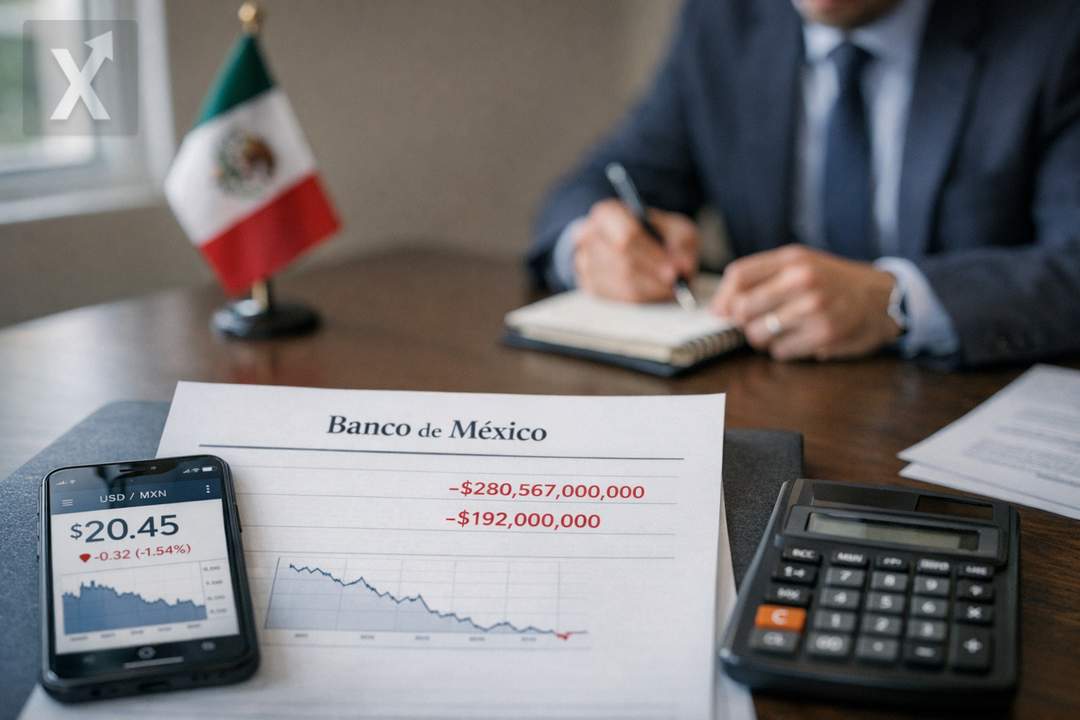
Valuation losses tied to the exchange rate will prevent the central bank from transferring extraordinary resources to the federal treasury this year.
The Bank of Mexico (Banxico) closed 2025 with a negative result of 410.052 billion pesos, mainly due to foreign-exchange losses, meaning there will be no operating surplus to transfer to the Ministry of Finance and Public Credit (SHCP, commonly referred to as Hacienda). In its audited financial statements, the central bank explained that the year’s performance was dominated by the valuation effect on its foreign-currency assets and liabilities—an item that tends to be amplified when there are significant moves in the exchange rate.
In Mexico, Banxico’s operating surplus is an extraordinary source of revenue for public finances that, when it exists, is typically delivered to the Federal Treasury in April, based on the prior year’s accounting close. By law, most of it must be used to reduce public debt and the rest to strengthen financial stabilization funds. However, when the central bank’s result is negative—as it was in 2025—there are no resources to distribute.
The report comes at a time when the federal government still faces the challenge of balancing spending priorities with the need to preserve confidence in the fiscal path. While these surpluses are not recurring revenue and should not fund permanent spending, in years with large transfers they can ease short-term pressure on public-sector financing. The absence of this flow forces greater reliance on tax revenues, spending cuts, reallocations, or higher borrowing authorized in the budget.
The negative result also underscores a technical point: Banxico doesn’t “lose money” the way a commercial bank would through ordinary operations; rather, its balance sheet reflects the valuation of international reserves and monetary liabilities. When the peso appreciates or stays strong against the U.S. dollar (USD) relative to prior scenarios, the peso value of certain external assets can decline on an accounting basis, affecting the year’s result.
Operating surpluses: why they depend on the exchange rate and what it means when they don’t arrive
The mechanism behind these surpluses is closely tied to the composition of the central bank’s balance sheet. Banxico manages international reserves and other assets denominated in foreign currencies; at year-end, those assets are translated into pesos. If the peso depreciates against the U.S. dollar (USD), the peso value of external assets tends to rise, which can translate into a positive accounting result and, eventually, an operating surplus. Conversely, when the exchange rate moves in a way that reduces that peso valuation—or when other balance-sheet components weigh on the result—the surplus can disappear. For Hacienda, this means there will be no unbudgeted revenue that, in previous years, has been used mainly to pay down debt or reinforce fiscal buffers.
From a public-policy standpoint, the absence of an operating surplus is typically read in two ways. The first is accounting-related and prudent: it prevents the government from building volatile income into structural spending. The second is financial: without that support, debt reduction depends more on budget discipline and the cost of financing in the markets. In an environment of still-elevated interest rates and close scrutiny of the fiscal balance, the room for positive surprises narrows.
Looking ahead, the immediate macroeconomic impact of not receiving these surpluses is usually limited, but it does shape the fiscal conversation: how much leeway the government has to meet deficit targets, how public investment is financed, and how quickly the debt-to-GDP ratio can be stabilized. In that context, Banxico’s figure reinforces the idea that operating surpluses are an extraordinary and variable component—closer to an occasional buffer than a stable source of funds.






