S&P Puts Sinaloa on Negative CreditWatch, Raising Financial Pressure on the State
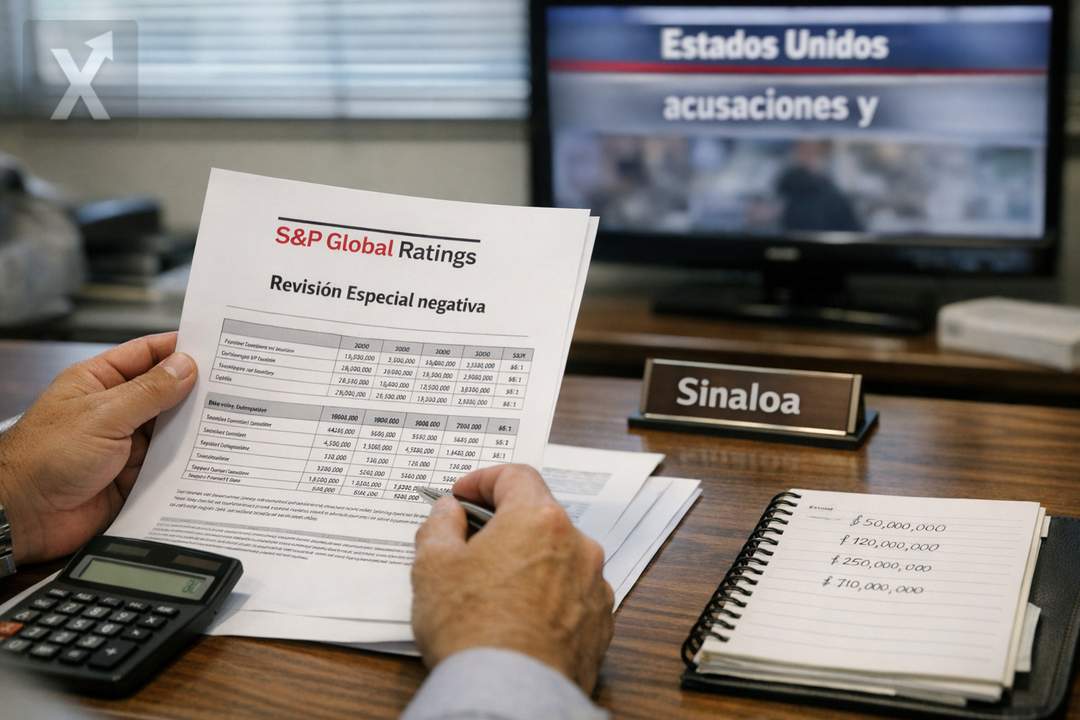
S&P’s review adds uncertainty to Sinaloa’s funding outlook at a time when credit conditions and fiscal discipline are already facing a tougher environment.
S&P Global Ratings placed Sinaloa’s credit rating on CreditWatch with negative implications, a move that typically signals a possible near-term downgrade if key variables such as liquidity, budget performance, or financial governance deteriorate. The decision comes amid heightened political sensitivity due to allegations raised in the United States against Governor Rubén Rocha Moya and other officials, which increases perceived risk and could affect the state’s relationship with lenders and financial counterparties.
In practical terms, the “negative review” works as a market warning: over the coming weeks, S&P will assess whether this episode raises borrowing costs, limits access to bank credit, or puts pressure on the state’s cash flows. For subnational governments, timely access to short-term credit lines is a core operating tool, used to smooth liquidity gaps tied to the schedule of federal revenue-sharing transfers, payroll, and payments to suppliers.
The rating agency had already been pointing to vulnerabilities: “less than adequate” liquidity and recurring reliance on short-term borrowing, which increases refinancing risk. As of year-end 2025, Sinaloa’s total debt stood at 7.182 billion pesos, including 2.695 billion pesos in short-term obligations—an arrangement that requires keeping credit windows open and frequently renewing terms. Under that structure, any rise in risk aversion can translate into higher rates, smaller available amounts, or stricter collateral requirements.
The rating remains at ‘mxA’ on the national scale, a level associated with a relatively solid capacity to meet financial commitments compared with other local issuers. However, the shift to CreditWatch negative indicates the risk balance has tilted toward a less favorable scenario, and the final outcome will depend on whether Sinaloa can maintain financial stability and preserve access to the banking market during a period marked by uncertainty.
Liquidity, commercial banks, and the cost of refinancing in an environment where rates are still high
For states, short-term bank financing is more than a “debt” tool—it’s a cash-management mechanism. When liquidity is limited and the share of near-term maturities is high, the state becomes more sensitive to shifts in credit conditions. In Mexico, even as the monetary policy cycle has trended lower as inflation eases, interest rates have remained restrictive for a prolonged period, making debt service more expensive and increasing the visibility of the cost of rolling over liabilities. In that context, a negative review can become an additional tightening factor: even without a formal downgrade, some financial institutions reassess internal limits, risk premiums, and tenors, especially when the news includes governance and compliance components.
Exposure to short-term debt can also magnify budget effects: if rates rise, a larger share of spending goes to interest and fees, leaving less room for public investment or programs. This matters at a time when several states are trying to sustain public works, security, and social spending with limited own-source revenue, while relying on federal transfers that, while relatively stable, do not always grow at the pace of spending pressures.
Beyond this specific case, the episode underscores how nonfinancial factors—governance, reputational risk, and institutional uncertainty—can flow through to financial metrics. For the market, the key issue isn’t only the size of the debt, but the state treasury’s ability to manage cash, the predictability of revenues, control of spending, and operational continuity to make timely decisions such as refinancing, adjusting payment schedules, or building liquidity reserves.
S&P said its review could be resolved within roughly 90 days, during which it will watch whether the state maintains access to credit, whether its liquidity position improves or weakens, and whether there are signs of a material impact on budget performance. At the same time, the broader macro backdrop—moderate growth, pressure from elevated real rates, and market caution—will continue to influence risk appetite toward subnational issuers.
Read neutrally, the message is clear: the negative review is not an automatic downgrade, but it does increase scrutiny of Sinaloa’s ability to manage short-term maturities and maintain financial stability amid political uncertainty, with potential implications for the cost and availability of credit.