BBVA Mexico Holds Profits Steady Amid a Weak Economic Start, Expects a More Dynamic Second Half
The bank kept earnings stable despite a GDP contraction and a slowdown in business lending, amid a more cautious backdrop.
BBVA Mexico posted profits of 28.236 billion pesos in the first quarter of the year, a marginal 0.3% increase versus the same period in 2025, though down 7% compared with year-end 2025. The performance comes amid an economic cooldown: Mexico’s economy shrank 0.8% in the quarter, reinforcing the narrative of a more fragile start to the year across both industry and services.
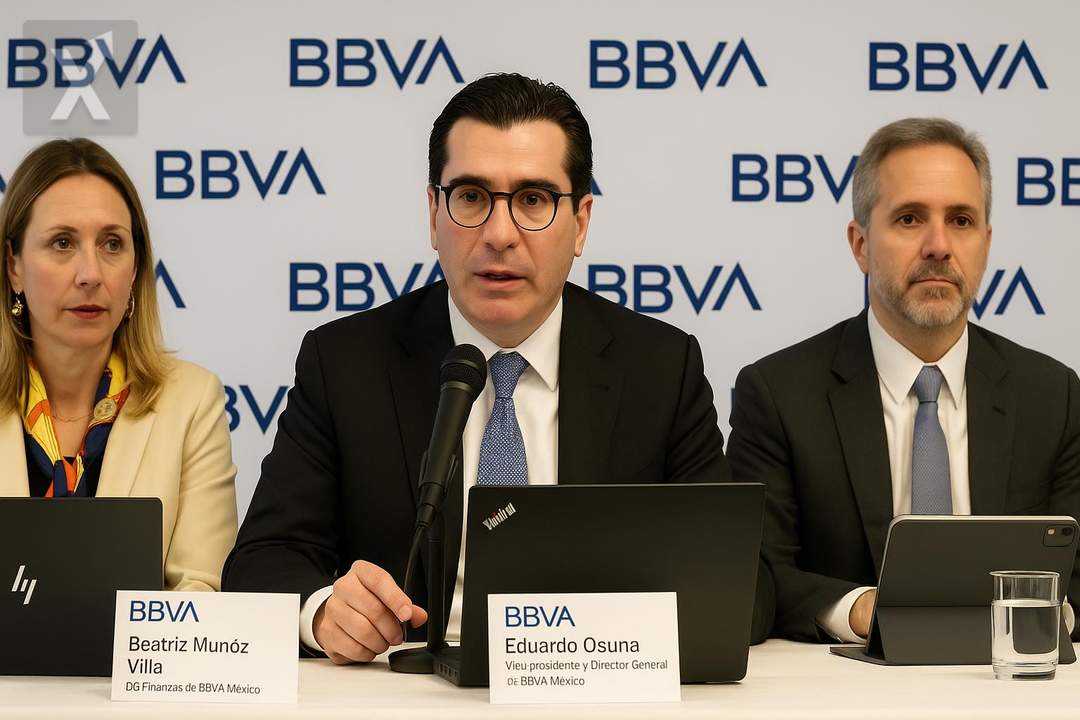
Speaking at a press conference, the institution led by Eduardo Osuna acknowledged signs of weaker momentum in consumption and productive activity, particularly evident in certain credit products. Even so, the bank kept its 2026 growth forecast at 1.8% and projected a 2.1% increase in formal employment, while warning that the GDP print opens the door to downward revisions to market expectations in the coming months.
Carlos Serrano, chief economist at BBVA Mexico, noted that to reach 1.8% annual growth, the economy would need to return to growth rates above 2% in the second half of the year. In his view, the first quarter may have been the low point of the year, with potential tailwinds ahead, including a temporary boost from World Cup-related activity, progress on infrastructure projects, and the USMCA renegotiation process—whose clarity is often important for private investment.
The macro outlook also remains shaped by the combination of high interest rates—though on a path that could gradually become less restrictive—and external demand tied to the United States cycle, Mexico’s main trading partner. In that environment, the banking sector becomes a barometer: it shows how quickly the slowdown is transmitted to households and companies, and which segments continue to expand.
Lending: Overall Growth, but a Brake on Businesses and a Collapse in Government
The loan portfolio showed mixed performance. Overall, BBVA Mexico reported 8.5% growth, but with notable contrasts: business lending fell 6.7%, and the government portfolio plunged 52%. The institution attributed part of the slowdown to weaker demand and signs of deceleration in billing, particularly in credit cards. The assessment suggests that while consumer credit may hold up due to inertia and the formalization of employment, corporate financing tends to react more sensitively to uncertainty and expectations of softer activity.
Osuna said that a rebound in lending to businesses and governments will depend largely on clearer signals of certainty, especially to spur private investment. From the bank’s perspective, implementation of the so-called “Plan Mexico” and the speed at which logistics and energy projects get off the ground will be decisive in reactivating demand for productive financing, with a potentially better tone in the second half of the year.
Beyond the quarterly results, the report fits into a broader discussion about Mexico’s economy: the balance between consumption, which is wearing down under still-high rates, and investment, which needs consistent signals on rules, returns, and continuity. Banks can sustain profits in the short term thanks to scale, efficiency, and product mix, but the trajectory of business lending often foreshadows the pace of investment—and, with it, productivity and future growth.
In perspective, BBVA Mexico’s performance confirms a start to the year with less traction, while also showing that the financial system continues to operate with resilience. The key in the coming quarters will be whether the economy can rebound with enough investment and certainty to revive business financing and sustain growth without increasing credit risks.