BBVA and Santander in Mexico: Spain’s banking giants navigate scale, digitalization, and competition
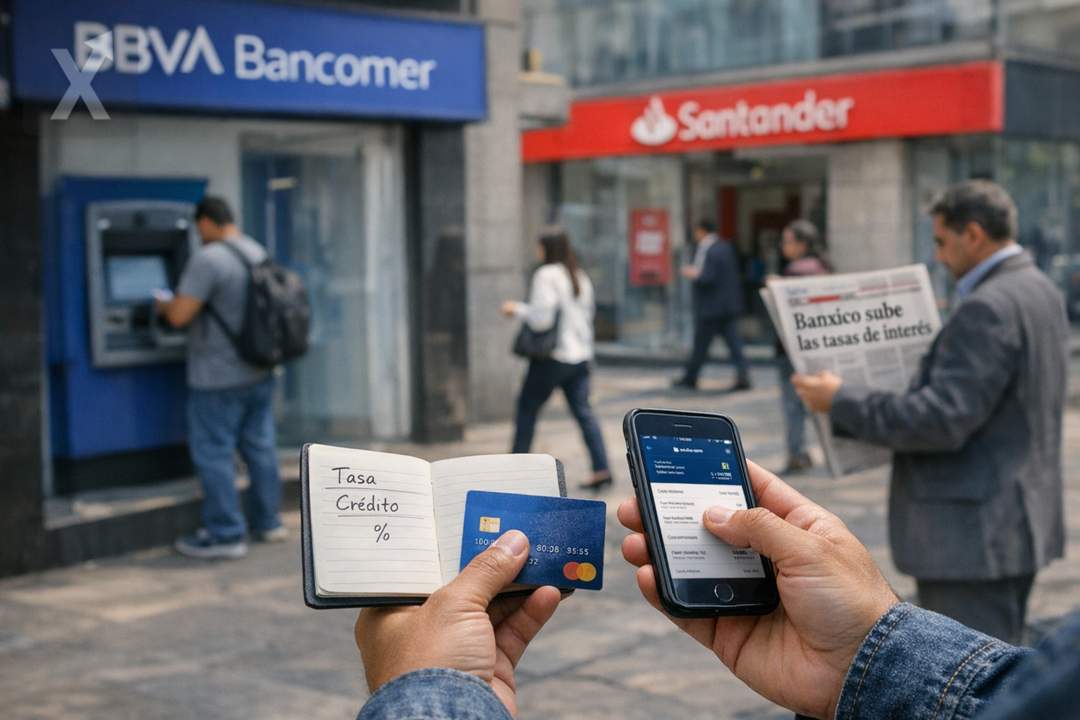
BBVA keeps its edge in revenue and branch coverage, while Santander fine-tunes its strategy in a market squeezed by high rates and faster digital adoption.
The footprint of Spanish-owned banking in Mexico rests largely on two names that are now part of the country’s financial landscape: BBVA México and Banco Santander México. Both institutions stand out for their operational weight, their role in financing households and businesses, and their importance as employers—within a country where banking intermediation coexists with heavy cash usage and rapidly growing digital channels.
Figures available through year-end 2025 show a clear scale gap between the two competitors. BBVA México posted revenue of 538,114 million pesos, up 2.9% year over year, while Santander México reported 238,847 million pesos, down 3.6%. The difference not only reinforces BBVA’s leadership within the banking system, it also illustrates how size translates into greater capacity to invest in technology, broader commercial reach, and potentially a more diversified customer base.
On employment, the contrast is also striking. BBVA México closed 2025 with 46,291 employees, compared with 23,518 at Santander México. That gap, however, shouldn’t be read simply as “more branches equals more staff”: in recent years, banks have reshaped roles toward analytics, cybersecurity, software engineering, and risk management, while automating traditional teller-window processes.
In physical infrastructure, BBVA kept the country’s largest branch network with 1,633 locations (14.3% of the system total) as of November 2025, while Santander operated 995 (8.7%). The trend is shared: both institutions have reduced branches since 2023, a sign that growth is shifting toward mobile banking and remote service—especially in urban segments. Even so, branches remain relevant for consultative sales—mortgages, wealth management, SMEs—and for servicing regions where digitalization is moving more slowly.
For ATMs, BBVA held onto the top spot with 14,343 machines (a 21.8% share), while Santander ranked third with 11,054 (16.8%). Here the movement has been different: BBVA trimmed its network slightly since 2023, while Santander expanded it—an effort to maintain “last-mile” cash access in a country where a large share of retail transactions is still settled in cash.
A high-rate environment reshapes priorities
Bank performance in Mexico can’t be understood without the recent macroeconomic backdrop. With Banxico maintaining a restrictive stance for an extended period to contain inflation, borrowing costs rose and demand became more selective. In that environment, banks face a delicate balancing act: on the one hand, high rates tend to lift net interest income; on the other, they can slow consumer and mortgage lending, increase sensitivity to delinquency in certain segments, and raise funding costs as banks compete for deposits. Competition then concentrates on operating efficiency, origination with stronger risk profiles, and strengthening fee income tied to digital services and payments—areas where scale and technology investment become decisive.
The contest between BBVA and Santander is also playing out in the digital transition. Branch reductions and ATM optimization coincide with growing electronic transfers, everyday use of banking apps, and greater adoption of card payments and QR codes. This is happening as the financial system faces challenges around security, fraud, and identity theft, making investment in authentication, transaction monitoring, and financial education a competitive differentiator—not just a regulatory box to check.
At the same time, the Mexican market offers a structural tailwind: expansion potential through financial inclusion. Despite gains in access to banking, a meaningful share of the population still lacks full access to formal credit products or insurance, creating opportunities for hybrid models (digital with physical support) and partnerships with retailers, payroll programs, and platforms. For large banks, capturing that growth typically depends on low customer-acquisition costs, a strong user experience, and the ability to assess risk using alternative data—without neglecting regulatory compliance.
Looking ahead, the scale difference suggests BBVA will continue defending its leadership through investment, network breadth, and end-to-end service capacity. For Santander, the challenge is to sustain profitability and share in a competitive market where efficiency and specialization can be key levers—particularly in corporate banking, SMEs, and high-value segments. In both cases, the final outcome will depend less on the number of branches and more on the combination of technology, pricing, risk management, and customer trust.
In sum, the 2025 data confirm BBVA México as the largest player by size and reach, while Santander México is reshaping its footprint and reinforcing specific fronts. The rate environment, digitalization, and the push for financial inclusion will set the pace of this rivalry in the years ahead.






