Treasury Approves New Alloys for the 10-Peso Coin, Aims to Cut Minting Costs
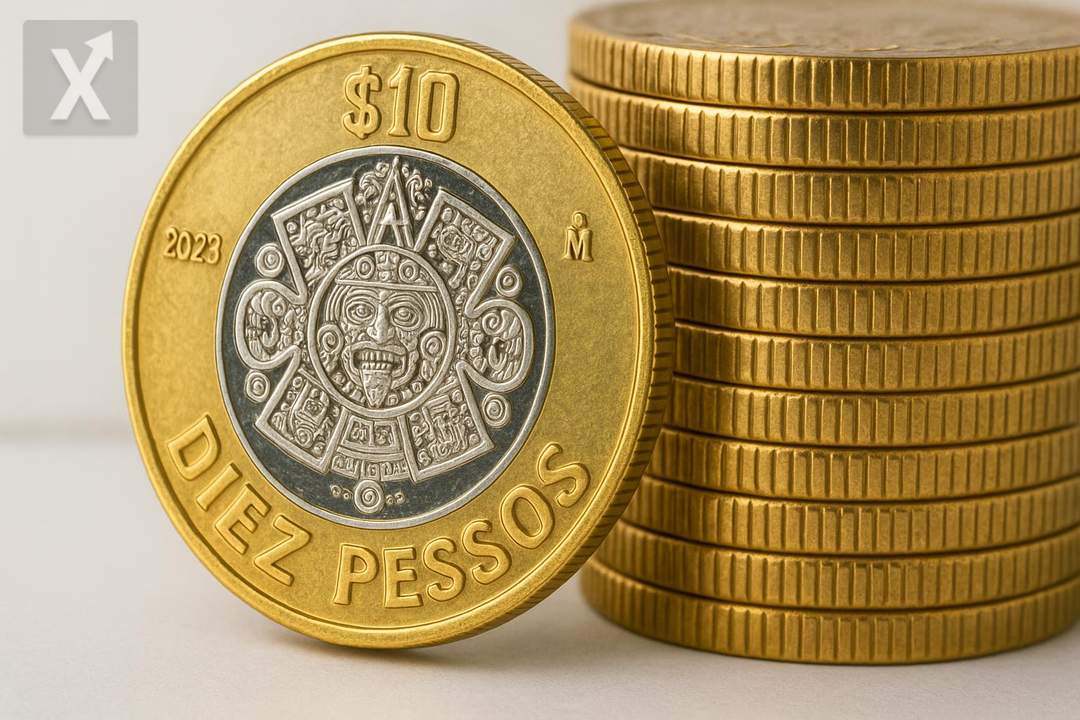
The change to the 10-peso coin’s core is intended to reduce production costs without altering its design or its validity in circulation.
Mexico’s Ministry of Finance and Public Credit (SHCP) has formalized a technical adjustment to how the 10-peso coin is made: the central portion, known as the core, will stop being produced with the traditional “silver nickel” alloy and will instead be made of nickel-plated steel. The resolution has already been published in the Official Gazette of the Federation (DOF) and takes effect immediately, clearing the way for minting with the new composition once industrial adjustments are completed.
The change does not modify the design or the bimetallic outer ring that distinguishes this denomination. In practical terms, for the public the coin will keep its general appearance and its legal tender status, while the adjustment focuses on production cost and logistics for the monetary authority and the Mexican Mint.
The move comes as central banks around the world have sought to optimize the unit cost of high-circulation coins. In Mexico, growth in retail trade, the continued use of cash in certain industries and regions, and the natural wear on coins that change hands frequently put pressure on the operating budget associated with replacing currency in circulation.
Why the Material Matters: Costs, Durability, and Cash Operations
The choice of nickel-plated steel responds mainly to economics and physical performance. Generally speaking, steel is cheaper and more durable than several alloys with high copper content and other metals, which can translate into lower input costs and better tolerance for heavy use. For day-to-day operations, a more durable coin tends to reduce the replacement rate due to wear, which lowers minting, transportation, and handling costs across the cash supply chain.
In addition, coin production is a small but constant component of the financial infrastructure: it requires inventory planning, production capacity, distribution through the banking system, and processes for pulling worn coins out of circulation. During periods of higher economic activity—and especially during high-spending seasons—the availability of cash remains key for low-value transactions, despite the growth of electronic payments.
Under the measure, existing 10-peso coins will continue to circulate normally and will remain valid until the Bank of Mexico decides on any eventual withdrawal. In Mexico, these kinds of transitions are typically gradual: multiple “generations” of coins coexist, and replacement happens as older coins return to the banking system and are sorted based on physical condition.
For the financial system and commerce, the main impact is operational: adjustments to verification and handling processes, particularly in self-service machines, validators, and counting equipment that rely on physical and electromagnetic parameters. Even though the design is unchanged, a new composition may require technical recalibration to ensure acceptance and reduce rejections in automated devices—an important point for public transit, parking meters, and certain services.
More broadly, the decision reflects a pattern of government cost management in areas where the public does not perceive immediate changes, but that do affect recurring spending. In recent years, Mexico has maintained a monetary policy focused on price stability and anchoring inflation expectations, while in parallel fine-tuning logistics and efficiency in the provision of cash, which remains an important part of everyday economic life.
Looking ahead, the actual transition timeline will depend on the Mexican Mint’s ability to complete necessary adjustments, the pace of demand for coins, and how quickly current coins return to the banking circuit. For consumers, the central message is clear: the 10-peso coin is not changing in value or design, but it is modernizing its “engineering” to be more economical and more durable.
In perspective, the materials adjustment is a reminder that the infrastructure behind physical money is managed with industrial criteria: cost, durability, and operational compatibility. The challenge will be executing the transition smoothly for retailers and automated equipment, while maintaining confidence in—and the smooth functioning of—cash in the Mexican economy.