Mexico and the United States tighten intellectual property coordination ahead of the USMCA review
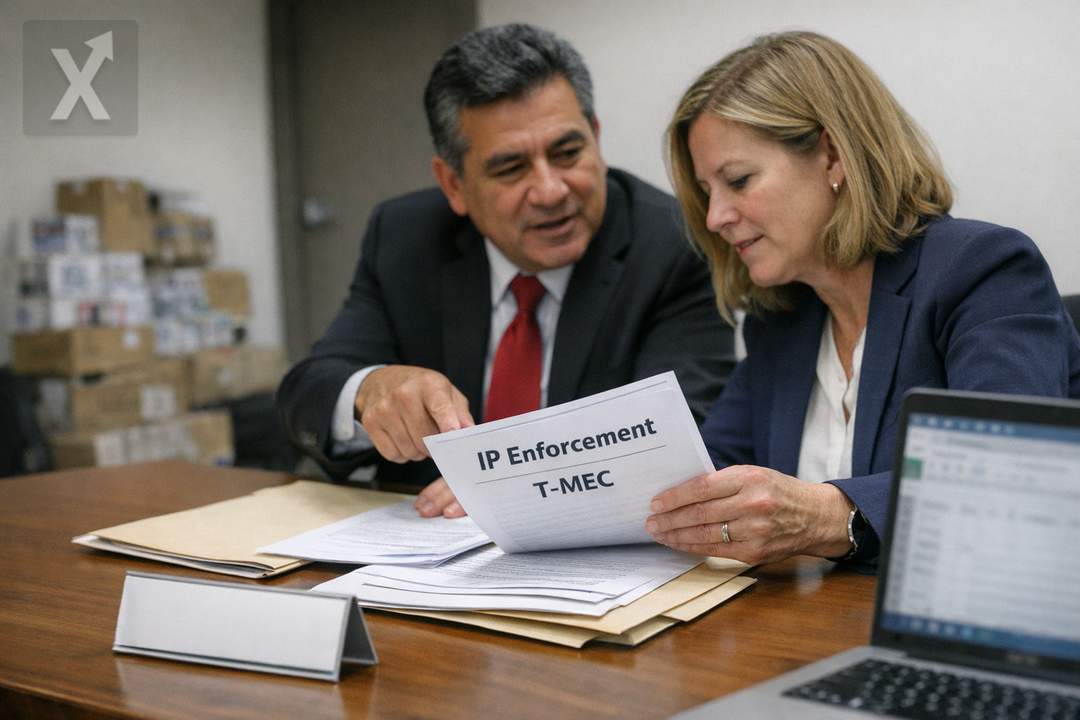
Mexico and the United States agreed on an operational plan to step up investigations and criminal prosecutions related to piracy and trademark misuse across the region.
Mexico and the United States agreed to strengthen intellectual property enforcement as part of their USMCA commitments, with the goal of increasing the number of criminal investigations, improving investigative techniques, and achieving more effective court proceedings against product counterfeiting and the illegal distribution of protected content.
Mexico’s Ministry of Economy reported that a binational working group will be established, led by the Ministry and the Office of the United States Trade Representative (USTR). The idea is to create a direct coordination channel between law enforcement authorities in both countries, share strategies, identify operational gaps, and accelerate concrete actions to deter crimes that harm holders of trademarks, patents, and copyrights.
In addition, a roundtable is planned with companies and rights holders to bring cases closer to authorities and clarify reporting pathways that can become criminally viable case files. In practice, these types of frameworks aim to reduce friction between incident reporting—including digital piracy—and the state’s ability to open investigations, secure evidence, and sustain prosecutions in court.
The move comes at a time when the trade agenda with the United States has become heavier on non-tariff issues: regulatory compliance, traceability, labor standards, and increasingly, protection of intangibles. For Mexico, the economic relevance is direct: in a country with a strong export-oriented manufacturing base, the integrity of supply chains and confidence in the legitimate use of technology, brands, and software becomes a factor in attracting investment—especially in projects tied to nearshoring.
Washington has repeatedly emphasized this issue in its Special 301 Report, which evaluates enforcement practices and legal frameworks in third countries. Formalizing coordination mechanisms under the USMCA aims, on one hand, to address those concerns and, on the other, to provide greater certainty for companies operating on both sides of the border—particularly in sectors where value added depends on innovation, design, and content.
Economic implications: investment, digitization, and competitive pressure
Stronger cooperation on intellectual property intersects with trends already putting pressure on Mexico’s economy: the growth of e-commerce, the digitization of services, and the expansion of export-linked logistics operations. In this context, piracy and counterfeiting don’t just generate losses for rights holders; they also distort competition, weaken tax collection, and raise reputational risks across production chains. For industries such as auto parts, pharmaceuticals, medical devices, electronics, and entertainment, more consistent enforcement can translate into better conditions for technology transfer and a greater willingness to locate processes in Mexico—though it also implies higher compliance costs for companies and platforms that will need to strengthen internal controls and cooperation with authorities.
Heading into the USMCA review, the issue carries more weight because it is part of the broader set of comments submitted to the USTR and to business stakeholders in the region. In the United States, think tanks such as the Information Technology and Innovation Foundation (ITIF) have argued that extending the agreement should be paired with stricter intellectual property enforcement and rules that reduce vulnerabilities to unfair practices, with a particular focus on China. At the same time, Mexico continues to face the challenge of turning international commitments into measurable results: solid investigations, inter-agency coordination, and court rulings that genuinely deter repeat offenses.
The forward-looking angle is clear: if the binational group succeeds in standardizing investigative criteria, speeding up information sharing, and improving the corporate reporting pathway, it could strengthen perceptions of certainty in the North American market. However, the impact will depend on institutional capacity to sustain cases, on targeting key pressure points (customs, digital channels, distribution centers), and on ensuring that actions do not devolve into discretion or disproportionate regulatory costs that end up hurting formal small and medium-sized businesses.
In short, the agreement between Mexico and the United States positions intellectual property as another component of regional competitiveness under the USMCA: an area where enforcement can help attract investment and bring order to markets, but where results will be measured in day-to-day execution and judicial effectiveness—especially as the treaty review draws nearer.






