Oil’s rise amid the Iran conflict puts pressure on Mexico’s deficit through gasoline tax breaks
Higher crude prices force a broader IEPS tax relief program, shielding consumers but cutting revenue and complicating fiscal consolidation.
The rebound in international oil prices—set off by the military escalation in the Middle East with Iran at the center—has once again put Mexico’s public finances in a familiar bind: cushion the hit to gasoline prices to keep inflation in check, or preserve revenue from the Special Tax on Production and Services (IEPS) to avoid veering off the deficit path. In recent weeks, the Ministry of Finance and Public Credit (SHCP) brought back fuel tax breaks, a measure that often acts as an anti-inflation “valve,” but one that reduces tax revenue at a time of pressure from rigid spending and higher financing costs.
The decision comes as the fiscal balance had already been strained in 2024 and 2025, when the deficit (measured by the Public Sector Borrowing Requirements) reached elevated levels compared with the prior decade. The government’s stated goal of lowering it toward 4.1% of GDP now faces the risk of being surpassed if the external shock drags on: IEPS tax breaks typically grow precisely when international prices push up the import cost of fuels, and Mexico still relies heavily on imported gasoline.
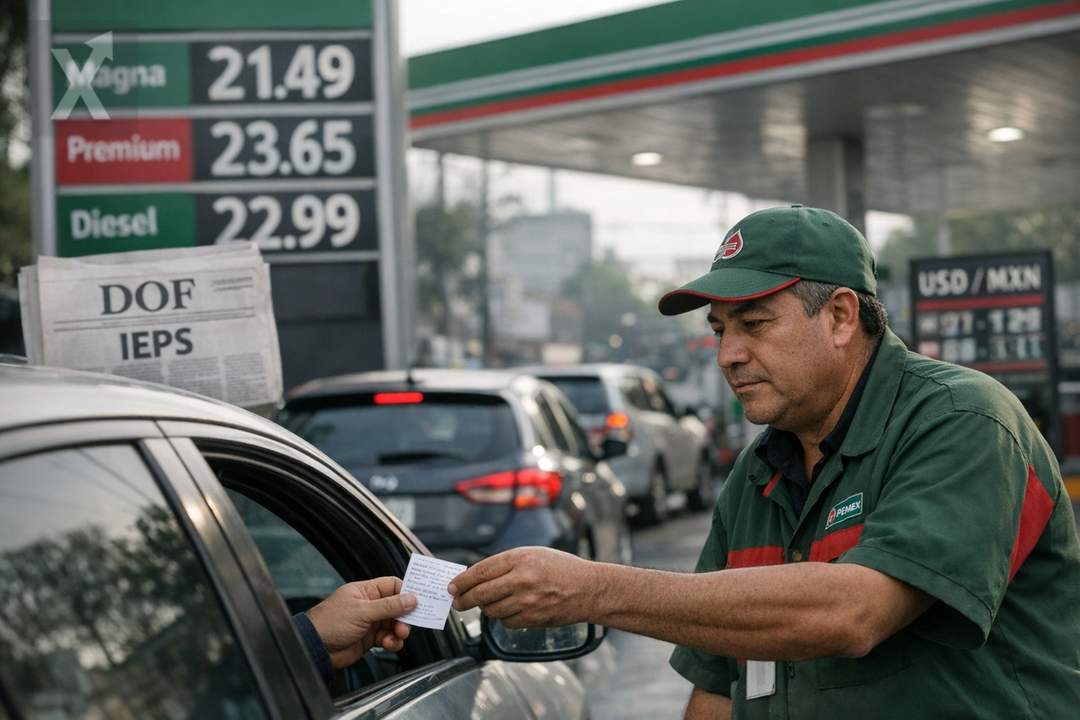
According to data published in the Official Gazette of the Federation (DOF), the Finance Ministry increased IEPS discounts for diesel and reintroduced support for regular gasoline, while applying smaller breaks for premium. The mechanism is updated weekly and aims to prevent consumers from absorbing the full brunt of international volatility; however, the fiscal cost shows up immediately as lower collections. Analysts have warned that if the episode persists, the deficit could land closer to 4.5% of GDP or even approach levels seen in 2025, depending on the size of the tax break and how long it remains in place.
For Mexico, higher crude prices have a dual effect. On one hand, stronger export prices can lift oil revenues; on the other, the IEPS relief reduces non-oil revenue. In addition, the benefit from higher oil prices does not always offset the cost of the implicit subsidies in fuels—especially when the country imports gasoline and when part of the additional revenue is channeled to Pemex’s operating and financial needs.
The episode also revives the debate over fiscal sustainability: with growing burdens from pensions, transfers, and debt service—which tends to rise when rates stay high or financial conditions tighten—the government’s ability to absorb shocks without deteriorating its balance sheet diminishes. In that environment, a persistent slippage in the deficit can increase financing needs and, in turn, keep investors and rating agencies focused on the debt trajectory.
Inflation, IEPS, and Mexico’s price “cushion” versus the United States
One reason the government often uses the IEPS as a shock absorber is that the tax component can be adjusted quickly without changing the target retail price. In practice, Mexico typically has a “cushion” in the per-liter tax burden, allowing it to temporarily cut the tax when international prices rise. In past episodes, this tool helped soften the pass-through from the energy shock to headline inflation and, in particular, to non-core inflation, which is most sensitive to fuels and food.
The problem is that the fuel IEPS is a significant source of tax revenue. When it is reduced for an extended period, the revenue shortfall can be sizable and is not necessarily offset by oil income—especially if Pemex faces its own investment, refining, debt, and budget-support pressures. The final impact on the deficit will also depend on how long the relief is maintained, Mexico’s crude blend, export volumes, and whether the government chooses to absorb additional costs on other fronts.
Added to the equation is the rise in the cost of agricultural inputs such as fertilizers, which can push food prices higher and complicate the inflation outlook. A simultaneous shock to energy and food tends to hit lower-income households harder, increasing the political incentive to contain administered or semi-administered prices. However, when that containment translates into lower fiscal revenue, the result is often a tougher adjustment later on: spending cuts, higher borrowing, or a mix of both.
Another important channel is the cost of electricity generation. If natural gas prices or fuels used in thermal plants rise, the finances of the Federal Electricity Commission (CFE) can take a hit and, in certain cases, require larger subsidies or support from the federal government to avoid passing the increase on to end-user tariffs—especially in segments where the social component carries weight. From a fiscal standpoint, this can become an additional pressure running parallel to the IEPS.
Looking ahead, the market’s focus will be on how long the conflict lasts and how crude prices behave, but also on the policy response: if the Finance Ministry prioritizes the deficit target, it could limit the tax breaks; if it prioritizes price controls, fiscal consolidation could be delayed. In any scenario, the structural challenge remains: reducing vulnerabilities requires improving the efficiency of non-oil tax collection, curbing the growth of rigid spending, and strengthening productive investment, while managing the energy sector’s financial legacy.
In short, the rise in oil prices due to the Iran conflict once again strains the trade-off between price stability and fiscal discipline in Mexico: IEPS tax relief helps contain inflation in the short run, but raises the risk of a larger deficit if it becomes persistent.