Fed Pauses Rates, Renewing Pressure on the Peso: Mexico Braces for a Higher-Cost Money Environment
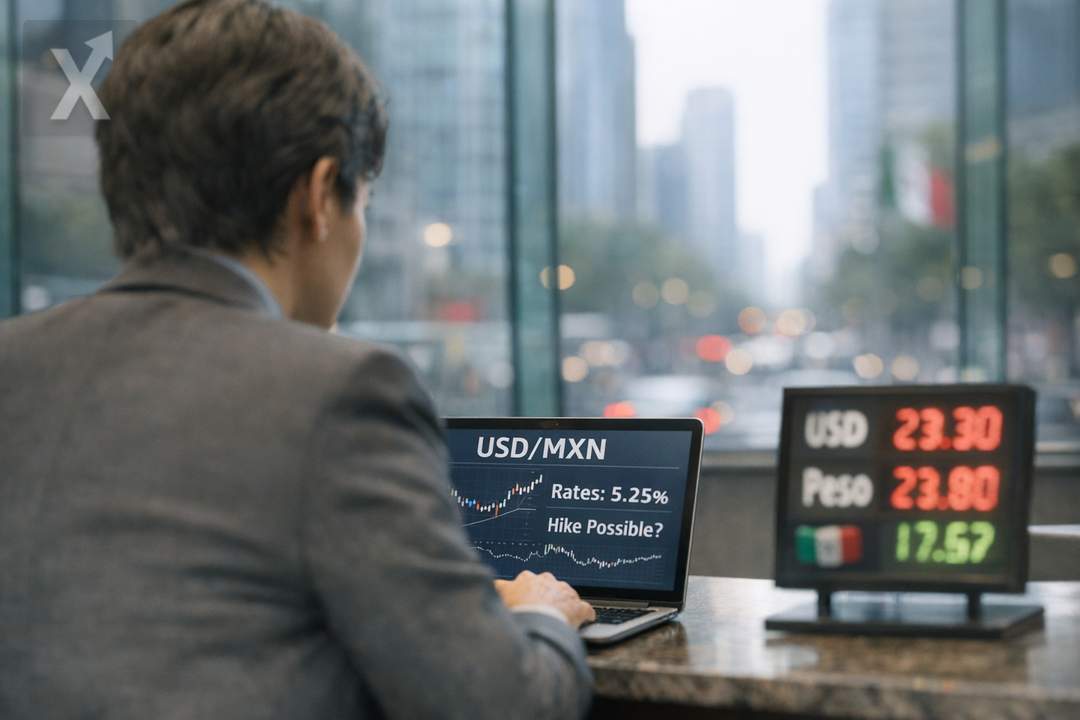
The Fed’s signal that rates will stay higher for longer complicates the outlook for the peso and forces Banxico to carefully calibrate its next rate cuts.
The U.S. Federal Reserve (Fed) left its benchmark rate unchanged in a range of 3.50% to 3.75% for a fourth consecutive meeting, but shifted its messaging in a more hawkish direction by leaving the door open to a possible hike toward the end of the year. The change in tone comes as inflation remains elevated in the U.S. economy and global uncertainty rises due to supply shocks—including energy—linked to geopolitical tensions.
For Mexico, the combination of high U.S. rates and a less “accommodative” narrative typically translates into tighter financial conditions: greater volatility in the FX market, adjustments in risk premia, and borrowing costs that can stay elevated for longer. In recent episodes, the peso has shown resilience thanks to the rate differential and inflows into local-currency instruments; however, when markets price in a more aggressive Fed, the “carry” trade can become less attractive if risk is seen rising faster than returns.
The Fed also revised up its year-end inflation forecast (3.6%) and trimmed its growth outlook (2.2%). If these projections play out, the scenario for Mexico would be mixed: on the one hand, a still-solid U.S. economy supports manufactured exports; on the other, persistent inflation can keep pressure on rates and the exchange rate, with implications for import prices and local inflation expectations.
On the domestic front, the Bank of Mexico (Banxico) faces the challenge of balancing a gradual disinflation process with the risk that a more restrictive external environment triggers temporary depreciation or a renewed spike in volatility. In practice, a Fed that is less inclined to cut reduces the room to speed up easing in Mexico without adding pressure on the peso—especially if demand for dollars increases due to corporate hedging or bouts of risk-off sentiment.
In addition, the financial channel directly affects credit costs: higher rates for longer tend to extend an expensive financing environment for Mexican households and businesses. This is often felt in rate-sensitive segments—such as mortgages and auto loans—and in refinancing costs for companies with floating-rate debt or near-term maturities.
Implications for Banxico, Inflation, and Economic Activity in Mexico
The main takeaway for Banxico is the need to protect the rate differential versus the United States while also sustaining progress toward inflation convergence. In Mexico, headline inflation has been decelerating compared with the peaks seen after the 2021–2022 global shocks, but pressure points remain in services and in some components that respond with a lag to monetary tightening. In that context, a Fed “higher for longer” stance may force Banxico to stay cautious: gradual, data-dependent cuts, with close attention to expectations and FX pass-through into prices.
In terms of growth, Mexico has leaned on consumption momentum, strong employment, and export strength tied to the United States. Additional tightening in external financial conditions could cool private investment, particularly in credit-intensive sectors, and raise the profitability bar for new projects. Even with the structural tailwind from nearshoring, the pace of expansion could become more sensitive to financing costs, credit availability, and regulatory certainty.
For markets, the most relevant signal is the expected path of rates and the Fed’s communication: when the Fed pares back forward guidance or delivers shorter messages, data dependence (inflation, jobs, wages) tends to increase—and with it, volatility. In Mexico, that volatility shows up in exchange-rate moves, shifts in government bond yields, and changes in risk appetite, all of which affect corporate hedging decisions and financial planning.
Looking ahead, Mexico’s balancing point will be maintaining price stability without choking off activity, in an environment where the United States has not yet fully anchored inflation at its target. If the Fed does raise rates or prolongs the restrictive cycle, the Mexican economy could see a peso that is more sensitive to global events and a more cautious Banxico on the timing of cuts. The key read for the coming months will be how core inflation, the labor market, and global risk perception evolve—variables that typically define the room for maneuver in monetary policy and the peso’s performance.