U.S. Supreme Court Ruling Reinforces the Fed’s Independence and Shakes Up Market Expectations: Takeaways for Mexico
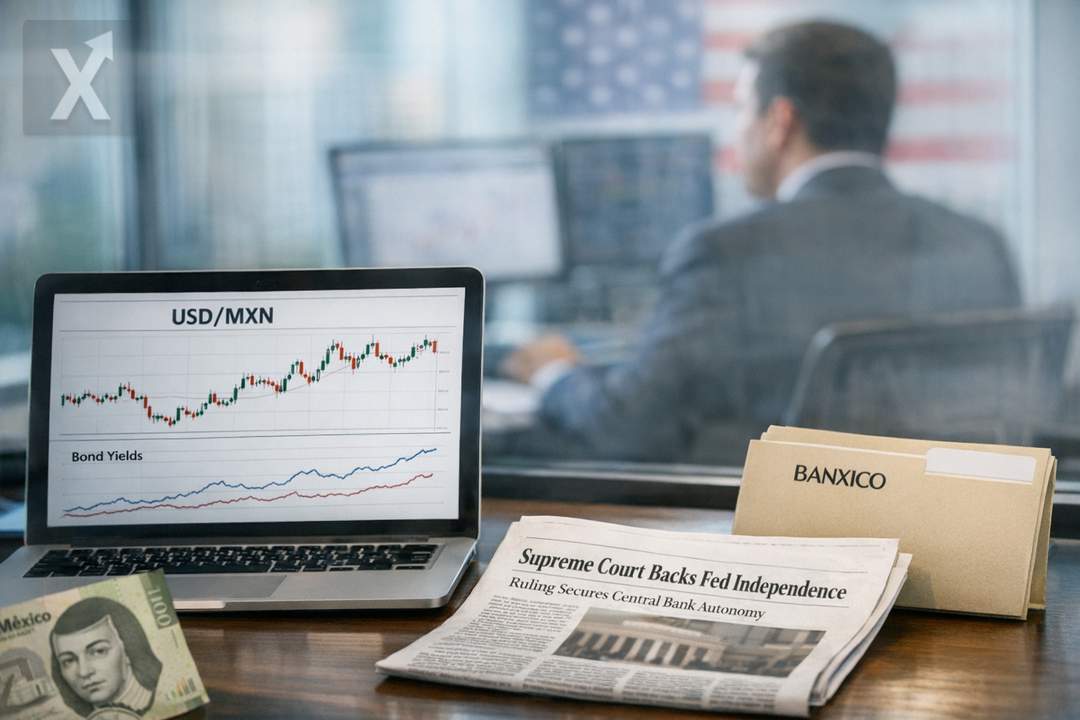
The decision limiting presidential power over the Fed reshapes U.S. rate bets and keeps Mexico’s exchange-rate stability in focus.
The U.S. Supreme Court struck down the dismissal of Federal Reserve (Fed) Governor Lisa Cook ordered by President Donald Trump, concluding—in a narrow 5–4 vote—that the Executive Branch cannot remove central bank officials “for any reason or for no reason at all.” Beyond the political and legal episode, analysts interpreted the ruling as a reaffirmation of the Fed’s independence, a factor that is often crucial for anchoring inflation and interest-rate expectations in global markets.
For Mexico, the news matters: the trajectory of U.S. monetary policy is one of the main drivers of capital flows into emerging markets and of the peso’s performance against the U.S. dollar. When investors believe the Fed retains room to decide based on technical criteria, risk premia tied to abrupt shifts in rates tend to decline. That can help smooth bouts of FX volatility and reprice bonds and equities across regions, including Mexico.
In the near term, the episode adds to an environment in which the interest-rate differential between Mexico and the United States, global risk appetite, and the read on inflation—both in the U.S. and in Mexico—continue to set the tone for the foreign-exchange market. In practice, a Fed seen as less exposed to political pressure can bolster the credibility of its inflation target, influencing the U.S. yield curve and, by extension, external financing costs for Mexican sovereign and corporate issuers.
The impact on Mexico also depends on the trade channel. The United States is Mexico’s largest trading partner, and the performance of the U.S. economy—consumer spending, jobs, and credit—affects demand for Mexican manufactured exports. If Fed independence contributes to more predictable monetary policy, exporters typically face a less uncertain financial planning environment, although a stronger U.S. dollar can affect the cost of imported inputs and corporate margins.
Banxico, autonomy, and the implicit message for the region
The debate over central bank independence resonates directly in Mexico given the importance of the constitutional mandate of the Bank of Mexico (Banxico), whose primary objective is to preserve the currency’s purchasing power. Banxico’s credibility has historically been a key factor in containing inflationary pressures and in moderating episodes of peso depreciation in the face of external shocks—from Fed hiking cycles to bouts of global risk aversion.
In a context of gradual rate normalization and a market that is highly sensitive to institutional signals, the U.S. case reinforces an investor-valued principle: keeping technical monetary-policy decisions separate from day-to-day politics. For Mexico, this often translates into a comparative read: when the monetary institutions of major economies remain independent, the odds of abrupt moves in the U.S. dollar decrease, helping stabilize expectations around imported inflation, energy prices, and financing costs.
Still, greater predictability does not eliminate risks. Mexico remains exposed to changes in U.S. growth, commodity shocks, and episodes of international financial volatility. In that sense, the peso’s performance and local rates will continue to depend on both external factors—such as the path of inflation and employment in the U.S.—and domestic factors, including inflation trends, consumer momentum, investment, and perceptions of country risk.
Looking ahead, the market will focus on two variables: first, whether the Fed maintains guidance consistent with inflation and activity data; and second, whether Banxico preserves clear communication about its balance of risks. If both central banks sustain credible decision-making frameworks, Mexico could face a less erratic external environment—though not necessarily a cheaper one in terms of financing costs, especially if global real rates remain elevated.
In sum, the U.S. Supreme Court ruling does more than resolve an institutional dispute; it also sends a signal about the continuity of checks and balances that underpin macro stability. For Mexico, the main takeaway centers on U.S. rate expectations, moves in the U.S. dollar, and the value markets place on Banxico’s autonomy as an anchor for inflation and the exchange rate.






