Oil Down, Gas Prices Sticky: Why the Discount Takes Time to Reach Mexico
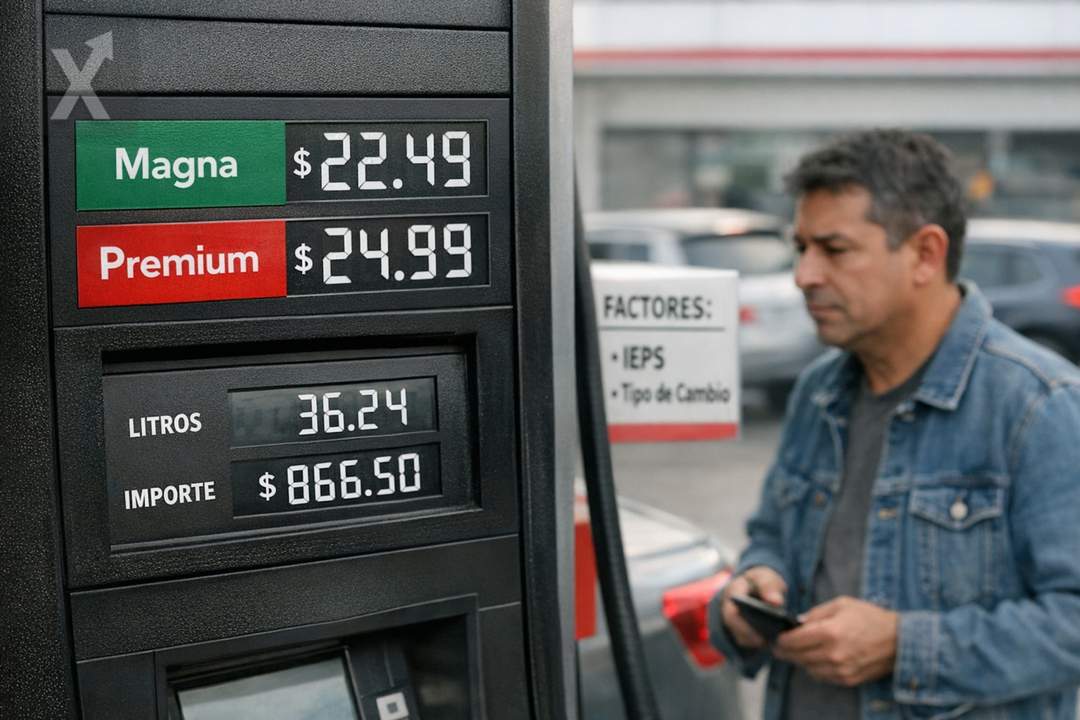
Even as international crude gets cheaper, prices at Mexican pumps often adjust with a lag due to taxes, imports, and logistics costs.
The recent pullback in oil prices—driven by easing geopolitical jitters after signs of understanding between the United States and Iran—has once again raised a familiar question for Mexican households: if crude drops sharply, why doesn’t gasoline fall at the same pace? In the local market, the pass-through of those moves is usually slow and partial, even when Mexico’s export blend posts steep declines.
In recent weeks, the Mexican Blend has fallen from levels near recent highs to around the mid-$70s per barrel, a drop of more than 30%. Even so, retail prices have shown inertia: Regular gasoline has remained virtually unchanged at the start of summer, while Premium has felt pressure from margins, costs, and import dynamics; diesel, meanwhile, has eased off prior peaks but remains high compared with the beginning of the year.
Mexico’s experience shows that gasoline is not a direct “mirror” of oil. When prices rise, the Ministry of Finance typically cushions part of the impact through IEPS tax subsidies to prevent abrupt increases. But when crude falls, pump prices tend to adjust with delays, and in many cases prices do not return in nominal terms to the levels seen before the shock. This asymmetry has been observed since the global energy episode of 2022 and is repeating in 2026.
On top of that, Mexico imports the majority of the gasoline it consumes. That means that, more than the price of the Mexican Blend, what matters for consumers are international benchmarks for finished fuels, transportation and storage costs, regional supply conditions, and the exchange rate. If the peso weakens against the U.S. dollar, part of the benefit of cheaper oil can be offset in the import bill.
IEPS, Imports, and the Exchange Rate: The “Black Box” Behind Pump Prices
The retail price is built as the sum of components that don’t move at the same time: the cost of the molecule (or imported fuel), commercial margins, logistics, and the tax burden. Among them, the IEPS often acts as the main stabilizer: when crude rises and puts pressure on inflation, the Finance Ministry can temporarily reduce the effective tax via subsidies; when crude falls, those subsidies are cut back or eliminated, which limits the visible drop at the pump. At the same time, heavy import dependence means the final price is more closely correlated with U.S. Gulf Coast gasoline and refining costs than with the day-to-day quote of Mexican crude. In that context, falling oil can coexist with relatively firm prices if refining differentials widen, if there are logistics bottlenecks, or if the exchange rate stops being favorable.
The price-stabilization agreement for Regular gasoline also affects how quickly prices adjust. With a large share of stations selling within agreed parameters, local competitive dynamics tend to organize around a “target” price range, which reduces day-to-day volatility but can also make the pass-through of declines more gradual when the external backdrop improves.
From the public-finance perspective, oil still looks relevant. Even after the correction, the observed price remains above the assumption approved in the 2026 Economic Package, which—in theory—boosts oil revenues. Official sensitivities estimate that each additional dollar can add billions of pesos to oil-related revenue, but that benefit does not guarantee an improvement in the net fiscal balance: at the same time, the government may forgo IEPS revenue if it chooses to contain prices, and it also faces spending pressures, debt-service costs, and weaker tax momentum if activity cools.
On the macro front, fuel behavior matters because of its effect on inflation and expectations. Sticky gasoline prices reduce the direct relief to households and can delay the disinflation of certain components of Mexico’s CPI (INPC) linked to transportation. For Banxico, a slower inflation path can translate into less room to speed up rate cuts, especially if external risks persist (global volatility, geopolitical events, or changes in U.S. financial conditions) and domestic pressures remain (services, wages, and logistics costs).
Looking ahead, the key will be whether the oil decline proves durable and whether the import environment remains favorable: refining spreads, exchange-rate stability, and smooth logistics. If those variables cooperate, there could be room for more noticeable adjustments, especially in regions with stronger brand competition. But if the peso depreciates or refining costs rebound, consumers may keep seeing a smaller-than-expected “discount,” even with cheaper oil.
In short, falling oil improves the cost outlook, but it doesn’t automatically translate into cheaper gasoline in Mexico: the IEPS, fuel imports, the exchange rate, and logistics explain the stickiness and lags in the final price, with implications for both inflation and public finances.






