Weak Start to 2026 Puts Treasury’s Forecast Under Pressure and Reignites the Debate Over Potential Growth
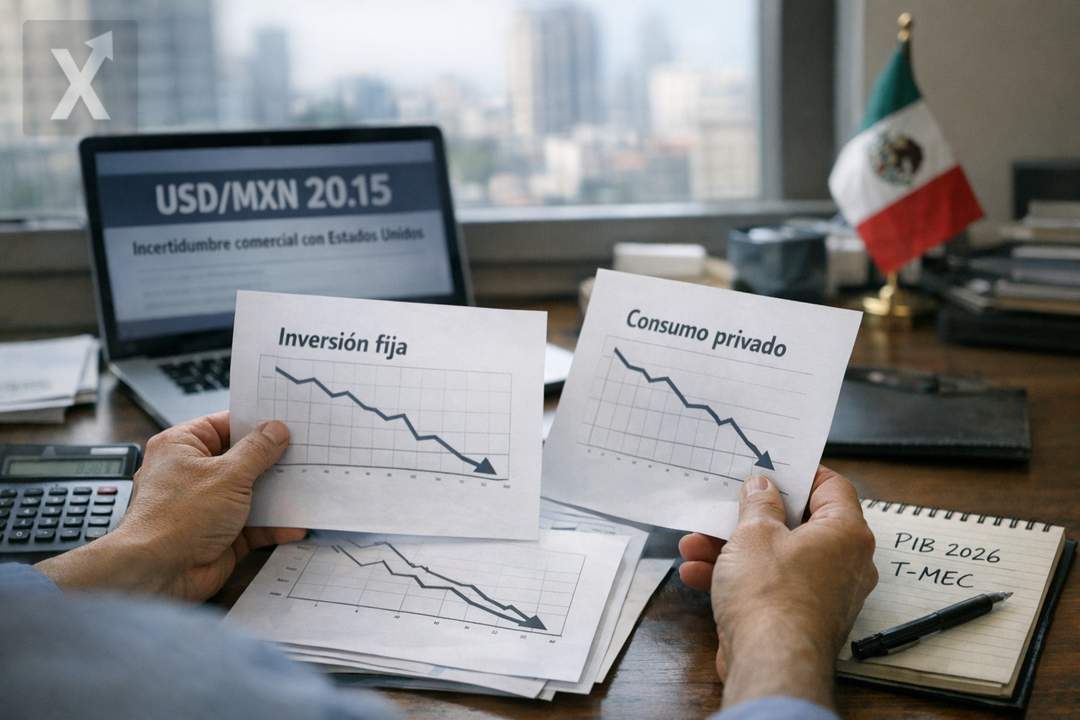
The drop in investment and consumer spending early in the year makes it harder to hit the official target and reinforces signs of a more persistent slowdown.
Mexico’s economic performance at the start of 2026 has reopened a gap between the official outlook and market estimates. The Finance Ministry (Secretaría de Hacienda) said in its Pre-Criterios that growth would fall in a range of 1.8% to 2.8% this year (with a midpoint near 2.3%), but the first activity data—with declines in investment and private consumption in January—strengthen the view that expansion could come in below that floor.
The signal is significant: when consumption and investment weaken at the same time, a rebound usually depends on external factors or a fast improvement in confidence—something difficult in an environment where companies have been cautious about committing long-term capital. In practical terms, the start of the year shapes first-quarter growth and raises the risk that 2026 momentum will be too weak to lift income per capita, which has made only limited gains after several years of modest economic performance.
The contrast with other forecasts is clear. Analysts and institutions have been cutting expectations as evidence mounts that the economy is growing below its potential, while the Bank of Mexico (Banxico) has kept a more cautious view of growth, with projections below Treasury’s central assumptions. That difference matters not only as a technical debate: it affects estimates of public revenues, debt metrics, and the real room to sustain programs and projects without undermining fiscal stability.
In the background is the recent trajectory. In 2025, growth remained low and the economy narrowly avoided a technical recession, but the slowdown lasted long enough to prompt changes in companies’ expansion plans and in formal hiring in some sectors. Even as the labor market retains some buffers—such as real wage gains amid disinflation—investment is the variable that often determines the difference between a cyclical soft patch and a structural problem.
Fixed investment has been hit by a combination of still-high financing costs, mixed signals on regulatory certainty, and the fading of some early boosts tied to supply-chain relocation. What translated into a notable upswing in 2023 turned in 2025 and early 2026 into a string of year-over-year declines, directly affecting capital accumulation, productivity, and the ability to grow faster in the years ahead.
The External Variable: U.S. Trade Uncertainty and the USMCA Review
A key component of the slowdown is the external environment, particularly uncertainty tied to the United States. The 2026 review of the USMCA has effectively created a “wait-and-see” period for capital-intensive projects: when rules of origin, verification mechanisms, or preferential access terms could change, many companies choose to delay decisions until there is greater clarity. In sectors such as auto parts, advanced manufacturing, and electronics, that postponement can quickly show up in machinery orders, industrial construction, and hiring.
In addition, U.S. trade policy has been a recurring source of volatility for export and investment expectations. Mexico benefits from its deep production integration with North America and its logistical proximity, but that same advantage means any change to the trade and compliance framework is transmitted quickly to the real economy. An orderly, predictable USMCA review could unlock stalled projects; a drawn-out process or mixed signals could extend the wait-and-see stance through much of the year.
Domestic factors also matter. Several analysts have noted that recent institutional changes and the debate over the constitutional framework—particularly on issues linked to the judiciary—have raised the uncertainty premium for long-term investment. Meanwhile, public investment has been weak after spending adjustments and shifting priorities, compounded by the fact that fiscal space is limited if the government seeks to keep a prudent debt path and meet consolidation goals.
That fiscal constraint puts Treasury in a bind: protecting public-finance stability in a lower-growth context—which requires realistic assumptions on GDP, inflation, interest rates, and oil revenues—while also avoiding spending cuts that deepen weak demand. In practice, the room to maneuver will depend on tax collection, spending efficiency, and the ability to sustain public investment with a high multiplier effect without jeopardizing the fiscal balance.
For Banxico, the challenge is different but related. In a slowdown, more contained inflation opens the door to gradual rate cuts, which could ease financing costs for households and businesses. However, monetary policy typically works with lags and, by itself, cannot offset a lack of certainty or a shortage of projects ready to move forward. If investment does not rebound, rate cuts may end up boosting short-term consumption more than expanding productive capacity.
Looking ahead to 2027, the official scenario assumes improvement, but the main risk is that low growth becomes “self-reinforcing”: with weak domestic demand, companies invest less in expansion and technology; with less investment, productivity falls and potential growth declines; and with lower potential, any external shock hits harder. Nearshoring remains an opportunity, but it requires complementary conditions: infrastructure, reliable energy, security, human capital, and legal certainty so the pipeline of projects does not stall.
Overall, the start of 2026 strengthens the debate over whether Mexico is facing a temporary soft patch or a gradual loss of structural momentum. The distance between Treasury’s forecast and the signal from leading indicators suggests the key will be restoring investment and reducing uncertainty—especially in the trade relationship with the United States and in the domestic rules framework. Without those elements, the country may preserve macro stability, but with growth too weak to deliver a sustained improvement in living standards.






