Mexico Kicks Off 2026 with Record FDI: More Reinvestment, More Manufacturing, and the Challenge of Attracting New Capital
Mexico captured a record-high level of foreign investment in 1Q26, driven by reinvested earnings, while the challenge of diversifying destinations and attracting brand-new projects persists.
Mexico posted an outstanding start to the year in foreign direct investment (FDI) during the first quarter of 2026, setting an all-time high for the beginning of a year and extending a three-year streak of growth. The performance confirms that, despite a global environment of still-elevated interest rates and bouts of trade tension, the country remains attractive to foreign capital thanks to its production integration with North America, its logistics location, and the momentum behind nearshoring.
According to figures cited by the analysis from México, ¿cómo vamos?, first-quarter FDI has logged consecutive increases of 9.0% in 2024, 5.2% in 2025, and 10.4% in 2026. Behind the gains is the perception that Mexico remains a key link in regional value chains at a time when companies are looking to shorten routes, reduce supply risks, and leverage the industrial base already in place.
However, the breakdown of the flow is just as important as the headline number: reinvested earnings accounted for 94.2% of the quarter’s FDI. In practical terms, that means a substantial share of the record came from companies already operating in Mexico that chose to expand lines, modernize processes, or strengthen working capital in the country, rather than from an equivalent wave of new greenfield announcements (fully new projects).
That makes for a two-sided reading. On one hand, such a high level of reinvestment is often seen as a sign of operational confidence: firms that already know the market see conditions to keep producing and selling from Mexico. On the other hand, it highlights the structural challenge of attracting more “fresh capital” for new plants, new technologies, and geographic expansion—key to ensuring that nearshoring’s benefits spread to more states and local suppliers.
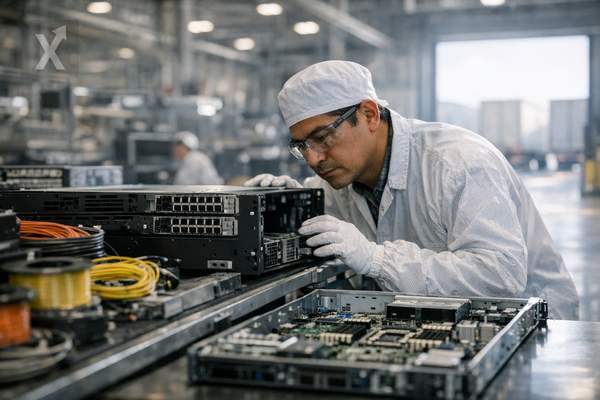
By sector, activities tied to the regional economy and more sophisticated services stood out. Financial services and insurance rose from $5.321 billion to $6.851 billion, an increase of about 28.8%, consistent with greater needs for financing, coverage, and risk management as industrial supply chains become more complex. At the same time, motor vehicle manufacturing climbed from $3.351 billion to $4.033 billion, even amid an international backdrop shaped by tariff frictions and a reshuffling in the global auto industry.
The predominance of the United States in FDI into Mexico was once again central, reflecting the depth of the production and trade relationship. With the USMCA as a framework of relative certainty, many investment decisions tend to hinge on the North American industrial cycle, consumer demand in that market, and the continuity of rules of origin, regional content requirements, and sector-specific policies—particularly in autos, electronics, and medical devices.
At the regional level within Mexico, concentration remained high. Mexico City captured 49.9% of the total, followed by the State of Mexico (8.4%) and Nuevo León (8.3%). This investment map confirms a persistent reality: capital tends to land where there is already logistics infrastructure, available talent, supplier ecosystems, corporate services, and more proven regulatory conditions.
Nearshoring: A Real Opportunity, but Constrained by Infrastructure, Energy, and Talent
Nearshoring continues as both a narrative and a real driver in specific segments, but turning it into new and more widely distributed projects faces bottlenecks. Among the main constraints, specialists often point to energy capacity and reliability (for new electricity-intensive industrial lines), water availability in high-demand regions, logistics and connectivity (highways, rail, border crossings, and ports), as well as security along industrial corridors. Added to that is the human-capital challenge: expanding advanced manufacturing and tech services requires technicians, engineers, and digital talent that can’t be trained overnight, making collaboration among companies, governments, and universities decisive for scaling up.
Regional competition also matters: other countries are trying to capture part of the reshoring/relocation wave with incentives, industrial parks, and streamlined permitting. For Mexico, the differentiator is typically its proximity to the United States and its existing manufacturing base; however, maximizing that advantage requires faster permitting, stronger regulatory certainty, and more infrastructure in states with potential but less-established industrial ecosystems.
Projects identified at this stage point to higher value-added FDI: e-mobility and auto parts, technology and digitalization, medical devices, infrastructure, and financial services. This pattern suggests investment is seeking not only production capacity, but also operating support (finance, insurance, logistics) and technology upgrades to compete in supply chains with tighter requirements around traceability, compliance, and efficiency.
Looking ahead, FDI performance will depend on external variables—U.S. growth, global financing costs, and trade rules—but also on internal factors such as the execution of logistics projects, expansion of power grids, availability of industrial parks, and the strengthening of local supplier capabilities. A larger share of new investment, in addition to reinvestment, would signal that Mexico is turning today’s moment into a long-term structural shift.
In sum, the record in the first quarter of 2026 shows a country that remains a relevant platform for producing and operating in North America, with established companies betting on staying and growing. The challenge will be to convert that confidence into more new projects, better geographic distribution, and stronger local linkages that broaden the economic impact.