Mexican exports hit a record high in April, bolstering a trade surplus
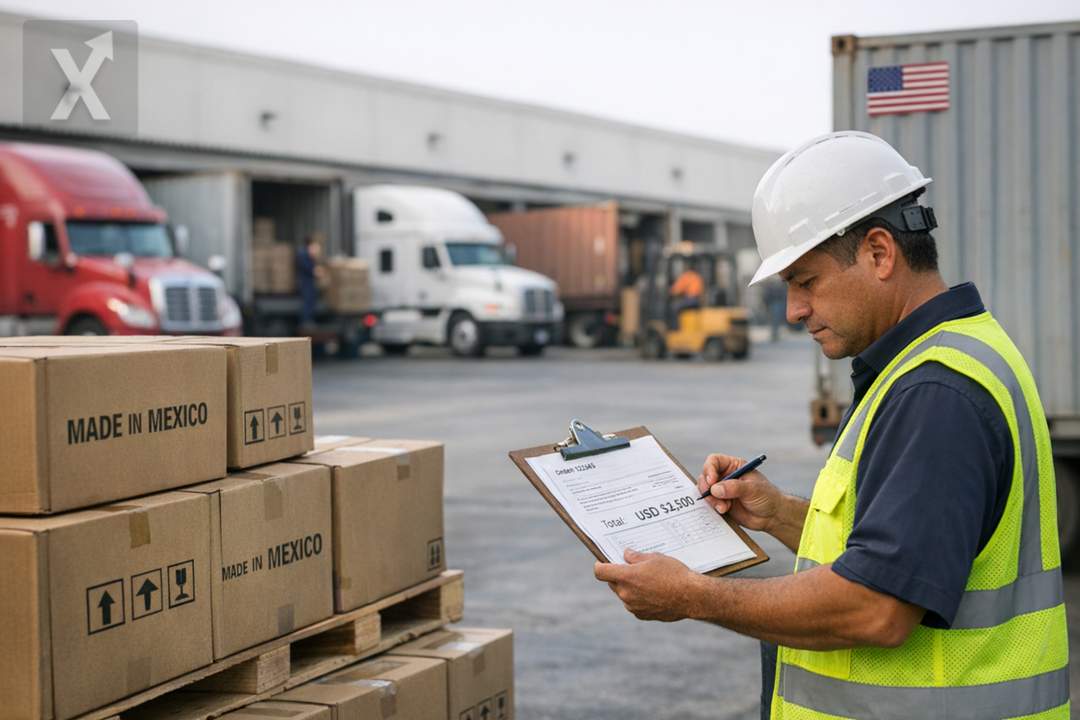
The export surge—driven by manufacturing and demand from the United States—lifted the surplus despite rising imports of production inputs.
Mexico’s foreign trade kicked off the second quarter with an outstanding performance: in April, total exports posted an all-time high, confirming the manufacturing sector’s role as a key growth anchor at a time when industry based in the country continues to capitalize on regional production integration and the reshuffling of supply chains across North America.
According to data from INEGI, exports totaled $72.042 billion in April, a 32.6% increase from a year earlier. Growth was led by non-oil exports, which rose 33.5%, while oil exports increased 7.9%, showing that the boost came mainly from industrial activity rather than hydrocarbons.
Manufacturing accounted for most of the momentum: manufacturing exports reached $65.687 billion, up 34% year over year. Within that, shipments of mining-and-metallurgy products stood out (42.5%), along with food, beverages, and tobacco (16.8%), electrical and electronic equipment (15.9%), and the automotive sector (8.2%), which kept growing, though at a slower pace than other categories.
Export destinations once again underscored Mexico’s dependence on—and at the same time, the strength of—the U.S. market: non-oil exports to the United States rose 34.8% year over year, while those shipped to the rest of the world increased 26.7%. In autos, shipments to the United States grew 5.8%, but exports to other markets jumped 22.5%—a sign of gradual diversification that becomes especially relevant amid bouts of demand volatility and industry-by-industry regulatory changes.
On the oil front, results were mixed. While the average price of Mexico’s export crude blend came in at $94.99 per barrel, export volume fell to 478,000 barrels per day from 726,000 in the same month a year earlier. This suggests that even with favorable prices, volume constraints limit oil’s net contribution to the external balance.
The agricultural sector, for its part, was flat: exports totaled $2.230 billion, just 0.1% above a year earlier. There were sharp contrasts across products: shipments of melon, watermelon, and papaya surged (73.2%), citrus rose (55.8%), and tomatoes increased (24.3%), while avocado exports dropped 28.8% and fresh strawberries plunged 56.5%—moves that are often linked to weather conditions, production cycles, logistics, and sanitary market access.
On the import side, Mexico purchased $67.522 billion from abroad in April, a 24.1% year-over-year increase. Growth was concentrated in intermediate goods—inputs for production—which totaled $54.228 billion and rose 29.8%. This mix is typically read as a sign of elevated industrial activity, consistent with an export model in which much of the value added is generated within regional supply chains that import components to re-export finished or semi-finished goods.
By contrast, imports of consumer goods rose 7.7% and capital goods just 1.3%. The latter is especially notable: weaker momentum in machinery and equipment may point to caution in private investment or more selective investment decisions, in an environment where firms are weighing financing costs, regulatory certainty, and the availability of infrastructure and energy.
With these flows, the trade balance posted a surplus of $4.520 billion in April. While the surplus was smaller than in March ($5.932 billion), the country kept exports above imports. Cumulatively from January to April, the surplus reached $3.508 billion, compared with a $314 million deficit in the same period of 2025.
Implications for the economy: strong manufacturing, mixed signals on investment and energy
April’s performance reinforces the idea that Mexico is benefiting from the regional manufacturing cycle and “nearshoring” as long as external demand—especially from the United States—remains solid. However, the import breakdown adds nuance: the strong increase in intermediate goods is consistent with an expanding export platform, but the modest growth in capital goods could suggest that the next phase—expanding productive capacity—may move at an uneven pace across sectors and regions. This is compounded by oil’s performance: when export volumes fall, the economy loses an external buffer that in other episodes helped offset shocks in manufacturing. Looking ahead, attention will focus on the durability of the U.S. industrial cycle, Mexico’s ability to attract complementary investment (supplier networks, logistics, semiconductors, auto parts), and domestic bottlenecks such as energy, water, security, and transportation, which affect costs and delivery times.
In broader perspective, a sustained trade surplus can support macroeconomic stability by strengthening the external position and cushioning periods of financial volatility. Still, the structural challenge remains: raising domestic content, boosting investment in capital and technology, and improving productivity so that the export boom translates into broader and more lasting growth in the domestic economy.






