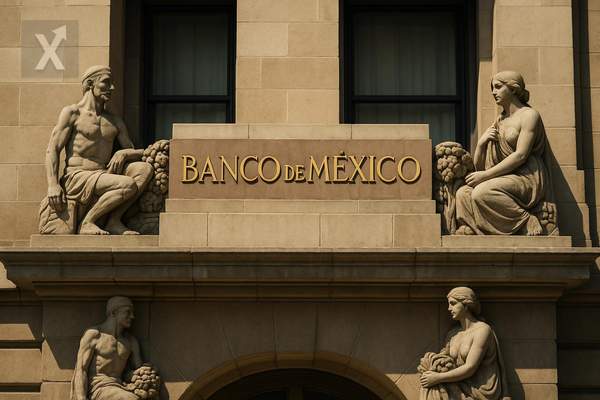
Alan Greenspan Dies; His Legacy Rekindles the Debate Over U.S. Rates and the Impact on Mexico
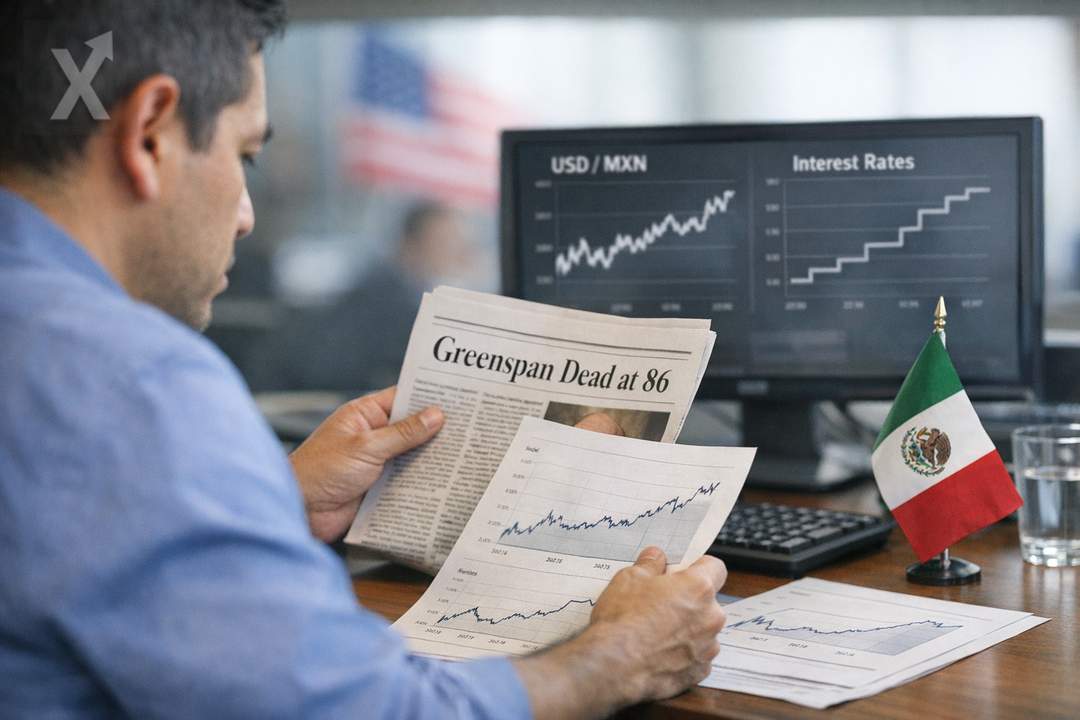
Alan Greenspan’s death puts renewed scrutiny on how Fed decisions influence Mexico’s peso, inflation, and the cost of credit.
The death of Alan Greenspan, former chairman of the U.S. Federal Reserve (Fed), at the age of 100, has revived in markets and economic policy circles the discussion about the role of central banks in financial stability. Greenspan led the Fed from 1987 to 2006, a period marked by disinflation, long expansions, and a growing sophistication of the financial system, though his reputation became controversial after the 2008 global crisis, when questions arose over whether regulation and the assessment of systemic risk were sufficient.
Beyond the historical accounting in Washington, Greenspan’s figure serves as a reminder of a still-relevant reality for Mexico: U.S. monetary policy is often the main “external wind” affecting the peso and domestic financial conditions. When the Fed tightens or eases its stance, the adjustment is transmitted through capital flows, interest-rate differentials, asset valuations, and inflation expectations—channels that in Mexico affect borrowing costs for companies and households, as well as the sovereign risk premium.
In recent years, the link has become more visible amid a backdrop of elevated global inflation (which has gradually moderated), bouts of risk aversion, and deep trade integration with the United States. For Mexico, which operates under a flexible exchange-rate regime, moves in the U.S. dollar are often quickly reflected in quotes, hedges, and investment decisions, while the pass-through to prices depends on the degree of exchange-rate pass-through, domestic competition, and the stance of local monetary policy.
In that context, the Bank of Mexico (Banxico) has sought to anchor expectations and keep inflation on a path toward its target, calibrating its stance based on core price dynamics, economic activity, and the external environment. The interest-rate differential versus the United States also influences demand for peso-denominated assets, a factor that has at times contributed to exchange-rate resilience, though without eliminating sensitivity to global shocks.
From Fed “communication” to Mexican wallets: transmission channels
Greenspan was among the first modern central bankers to turn communication into a policy tool: his messages—sometimes deliberately cryptic—moved expectations and, with them, long-term rates. Today that mechanism is even more powerful: a Fed signal about the direction of rates can reshuffle portfolios and affect risk appetite in emerging economies. In Mexico, this translates into exchange-rate swings, changes in banks’ funding costs, and adjustments in yields on government bonds; in turn, consumer and business credit often feels the strain during periods of high rates, while export-oriented sectors may benefit or come under pressure depending on the dollar’s direction and external demand.
Transmission also runs through confidence: when the market perceives an environment of institutional stability in monetary policy, the adjustment can be less abrupt. In Mexico, Banxico’s credibility, public-debt management, and the quality of the financial regulatory framework are elements that shape the reaction to a Fed shift. In a country with an export base integrated into North American supply chains, the U.S. cycle also directly influences manufacturing output, investment, and employment—reinforcing the link between U.S. monetary policy and local performance.
The debate that surrounded Greenspan—over whether price stability is a sufficient condition for financial stability—also resonates in Mexico. After global experiences of asset exuberance, authorities and market participants have paid closer attention to leverage risks, credit quality, and sector concentration. In this setting, coordination among monetary policy, prudential regulation, and supervision becomes crucial to contain vulnerabilities, especially when rates remain high for extended periods.
Looking ahead, Mexico’s main focus will continue to be the balance between keeping inflation on a downward trajectory and avoiding an excessive drag on activity, in an environment where the Fed could hold a restrictive stance longer than expected if prices or the U.S. labor market prove slow to cool. For Mexican issuers, households, and local governments, reading the U.S. rate cycle will remain a key input for deciding maturities, hedges, and financing structure.
In sum, Alan Greenspan’s death closes an emblematic chapter in contemporary monetary policy, but his legacy leaves a timely lesson for Mexico: financial stability depends as much on interest rates and inflation as on risk management and institutional clarity, in a world where the Fed still sets the rhythm for global conditions.