Banxico Nears the End of Its Rate-Cutting Cycle: The Policy Rate Enters the Final Stretch
Governor Victoria Rodríguez Ceja signals one last rate cut, as Banxico fine-tunes inflation risks and takes the economy’s growth pulse.
The Bank of Mexico (Banxico) is lining up one final cut to its benchmark interest rate before declaring the easing cycle that began in 2024 over. That comes as inflation remains above the 3% target but is gradually moderating. Governor Victoria Rodríguez Ceja laid this out during her appearance before the Senate, noting the central bank is “close to concluding” this phase of adjustments, which overall has delivered a cumulative 450-basis-point reduction.
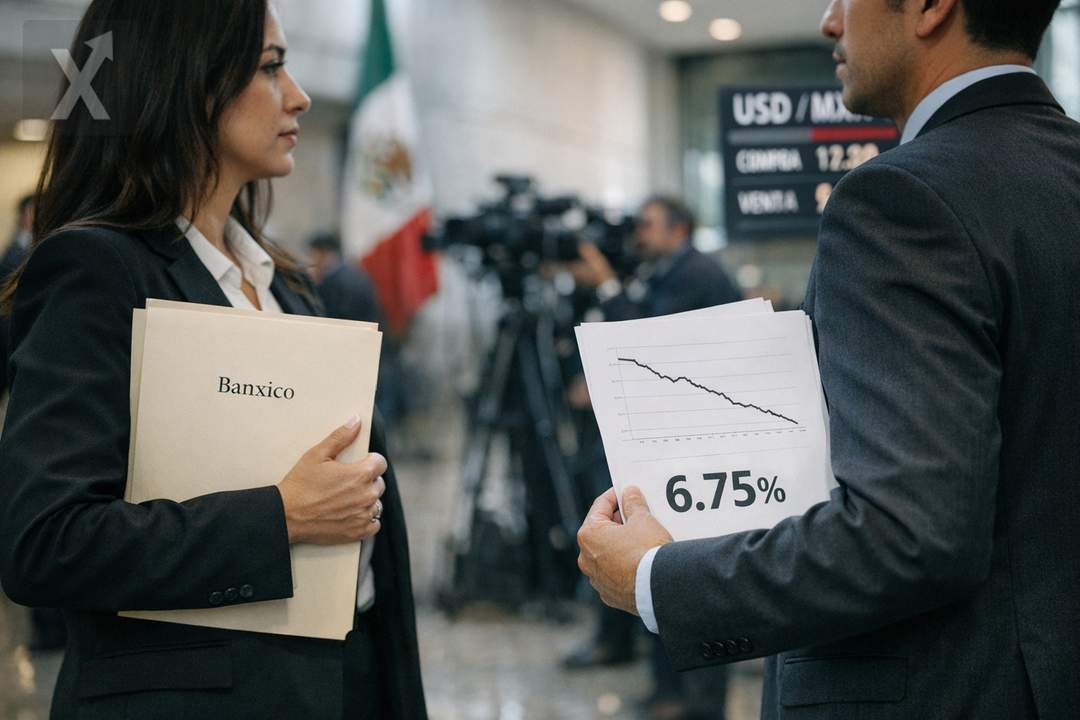
The message follows Banxico’s March 26 rate cut, which brought the policy rate to 6.75% in a split vote. The decision fueled debate in the market, especially because headline inflation remains outside the desired range and because the non-core component—more volatile—has been hit by food shocks, particularly in fruits and vegetables, which often drive short-term moves in the indicator.
Defending the cut, Rodríguez Ceja argued that monetary policy isn’t set off a single data print, but rather an overall assessment of trends, risks, and transmission lags. In Mexico, the tight stance implemented in recent years—when rates were held high for an extended period—continues to affect credit, investment, and consumption with a delay. From the central bank’s perspective, that helps lock in the disinflation process even if convergence to 3% is not immediate.
A core part of Banxico’s argument has been the exchange rate: the Mexican peso has stayed relatively strong against the U.S. dollar, which typically makes imports cheaper and helps contain goods prices. The governor even pointed to signs of potential misalignment relative to fundamentals—an important comment because a prolonged appreciation can also reverse quickly if external financial conditions shift or if risk appetite toward emerging markets changes.
The central bank has also emphasized that Mexico’s economy has shown signs of cooling compared with earlier periods, with slack in certain sectors and growth that—while expected to pick up later relative to the start of the year—would not necessarily translate into broad-based demand pressures. In other words, Banxico’s risk balance suggests growth by itself is not strongly pushing inflation higher, at least at the margin.
The global backdrop, however, still weighs heavily. Geopolitical tensions in the Middle East have triggered bouts of energy-price volatility, creating upside risks for global inflation. In Mexico, public-policy measures aimed at cushioning the pass-through from oil-price swings to consumer prices can soften the impact, but they do not fully eliminate the risk of external shocks—especially if those shocks persist or coincide with currency depreciation.
What a “Last Cut” Means: Credit, the Peso, and Investment
If Banxico delivers one additional cut and then pauses, the market takeaway would be twofold: on the one hand, it would acknowledge progress on disinflation and on monetary-policy transmission; on the other, it would reinforce that the priority remains anchoring expectations, preventing inflation from getting “stuck” above target. For households and businesses, a lower rate typically translates over time into improved financing conditions, though the effect is uneven: consumer credit and lending to SMEs may take longer to reflect it, while variable-rate instruments adjust more quickly. In the FX market, an additional cut could narrow the rate differential versus the United States—a key factor for portfolio flows. Even so, the peso’s performance also depends on external accounts, country risk, fiscal expectations, and how investors interpret the economic and political cycle.
In the background, Banxico is also bracing for a year with added uncertainty tied to the USMCA review. The governor noted that regional integration and coordination among authorities can strengthen the cooperation framework, but she acknowledged the process may generate bouts of unease due to a lack of clarity on timing and the scope of negotiations. In that kind of scenario, the exchange rate could serve as an adjustment valve, and the central bank has signaled it will closely monitor market reactions.
For Mexico, expectations around supply-chain relocation—nearshoring—remain a medium-term driver, conditioned on infrastructure, energy availability, security, water, and regulatory certainty. A lower-rate environment helps at the margin by reducing the cost of capital, but productive investment decisions typically respond more to clear rules, logistics, and market access. Banxico’s stance, in that sense, seeks to balance economic momentum with its top priority of price stability.
Looking ahead, the key will be whether core inflation continues to trend down, whether food and energy shocks ease, and whether U.S. monetary policy shifts tone—factors that directly affect the rate differential and local financial stability. A “last cut” does not mean an automatic return to low rates; rather, it suggests a wait-and-see phase in which incoming evidence and risks will determine how long the pause lasts.
Overall, Banxico’s message points to ending the cycle cautiously: recognizing progress on disinflation and cooling demand, while keeping in mind that inflation is still above target and that the exchange rate can react sharply to external shocks or trade uncertainty.