Trump Ramps Up Tariff Pressure on the EU, and Mexico Gauges the Risk to Its Auto Industry
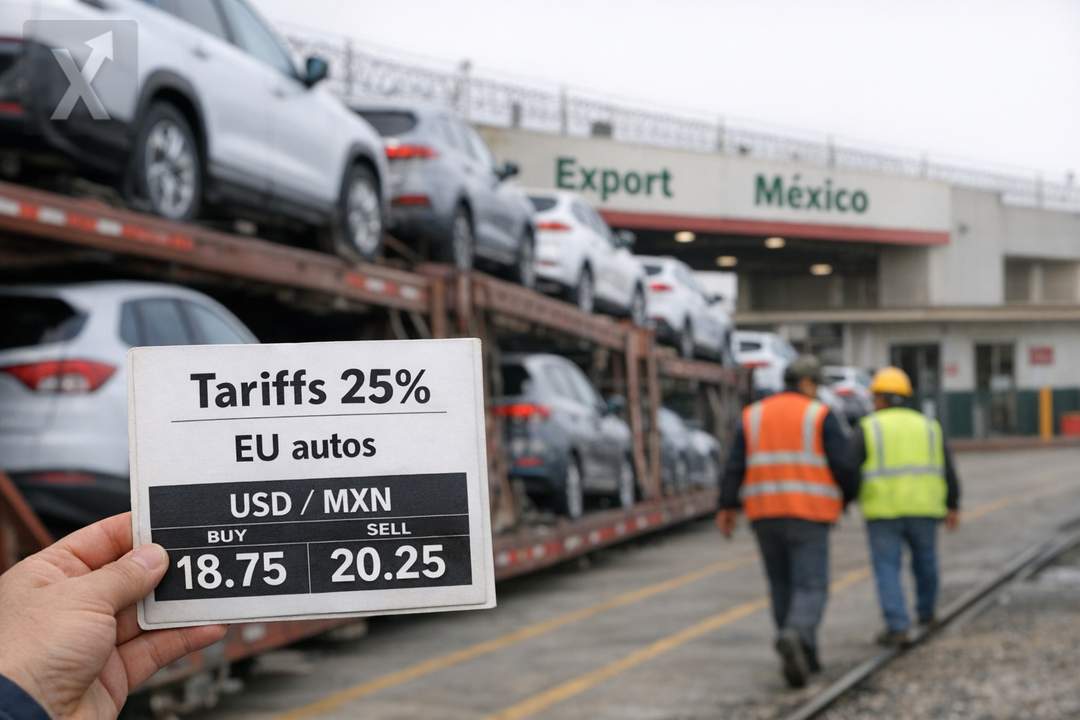
The announcement of 25% tariffs on EU cars and trucks revives trade uncertainty and forces Mexico to recalibrate its export strategy.
U.S. President Donald Trump announced that next week he will raise tariffs to 25% on automobiles and trucks coming from the European Union (EU), accusing the bloc of failing to meet trade commitments. If implemented, the move would mark a shift from the earlier understanding that had capped the levy at 15% for European cars and auto parts.
Beyond the direct hit to European manufacturers—with Germany potentially among the hardest hit given its export weight—the change tightens the global outlook for the auto sector and reopens questions about the reshuffling of supply chains toward North America. For Mexico, whose economy remains highly exposed to the U.S. manufacturing cycle, the announcement lands at a delicate moment: an industrial slowdown, cautious investment, and an interest-rate environment that is still high, though with signs of possible monetary easing by the Bank of Mexico (Banxico) as inflation cools.
The auto industry is one of Mexico’s main export engines and a key pillar of nearshoring. Most Mexican vehicles and auto parts are shipped to the United States, so any change in relative prices, trade rules, or the cost of accessing the U.S. market can end up reshaping production plans, sourcing platforms, and investment decisions.
Implications for Mexico: Limited Opportunities and Risks From Rules of Origin
In the short term, a higher tariff on European vehicles could give a competitive opening to producers based in North America, including those operating in Mexico—so long as they comply with USMCA rules of origin and associated labor requirements. However, the opportunity is not automatic: a significant share of the content in vehicles assembled in Mexico includes imported inputs—including components from Europe and Asia—and changes in costs or customs scrutiny can squeeze margin structures.
In addition, Mexico’s industry faces a twofold challenge. On one hand, U.S. demand is sensitive to prices and financing conditions; if tariffs raise the final cost of certain models, the adjustment could shift sales across brands, but it could also cool the overall market. On the other, competition to capture investment from the production realignment is intensifying: the United States is looking to consolidate regional manufacturing while also hardening its trade stance toward extra-regional partners, which could translate into greater regulatory volatility.
For Mexico, the broader message is that U.S. trade policy can change quickly and for reasons that are not always strictly economic. That increases the value of certainty for long-term projects—from new plants and expansions to supplier integration, cross-border logistics, and energy capacity. In this context, the peso’s performance against the U.S. dollar and Banxico’s decisions also matter, because they affect the cost of importing inputs, export competitiveness, and financial conditions for working capital.
Macro Backdrop: Manufacturing, Investment, and the Exchange-Rate Factor
The tariff hit announced against the EU adds to a landscape in which Mexico is trying to sustain nearshoring appeal, but is still dealing with bottlenecks in infrastructure, water, and electricity in key industrial hubs. Gross fixed investment has shown periods of resilience, but the machinery-and-equipment component—especially imported equipment—is sensitive to exchange-rate volatility and growth expectations. If trade noise rises, some companies tend to delay decisions until they have clarity on rules, costs, and market access.
On the financial front, Mexico has maintained an interest-rate differential that supports portfolio inflows, though the forward path depends on inflation converging and the Federal Reserve’s cycle. A relatively firm peso helps contain price pressures in imported goods, but it can reduce competitiveness for certain segments if it isn’t accompanied by productivity and logistics improvements.
In sum, Trump’s tariff announcement targeting the EU revives uncertainty in an industry that is crucial for Mexico. The possibility that North America gains share versus Europe exists, but it is constrained by rules of origin, supplier capacity, and regulatory stability. For the Mexican economy, the challenge is to turn the moment into sustained productive investment—without losing sight of how quickly trade volatility can spill over into output, exports, and jobs.






