USMCA and Global Volatility: The Factor Keeping an Extra Premium in Mexican Bonds
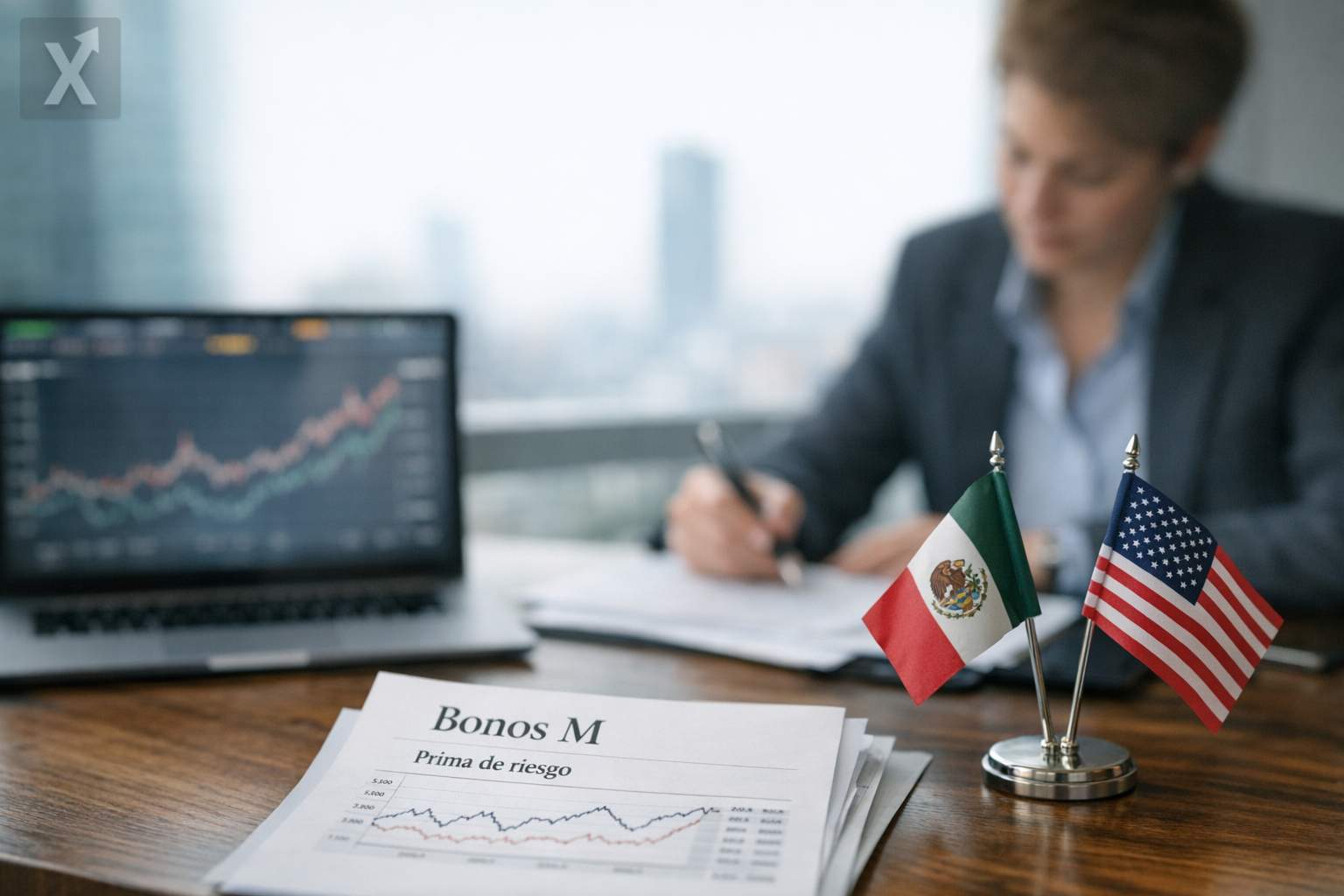
The premium on Mexican debt reflects less about local inflation and more about trade uncertainty with the United States, which could shape the 2026 cycle.
Even with signs of cooling inflation and a rate path that is gradually pointing lower, Mexico’s debt market continues to carry an additional “premium” that can’t be explained solely by macro fundamentals. At the center of the debate is the review of the United States–Mexico–Canada Agreement (USMCA), which has increased the sensitivity of government bonds to trade headlines and bouts of geopolitical stress.
At the long end of the curve, the compensation investors demand to hold Mexican bonds—the term premium—has remained high compared with advanced economies, even as Mexico retains investment-grade status and a track record of monetary discipline. That combination has supported the appeal of peso carry-trade strategies in an environment where rate differentials remain wide versus countries with lower yields.
According to estimates circulated by Oxford Economics, the yield on the 10-year sovereign benchmark was hovering around 8.9% by March 2026—high relative to advanced-economy peers and competitive versus other emerging markets. The key point, they argue, is that a meaningful share of that yield isn’t just the “rate,” but a risk premium tied to the trade relationship with the United States, the main destination for Mexican exports and the backbone of North America’s integrated manufacturing model.
The market’s read is binary: a USMCA review that reduces uncertainty could compress yields and keep the peso relatively strong; a rocky process, by contrast, would tend to lift risk premia, raise borrowing costs, and worsen investment expectations. The same analysis warns that the exchange rate may be supported by temporary factors—such as carry—and that under some models the peso looks above its equilibrium value, leaving it vulnerable when external shocks rise or risk appetite fades.
In parallel, Banxico has kept a cautious message: disinflation allows for gradual cuts, but the balance of risks has shifted outward. The debate over the pace of monetary easing intersects with global volatility and the need to preserve orderly financial conditions—especially in an economy where credit, investment, and consumption quickly feel episodes of depreciation or sharp increases in long-term rates.
Investment Grade, a Local Buyer Base, and the Market’s “Cushion”
One factor that has limited episodes of dislocation along the curve is the depth of the local market. Banxico has underscored in recent statements and reports that there is a broad, diversified base of holders—including Siefores (pension funds), fixed-income mutual funds, and commercial banks—able to absorb issuance and cushion outflows. This domestic support doesn’t eliminate sensitivity to shocks, but it does reduce the likelihood of disorderly moves like those seen in less-deep markets.
Also, relative to Latin America, Mexico maintains a key advantage: its investment-grade rating and a debt profile that, while facing pressure from higher spending needs and interest costs, is viewed as more contained than that of several regional peers. On the sovereign-risk gauge, Mexico’s EMBI has sat at relatively restrained levels compared with economies such as Colombia, Ecuador, or Argentina, helping explain why local debt often regains traction when the global backdrop stabilizes.
The challenge is that this resilience coexists with heavy dependence on the U.S. industrial cycle and a trade agenda that directly influences investment and reshoring/nearshoring decisions. In a scenario where the USMCA review comes with frictions—or with periodic reviews that prolong uncertainty—investors could demand a more persistent premium even if local inflation continues to ease. Under that dynamic, the policy rate could fall, but long-term yields wouldn’t necessarily drop at the same pace if the market keeps “charging” for trade risk.
For the exchange rate, the message is similar: the peso has gained appeal thanks to rate differentials and flows into local-currency instruments, but that strength can reverse quickly when geopolitical shocks, rising risk aversion, and noise around the bilateral relationship with the United States combine. In recent weeks, the peso’s sensitivity to conflicts in the Middle East and to moves in the dollar has been a reminder that beyond fundamentals, the financial channel amplifies uncertainty.
Heading into 2026, the roadmap for Mexican bonds is defined less by the question “How much will inflation come down?” and more by “How much certainty will there be around the rules of trade?” If the USMCA review stays on track, Mexico could see a gradual compression of premia and better conditions for productive investment; if the noise drags on, the cost of capital could remain high despite disinflation, with implications for growth.
In short, the market recognizes Mexico’s relative strength—financial depth, a local buyer base, and investment-grade status—but continues to price in uncertainty over trade with the United States. The USMCA outcome and external volatility will be decisive in determining whether local debt transitions to a lower-premium environment or whether a “new floor” of risk becomes the norm at the long end.






