Banxico Cuts Rate to 6.75% and Reinforces a Cautious Message Amid an Inflation Uptick
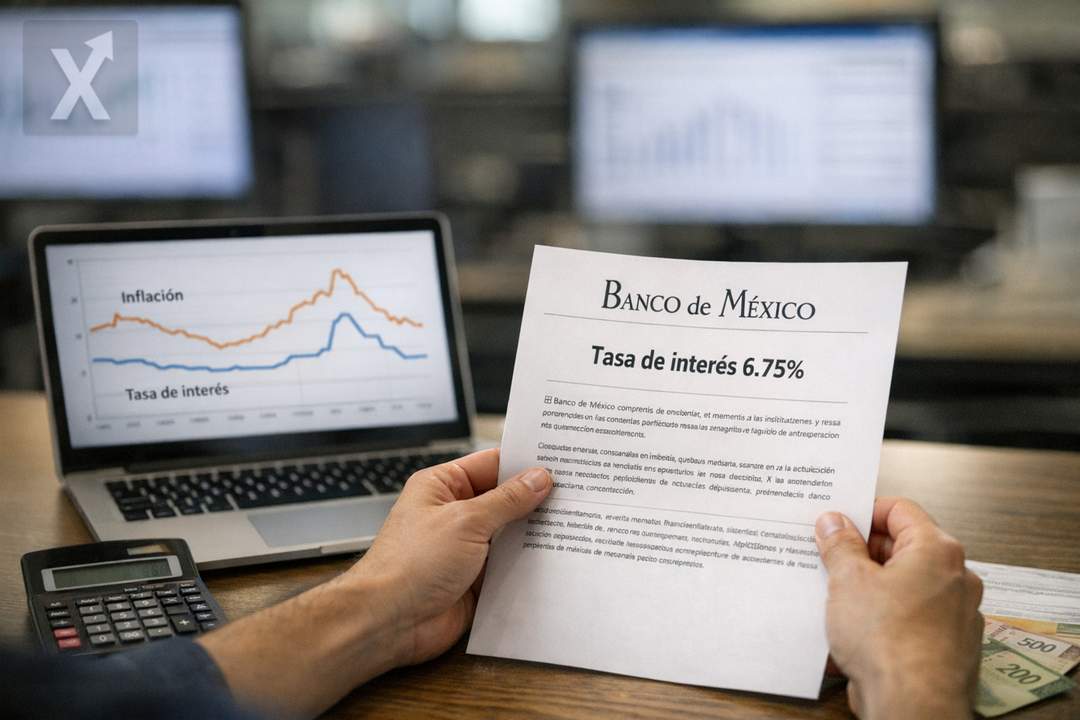
The central bank lowered the policy rate to 6.75% and kept a cautious tone on inflation and external risks, as the market adjusts expectations.
The Bank of Mexico (Banxico) cut its benchmark interest rate by 25 basis points to 6.75%, its lowest level since March 2022. The decision confirms that the easing cycle is continuing, but it comes at a time when inflation has started to push higher again and the economy is showing signs of slowing—forcing the monetary authority to balance its goal of converging to the 3% target with the need to avoid choking off activity.
The vote was not unanimous: two members of the Governing Board favored holding the rate at 7%, underscoring that the internal debate is focused on the appropriate pace of monetary easing. In its statement, Banxico emphasized that the current degree of restraint remains consistent with the inflation outlook, taking into account exchange-rate behavior, weakness in economic activity, and the amount of tightening already accumulated.
The cut follows an uptick in headline inflation in the first half of March to 4.63% year over year, while core inflation—closely watched to gauge the medium-term trend—came in at 4.46%. The uptick was driven by increases in food and services, categories that tend to feed into the consumer basket more persistently.
In its forecasts, Banxico revised up its inflation estimates for the first three quarters of the year (4.1%, 4.0%, and 3.7%), a sign that convergence could be slower. For the market, this reinforces the view that the central bank will seek to keep a restrictive stance for longer, even with gradual cuts, to prevent inflation expectations from becoming unanchored.
Between Domestic Slowdown and External Shocks: The Dilemma Over the Pace of Cuts
Mexico’s economy has faced a combination of softer momentum in some domestic-demand indicators and a volatile global environment. In that context, Banxico has reiterated that its path will depend on how macroeconomic and financial conditions evolve. Factors that could alter the pace of cuts include episodes of FX volatility, swings in international energy and food prices, and the impact of trade measures such as tariffs on supply chains. Added to that is the risk that geopolitical tensions—such as a prolonged escalation of the conflict in the Middle East—could show up in logistics costs, fuel prices, and inflation expectations.
For households and businesses, a lower policy rate typically translates—after a lag—into some relief in borrowing costs; however, pass-through is neither immediate nor uniform, since it depends on banking competition, risk profiles, and loan tenors. With core inflation still above 4%, the central bank appears to be aiming for easing that is gradual enough to avoid reigniting price pressures, especially in services.
In financial markets, the decision is also viewed through the lens of the interest-rate differential versus abroad and its potential impact on flows and the exchange rate. While a relatively stable peso can help contain imported inflation, Banxico has made clear it does not target the exchange rate; its priority remains price stability and, by extension, the credibility of its monetary-policy framework.
Looking ahead, the central message is prudence: Banxico is keeping the door open to further cuts, but only if inflation returns to a clearer downward path and the balance of risks does not deteriorate. In a year with mixed pressures—economic slowdown on one side and price shocks on the other—the central bank appears set to move step by step, ensuring that lower rates do not compromise convergence toward the target.






