USMCA 2026: Mexico’s Labor Reform Faces Its Most Delicate Test
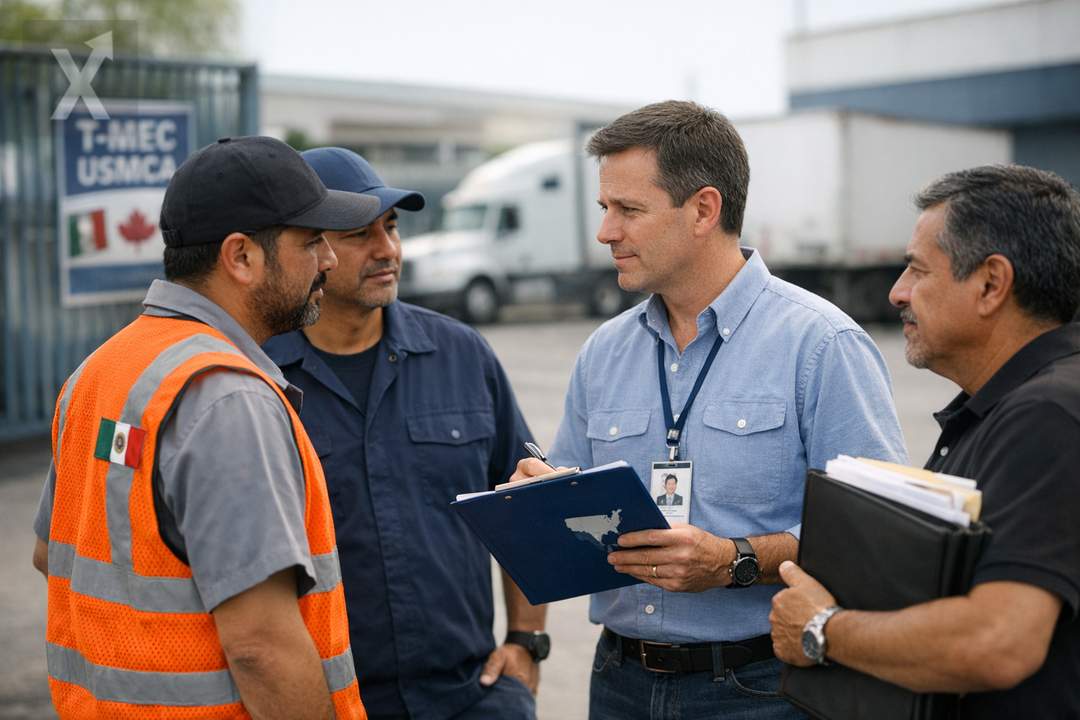
Mexico heads into the USMCA review with institutional labor gains, but rising pressure on inspections, case management, and sustaining the reform.
As Mexico shares the spotlight with the United States and Canada on the road to the 2026 FIFA World Cup, the decisive match for the region’s economy will be played off the field: the USMCA review. Industrial and agricultural issues will converge in the negotiations, but the labor chapter is shaping up to be one of the most sensitive due to its direct impact on costs, competitiveness, and investment certainty. At the same time, the debate is taking on a more political tone amid the possibility—raised at different times by U.S. President Donald Trump—of tightening the agreement’s terms or letting it expire if Washington’s priorities are not met.
For Mexico, the review arrives with a mixed scorecard. On one hand, the labor reform launched between 2017 and 2019 changed the rules of the game that for decades had propped up a collective bargaining model criticized for its opacity. On the other, the country faces an implementation challenge: sustaining new institutions, building technical capacity, and responding to unprecedented scrutiny—just as the labor market operates under its own strains (high informality, turnover, and wage heterogeneity) and as investment seeks certainty amid the reshaping of North American supply chains.
The institutional redesign was sweeping: the old conciliation and arbitration boards were replaced by labor courts within the Judicial Branch, mandatory pretrial conciliation was strengthened, and the Federal Center for Conciliation and Labor Registration (CFCRL, by its Spanish acronym) was created to oversee union life, collective bargaining agreements, and contract legitimation processes. In economic terms, the goal is not only about rights: the USMCA brought labor into the core of the treaty to reduce incentives to compete through depressed wages or lax standards—something that in the United States was long associated with manufacturing job losses and downward pressure on pay.
In practice, the new framework requires Mexico to prove that the shift is not merely on paper, but verifiable at workplaces. The key is authentic collective bargaining and workers choosing representatives without coercion. That is particularly relevant in export-integrated sectors—autos, auto parts, steel, electronics—where any trade or reputational sanction can translate into higher costs, disruptions, and reduced appeal for reshoring and nearshoring projects.
A central component is the Rapid Response Labor Mechanism (RRM), designed to address specific cases of alleged denial of freedom of association and collective bargaining. To date, dozens of proceedings have been filed against companies operating in Mexico, confirming that labor has stopped being a side issue and has become an operational factor in trade. The pattern has also shifted: from early settlements through cooperation to disputes that increasingly move toward panels, with rulings that tend to pressure Mexico to speed up corrective actions.
In the early years, part of Mexico’s capacity was bolstered by U.S. technical assistance focused on digitization, training, and institutional strengthening. However, the cancellation of some support programs in 2025—according to analyses cited by specialists at the Inter-American Dialogue and Grupo Estrategia Política—raised the risk that the system will operate with fewer resources just as the caseload grows, staff turnover increases, and the need for judicial and administrative specialization becomes more acute.
Inspections, informality, and forced labor: the economic vulnerabilities in the labor agenda
The most immediate challenge is enforcement. Mexico has a longstanding shortfall in labor inspections when comparing the size of its workforce to the number of federal inspectors, limiting its ability to detect violations and prevent conflicts that later escalate under the RRM. In parallel, informality—which in Mexico often hovers above half of employment, according to INEGI estimates—complicates oversight and reduces the effectiveness of reforms designed for formal labor relationships. This creates a duality: while export sectors operate under an international spotlight, a large share of the labor market remains outside institutional mechanisms, affecting productivity, tax collection, and upward wage mobility.
Another vulnerability is forced labor, an issue that has become a higher priority in the United States and is tied to supply-chain due diligence policies. For Mexico, the risk is not only legal—it is also commercial and reputational, especially in labor-intensive activities such as certain agricultural production. If investigations and restrictive measures increase on goods linked to irregular practices, the impact could be felt in regional exports, local employment, and supplier stability, pushing companies to strengthen internal controls and traceability.
Adding to this is a security dimension: some case files have documented alleged interference by organized crime groups to suppress collective rights at workplaces. In economic terms, that intersection of violence and labor relations is a red flag for investment: it raises compliance costs, undermines operational certainty, and can increase the cost of insurance, logistics, and hiring in higher-risk regions.
At the macro level, the outcome of the USMCA review intersects with Mexico’s strategy to attract investment through nearshoring. The promise of U.S.-integrated manufacturing depends as much on infrastructure and energy as on a predictable labor environment. If Mexico manages to consolidate labor courts, conciliation, and union registration with autonomy and reasonable timelines, it can reduce uncertainty and strengthen competitiveness not through “low wages,” but through productivity and stability. If it fails to do so, labor disputes could become a recurring cost for exporters and an argument for tougher conditions in the trade negotiation.
For companies, the message is clear: the labor agenda is now part of the regulatory risk of regional trade. That means investing in compliance, traceability, training, and internal grievance and representation mechanisms, as well as planning for audit and review scenarios. For the government, the challenge is to maintain momentum: more inspectors, better coordination, technical capacity, and institutional safeguards so the reform does not depend on political cycles.
In short, Mexico reaches 2026 with a labor reform that has advanced in design and institution-building, but that faces its maturity test in day-to-day enforcement and in its ability to respond to increasingly demanding international scrutiny. The USMCA review will be a thermometer of continuity: the outcome could reinforce North America’s productive integration or open a period of friction with direct impacts on investment, exports, and formal employment.