Mexican exporters rethink their strategy: the challenge is no longer just attracting investment, but keeping it amid tariffs and the USMCA review
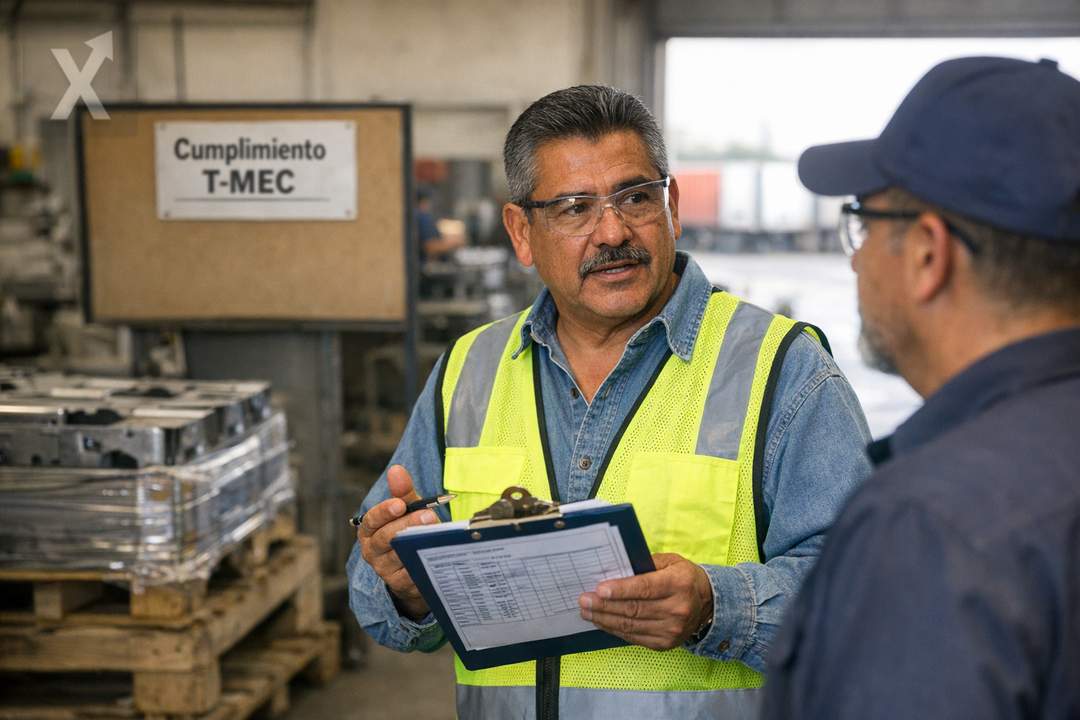
Trade uncertainty is reshuffling capital decisions: Mexico is trying to avoid a “silent drain” of expansions and new production lines to the United States.
Export-oriented manufacturers operating in Mexico are reshuffling priorities in a more uncertain North American trade environment: instead of focusing on attracting new plants, the immediate goal is to retain investments already in the pipeline—expansions, new models, and upgrades—to keep capital from being reassigned to the United States (U.S.). The view within the sector is that the risk won’t necessarily show up as sudden shutdowns, but as a gradual loss of competitiveness when companies choose to place their next project in another jurisdiction.
This shift in focus matters because export manufacturing carries significant weight in Mexico’s economy. Companies affiliated with industry associations such as Index include more than 1,200 manufacturers and account for a majority share of Mexico’s manufactured exports to the United States, the country’s main trading partner. In a context where U.S. industrial policy and tariff fronts are shaping supply chains, the business message is clear: keeping operations in place does not guarantee future investment will stay.
Concern is reinforced by signals seen in Canada, where business surveys have pointed to a partial shift of production toward the U.S. market, along with cuts to capital spending. For Mexico, the key parallel is not a full exit of companies, but a “rebalancing” of investment portfolios in favor of locations with greater regulatory certainty or closer proximity to the end customer—especially when margins are squeezed by costs, logistics, or compliance with rules of origin.
In Mexico, the discussion is also happening at a time when industrial activity has shown bouts of weakness and uneven performance: export-linked output is supported by external demand, while segments oriented toward the domestic market are more sensitive to financing costs, public investment, and the pace of consumption. At the same time, the exchange rate and labor costs are no longer the only selling points: infrastructure, energy availability, access to water in industrial hubs, and certainty for day-to-day operations now carry more weight.
Rules of origin, Section 232, and the “silent drain” of investment
The USMCA review has effectively become a decision-making process that could reshape production incentives. In recent bilateral rounds in Mexico City, led by Economy Minister Marcelo Ebrard and U.S. Trade Representative Jamieson Greer, progress was acknowledged, but key issues remain unresolved—particularly rules of origin and disciplines that affect regional integration. For companies, these criteria are neither technical nor marginal: they determine how much regional content must be included to keep tariff preferences and therefore influence supplier selection, process redesign, and where new investments are located.
On top of that is the continued presence of Section 232-linked tariffs in sectors such as steel and aluminum, which industry views as especially sensitive because of their impact on input costs, inventory planning, and competitiveness versus other producers. While Mexico has sought to limit the damage and provide operational continuity for exporters, the expectation across the sector is that trade relations with the U.S. will continue to be shaped by defensive measures and tighter scrutiny of supply chains, particularly in strategic segments.
The risk for Mexico, industrial leaders warn, is that investment losses happen “quietly”: a plant may keep operating but delay automation, cancel an expansion, or stop assigning new models. That pattern typically shows up later in productivity and, eventually, in market share. In other words, the fight for investment is as much about landing headline announcements as it is about winning internal capital-allocation decisions inside global corporations.
With that in mind, the sector has pushed to modernize the IMMEX program—often referred to as “IMMEX 4.0”—to reduce operational friction and speed up technology adoption. The goal is to make compliance timelines more predictable and make it easier for higher value-added operations to stay in Mexico. The discussion is also taking place as the country tries to lock in nearshoring advantages, but faces bottlenecks: power transmission and permitting, congestion at border crossings, logistics capacity, and the availability of specialized labor in certain corridors.
The bet, however, is not limited to preserving export volume. For many companies, the competitive edge is shifting toward engineering, certifications, traceability, and regional sourcing. If the region tightens rules to reduce dependence on Asia, Mexico could capture import substitution and higher local content—but that requires investment in suppliers, training, and labor-and-environment compliance, along with coordination between government and the private sector so regulatory certainty doesn’t turn into an added cost.
Heading into new negotiation rounds—including one expected in September—the industry’s message is that certainty matters as much as costs. Even if Mexico retains advantages from production integration, geographic proximity, and export experience, the corporate decision on where to place the next expansion may tilt toward the U.S. if tariffs, rules of origin, or compliance timelines raise operational risk.
In broader perspective, Mexico’s economy faces a classic late-stage industrialization dilemma: the challenge is no longer only to attract plants, but to sustain a continuous reinvestment cycle that preserves productivity, modernization, and value added. The USMCA review, U.S. tariff policy, and domestic bottlenecks will determine whether Mexico turns regional integration into a platform for expansion—or faces a gradual reallocation of projects north of the border.






