Young Mexicans drive savings into government debt: CetesDirecto nears 3 million users
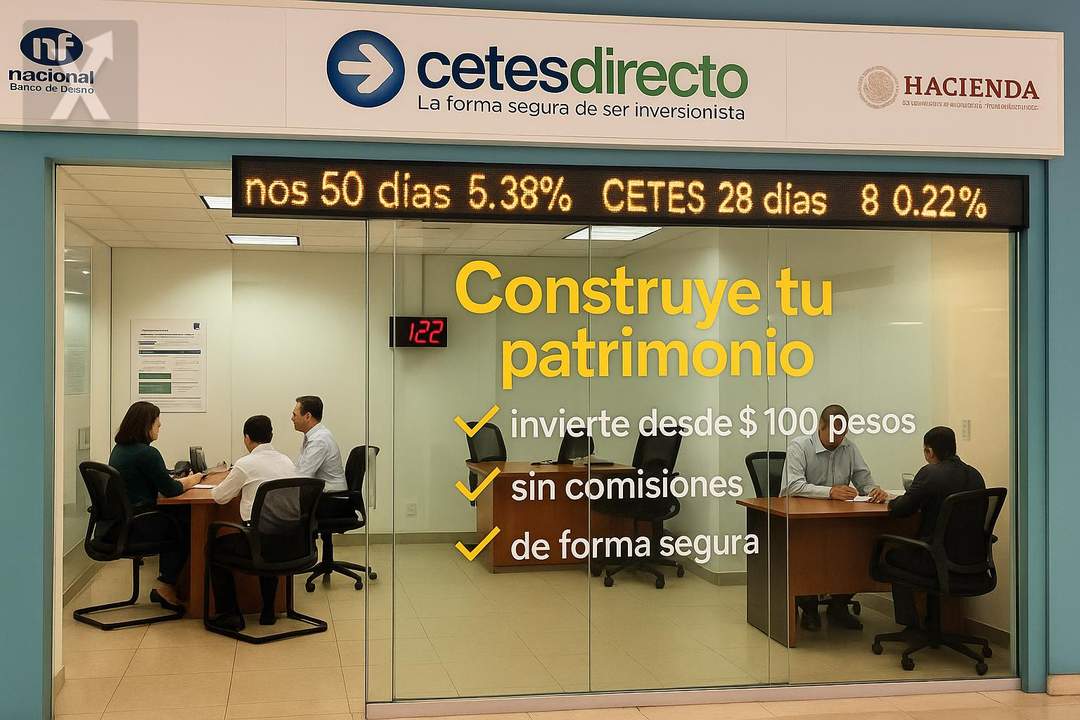
Millennials and Gen Z are turning CETES into their entry point to formal saving, drawn by yields and no-fee access.
Millennials’ and Gen Z’s participation on CetesDirecto has become one of the clearest barometers of changing financial habits in Mexico. The federal platform—created to bring investment in government debt to the public without intermediaries or fees—reports a base of 2.9 million users, more than one million of whom are between 26 and 35 years old, the largest segment in the ecosystem.
According to figures shared by platform executives, the second-largest group is ages 36 to 45, with 751,348 people (about 26% of the total). By contrast, adults over 56—who lived through the launch of CETES in 1978—account for roughly 10% of investors. The data suggests that digital adoption and interest in low-risk instruments are reshaping the typical profile of people saving in government-backed products.
As of July 14, CetesDirecto managed more than 223 billion pesos and posted an average balance per user of about 75,000 pesos. While the average alone doesn’t capture the full distribution (there are both small savers and investors with larger portfolios), it does point to adoption that’s no longer marginal and is starting to take hold as a recurring practice among urban, digitally connected segments.
CETES—federal government debt securities—are typically considered the local market’s benchmark low-risk instrument, with terms of 1, 3, 6, 12, and 24 months. Even so, user behavior on the platform shows a clear preference for liquidity: about four out of every five investments are concentrated in the 28-day term, suggesting that “money on hand” remains a decisive factor even among those who have already taken the step into investing.
A declining-rate environment that hasn’t cooled the appetite for safety
CetesDirecto’s growth is happening as Mexico’s rate cycle begins to normalize after a period of elevated returns. With inflation following a more contained path compared with recent years’ peaks, the Bank of Mexico has gradually cut its policy rate, which translates into potentially lower yields for short-term instruments. Even so, CETES remain attractive: for many young investors, the combination of safety, transparency, and direct access matters more than chasing the absolute highest rate available.
This nuance is important amid the rise of alternatives such as Sofipos and other vehicles that, in practice, often use government debt performance as a reference point to craft promotional offers. In some cases, the flashier rates come with conditions such as minimum balances, recurring spending requirements, or per-customer limits, while on CetesDirecto the rate is the same for small or large amounts. In a country where the cost of living has strained household budgets, clear rules and the perception of sovereign backing serve as anchors of trust.
The growth also lines up with early signs of greater financial inclusion in the country. The 2024 National Survey on Financial Inclusion (ENIF) recorded for the first time that 1% of the population says they invest their money. While the percentage is small, its emergence as a measurable figure suggests a turning point: investing is beginning to move beyond the exclusive realm of higher-income groups and is slowly entering more people’s financial vocabulary.
In the near term, the platform expects to reach 3 million customers between August and September, driven by momentum in new sign-ups and the virality of educational content on social media, where young people compare yields and walk others through the steps to save. At the same time, new government-linked products are expected—especially within the world of funds—which would open options for users looking to diversify without leaving publicly backed instruments.
In broader perspective, CetesDirecto’s expansion points to a wider trend: formal saving is gaining ground in response to economic volatility and the need to build wealth without taking on elevated risk. The challenge, however, is not only to grow the user base, but to deepen savings, encourage diversification, and strengthen financial education so that investing depends not only on the level of rates, but on clear goals and time horizons.
In sum, millennials and Gen Z’s push into CetesDirecto reflects a preference for simple, liquid, and perceived-safe instruments, even in a declining-rate environment. If the trend holds, it could become a catalyst for expanding Mexico’s retail investor base and gradually strengthening a long-term saving culture.






