The Fragrance Boom in Mexico: An Everyday Indulgence Now Driving More Than $500 Million in Imports
Perfume use became a repeat purchase after the pandemic and is now fueling record imports, with visible effects on retail, logistics, and services inflation.
What started as a “pick-me-up” expense during lockdown ultimately solidified into a stable part of urban consumption in Mexico. In recent years, buying fragrances has stopped being an occasional luxury and become a habit—one that has held up even with the full reopening of activities, the return to in-person work, and an economic backdrop where households are still reshuffling priorities across services, food, and discretionary goods.
The latest foreign trade data reflect that shift. According to figures from Banco de México, imports of perfumes and lotions rebounded in 2021 to pre-pandemic levels, at $256 million, and have followed an upward path ever since. In 2024 they reached $529 million, and by the end of 2025 they stand slightly above that, at around $531 million, setting a new high.
The business geography is also telling: Mexico City and the State of Mexico account for close to 90% of imports, reaffirming them as the main hubs for consumption, distribution, and logistics. In a market where e-commerce growth has increased demand for faster delivery, broader inventories, and omnichannel options, concentration in the metro area makes it easier for importers, wholesalers, and department store chains to operate—but it also intensifies competition for warehouse space and raises last-mile costs.
As for suppliers, Europe dominates. France leads with about 35.2% of total imports, followed by Spain and Italy. The United States ranks fourth, despite being Mexico’s most important trading partner in overall goods value. That mix suggests that for fragrances, country-of-origin branding and perceived quality still matter as much as freight costs or the advantages of regional integration.
The import surge aligns with an expanding domestic market. Industry estimates put Mexico’s perfumery market at roughly $915 million in 2025, with an expected average annual growth rate of around 6.6% over the next decade. If that trend holds, the sector could approach $1.734 billion by 2035, supported by broader personal care consumption and a more sophisticated product mix, from mass-market lines to premium options.
This momentum is playing out in a context where private consumption remains an anchor of the Mexican economy, though with signs of normalization after the post-pandemic rebound. In recent years, the labor market has shown resilience, with sustained minimum wage increases and contract adjustments in formal sectors that have raised disposable income for certain groups. At the same time, inflation—while easing from the 2022–2023 peaks—has continued to pressure essential categories, pushing households to be more selective about which “nonessential” expenses they keep. In that rebalancing, fragrances have managed to stick.
From “aspirational purchase” to repeat buying: what’s driving the market
Fragrance demand is rising for a combination of reasons. On one hand, the mass segment leads on price and accessibility: smaller sizes, promotions, gift sets, and trend-inspired lines make frequent purchases easier and bring in new consumers. On the other hand, the premium segment is gaining ground thanks to brand strategies, constant launches, identity- and status-driven storytelling, and digital marketing that turns each fragrance into content. Add to that a cultural shift: greater focus on personal grooming, the normalization of “self-care,” and a visible rise in men’s usage, which expands the overall market.
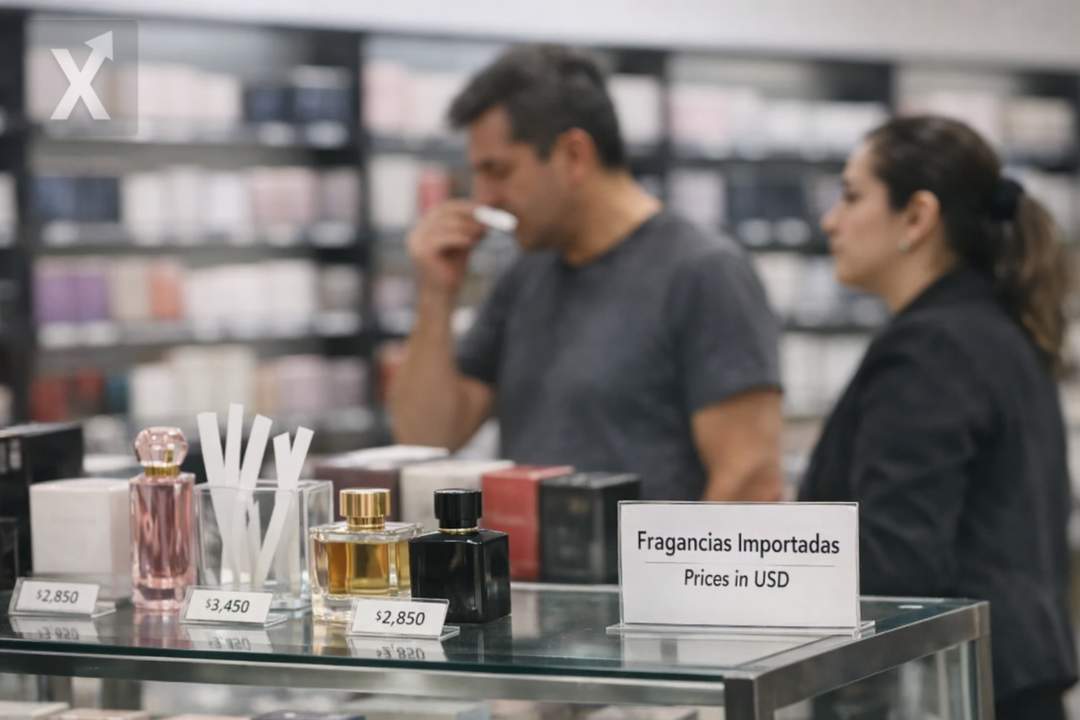
For the retail channel, growth means not just higher sales but greater operational complexity. Assortments become broader and more segmented; inventory management gets harder due to seasonal demand, limited editions, and faster turnover; and the in-store experience—testers, guided consultations, memberships—becomes a differentiation tool. In e-commerce, the challenge is different: turning a sensory product into a digital decision through reviews, samples, return policies, and loyalty strategies.
On the macroeconomic front, rising imports of a consumer good like fragrances are small relative to the overall scale of Mexico’s foreign trade, but they work as a thermometer of urban demand and the spending capacity of middle- and upper-middle-income households. They can also have implications for the exchange rate and restocking costs, since inventory is paid mainly in USD, and FX volatility tends to feed into final prices with varying lags depending on the channel and each chain’s bargaining power.
The trend also ties into a broader phenomenon: post-pandemic growth in spending on services and experiences is coexisting with “micro-luxuries” that consumers protect even as they cut back elsewhere. In practice, a perfume can take the place of frequent nights out or larger purchases, serving as an emotionally justifiable expense during periods of uncertainty.
Looking ahead, the sector will face a delicate balancing act. If Mexico’s economy maintains moderate growth, with controlled inflation and stable employment, the fragrance market could sustain its expansion, supported by innovation, digitization, and broader audiences. But if inflation pressures return, financial conditions tighten, or the USD strengthens consistently, consumption could shift toward more affordable options and intensify price competition. In any scenario, the core pattern appears to have changed: perfume stopped being an “event” and became part of the everyday budget.