Expensive oil and a volatile dollar: partial relief for public revenues, lingering pressure from gasoline prices
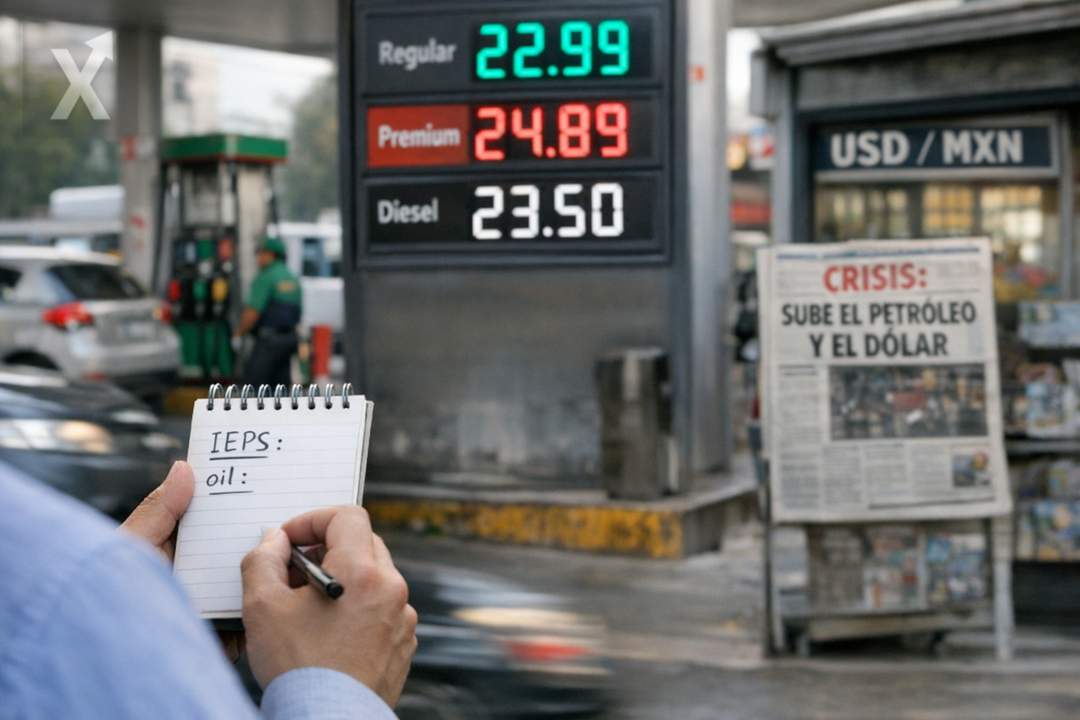
The oil rebound can boost petroleum revenues, but IEPS stimulus and the exchange rate can offset the fiscal gain.
The escalation of tensions in the Middle East—with direct impacts on international crude prices and bouts of volatility in the U.S. dollar—puts Mexico’s public finances back on familiar ground: when oil goes up, the government can receive more resources from exports, but at the same time the political and fiscal cost of cushioning gasoline prices becomes more expensive.
For 2026, the Ministry of Finance budgeted an average price for the Mexican crude blend of $54.9 per barrel. In recent days, the price has been well above that level (around $84 per barrel at the latest referenced close), which on paper raises oil revenue versus what was expected. Official estimates have indicated that for every additional dollar above the annual budget assumption, the treasury could bring in about 11.6 billion pesos in extra revenue. However, the net effect on the public balance sheet is usually far less linear.
The reason is that expensive oil tends to filter through—at different lags—into fuel prices. When that happens, the government turns to stimulus (relief) on the special tax (IEPS) to soften the impact on consumers and freight carriers, reducing potential tax collection. This fiscal “cushion” was particularly costly in prior shocks: in 2022, the revenue loss associated with fuel subsidies and stimulus exceeded one percentage point of GDP, a benchmark that now serves as a reference for sizing up risks.
Under the current framework, the per-liter IEPS rates for regular (Magna), premium, and diesel can be adjusted through temporary discounts. In practice, when broad stimulus is activated, the government stops collecting part of the tax, and the “extra revenue” from selling crude at a better price is offset, totally or partially, by lower domestic tax intake. The final outcome depends on the size of the increase, how long it lasts, and the degree of fiscal intervention used to contain retail prices.
Exchange rate: a shock absorber that doesn’t always help consumers
The FX market adds another layer. The Finance Ministry projected an average of 19.3 pesos per USD at year-end, but the peso has stayed strong in some episodes, hovering around 17.76 per dollar in the most recent reference. This appreciation usually makes imports cheaper and can soften some cost pass-through, but it also reduces the peso value of oil revenues denominated in dollars. According to the Economic Policy Guidelines, a 20-cent appreciation can imply a negative effect of roughly 4.9 billion pesos on public coffers.
Even so, in the opposite scenario—depreciation—the balance can improve through the conversion of oil revenues into pesos, although that isn’t necessarily good news for inflation: a weaker peso makes imported inputs more expensive and can push up prices, including energy. For the government, the exchange rate also affects items such as debt-service costs and the behavior of liabilities, so the “net” effect depends on the debt mix and the interest-rate response.
In the background, the debate comes at a time when Mexico is trying to sustain fiscal consolidation without stalling economic activity. With an economy highly integrated with the United States and sensitive to external shocks, energy remains a critical variable: it affects inflation, expectations, and logistics costs. In addition, Pemex faces structural challenges—debt, extraction costs, and investment needs—meaning a bout of high prices is not automatically equivalent to sustainable financial strength.
If the oil shock drags on, the room for maneuver will depend on the political decision over the price paid by consumers: holding it down through stimulus means giving up tax revenue; passing it through fully means higher inflationary pressure and social discontent, with spillovers to consumption and business costs. In that dilemma, coordination between fiscal policy (the Finance Ministry) and the monetary environment (Banxico) becomes key to prevent the episode from turning into more persistent pressure on prices and rates.
In perspective, expensive oil can temporarily improve revenues, but recent experience suggests the fiscal “benefit” gets diluted when the government tries to stabilize gasoline prices. The combination of crude prices, the exchange rate, and the IEPS will determine whether this episode translates into budgetary breathing room—or a new bill for subsidies.






