The “World Cup effect” fizzles: Mexico’s economy eases off after April’s boost
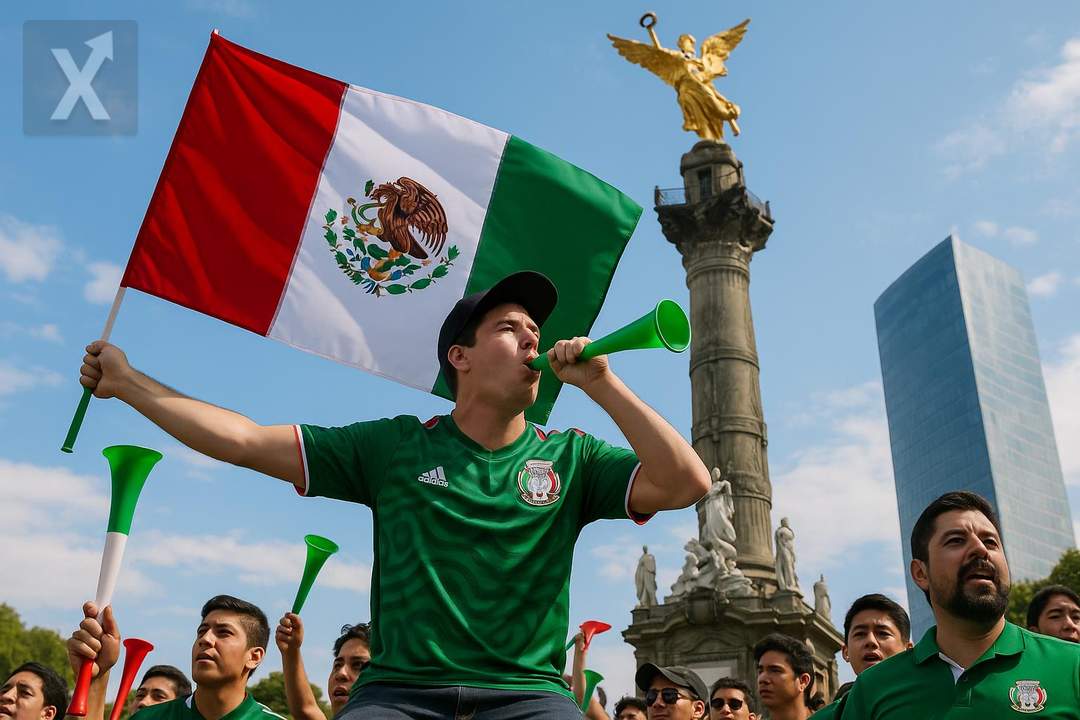
Early indicators point to an economy that lost momentum after pre-tournament spending, with consumption and services showing signs of cooling.
Mexico’s economy entered the World Cup period expecting an extra lift from tourism, consumer spending, and services; however, the latest indicators suggest the impact was limited and, in any case, not enough to alter the path of a growth trend that has been losing steam. INEGI’s Timely Indicator of Economic Activity (IOAE), revised downward, estimates a 0.28% month-over-month contraction in May, following April’s 1.20% gain, while for June—the month the tournament kicked off—it projects only a marginal 0.16% increase.
The performance suggests the strongest momentum was concentrated before the event, tied to construction, logistics, and preparatory spending, rather than a sustained increase in activity during the World Cup. In the breakdown by major sectors, both secondary activities (manufacturing and construction) and tertiary activities (trade and services) would have posted moderate changes, consistent with an environment in which domestic demand is holding up, but without the punch seen at the start of the second quarter.
With these figures, several private-sector estimates see quarterly growth of around 1.5% in Q2 as possible, although the first-half cumulative gain would remain close to 1%, reflecting an expansion that has yet to firmly take hold. The final IGAE report that INEGI will publish on July 23 will be a key reference point to confirm whether June marked an inflection point or merely a short-lived technical rebound.
On the consumption front, the gauge also cooled before the tournament began. The Monthly Survey of Commercial Establishments reported that retail sales fell 0.56% month over month in May after two months of gains, and while they rose 2.45% year over year, that was a slower pace than April’s 4.47%. In practice, consumption is feeling the effects of a gradual deterioration in confidence, a labor market that is normalizing, and inflation that—while down from the 2022–2023 peaks—still constrains purchasing power in some essential categories.
In services, the picture was mixed: activities tied to entertainment, lodging, and restaurants showed month-to-month improvements in certain segments, but signs of weakness persist in strategic areas. Notably, transportation, postal services, and warehousing remain fragile, along with the lack of a broad-based recovery in industries linked to mobility and distribution—key to the functioning of supply chains and domestic commerce.
Manufacturing, investment, and the shadow of external uncertainty
Beyond the one-off impact of a sporting event, Mexico’s economic pulse remains closely tied to manufacturing performance and investment. In manufacturing, the pace continues to depend on North America’s industrial cycle and on the composition of exports: shipments related to technology and equipment are growing, but they often include a high share of imported inputs, which limits domestic value added and, therefore, their ability to meaningfully spill over into local employment and consumption.
At the same time, private investment faces a cautious environment due to both external and internal factors. On the external side, the United States trade agenda and bouts of tension from tariff measures or sector-specific disputes increase expectations volatility, particularly in industries integrated across the region. Domestically, regulatory certainty and the rule of law weigh on long-term decisions, just as the country competes to attract production relocations (nearshoring) that require energy, water, infrastructure, and clear rules to turn into concrete projects.
Monetary policy also plays its part. With Banxico in a gradual adjustment process after keeping rates high to contain inflation, borrowing costs remain a hurdle for durable-goods consumption and, above all, for investment by small and mid-sized firms. The challenge is that disinflation does not necessarily translate immediately into a rebound in lending if risk perceptions and uncertainty persist.
Overall, the timely data suggest the World Cup provided a more visible stimulus in the run-up—through spending and preparations—than in a sustained acceleration of growth during the tournament itself. In the second half of the year, performance will depend less on extraordinary events and more on whether investment picks up, manufacturing stabilizes, and consumption holds up amid cooling employment and tighter credit.






